Get Full Government Meeting Transcripts, Videos, & Alerts Forever!
Get email alerts on the Homeownership Conversions Adus topic
No spam. Unsubscribe anytime.
Revere trust fund weighs direct investment and grants to convert market-rate buildings to affordable ownership
Summary
Revere — At its March 12, 2025, meeting, the City of Revere Affordable Housing Trust Fund board discussed two competing strategies to create affordable homeownership: the trust fund buying and converting 2–4‑family buildings itself, or subsidizing private developers to produce deed‑restricted units.
Revere — At its March 12, 2025, meeting, the City of Revere Affordable Housing Trust Fund board discussed two competing strategies to create affordable homeownership: the trust fund buying and converting 2–4‑family buildings itself, or subsidizing private developers to produce deed‑restricted units.
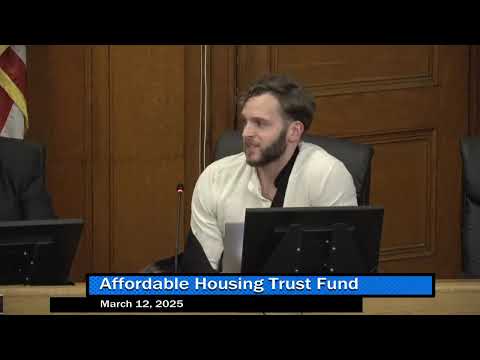
The discussion, led by board member Matt Wolfer at the homeownership subcommittee report, focused on tradeoffs of control, cost and operational capacity. Wolfer said the board is weighing “the trust fund direct investing in 2 to 4 family properties and converting them into condos” against offering gap funding to private developers to require one unit be sold at an affordable price.
The nut graf: the board must decide whether to pursue a capital‑intensive, high‑control model that would place buildings on the trust fund’s balance sheet, or a lower‑cost subsidy model that would use grants to make privately managed conversions affordable.
Under the direct‑investment option, Wolfer told members the trust would complete purchase, renovation and resale itself. He said that approach gives the trust control over location and renovation decisions but is “significantly more involved operationally” and requires more capital — Wolfer estimated the upfront capital need in the “neighborhood of a million to a million 2.” He listed higher operational risks: underwriting mistakes, renovation cost overruns, carrying costs for taxes and insurance, and the need to hire a general contractor capable of end‑to‑end delivery.
The alternative is providing targeted subsidies to private developers planning condo conversions. Wolfer said this approach would require less trust capital per project and lower operational burden because the private developer assumes underwriting and construction responsibility; the trust would subsidize the price gap that makes one unit affordable. He estimated the per‑unit subsidy range discussed at roughly $110,000 to $150,000, noting the exact figure remains to be modeled.
Board members discussed other design questions the subcommittee will study, including which building types yield the best leverage (two‑family vs. four‑family), bedroom mixes, and the effect of prevailing‑wage requirements or longer project timelines on total cost. Wolfer said the subcommittee has built a property scorecard and plans to underwrite five to 10 actual properties — either active listings or recently sold buildings — to model project‑level P&Ls and return with detailed cost comparisons at the next meeting.
ADU incentives also drew discussion. The subcommittee flagged incentives for accessory dwelling unit (ADU) conversions as a lower‑cost pathway to produce affordable units. Wolfer offered a hypothetical example of a $20,000 grant for homeowners who convert part of a house into an ADU and meet affordability requirements. He also cited Boston’s model, which pairs technical assistance (about $7,500 in Boston’s program) and a $50,000 zero‑interest loan payable on sale — a structure that would reduce the immediate outlay but would not necessarily replenish trust funds.
Board members raised program design questions: whether the trust would fund lead‑paint remediation or other environmental fixes that raise renovation costs, and how the trust would ensure contractor oversight without adding municipal staff capacity. Wolfer noted he will research whether loans or grants are more effective in Revere and whether the trust could reasonably administer construction oversight, given current staffing.
Next steps: the homeownership subcommittee will underwrite sample properties and compare the full cost stacks for the two approaches before recommending whether to pursue direct investment, a developer subsidy program, ADU incentives, or a mixed approach.