Get Full Government Meeting Transcripts, Videos, & Alerts Forever!
Get email alerts on the Public Safety Policing topic
No spam. Unsubscribe anytime.
Senate passes bill defining 25-foot ‘reactionary gap’; debate centers on measurement and officer discretion
Summary
The Indiana Senate passed House Bill 11 22, which keeps a 25-foot reactionary gap around law enforcement officers but adds a requirement that an officer must reasonably believe continued encroachment would interfere with duties before ordering someone to stop. The bill passed 39-10 after extended floor debate about vagueness and enforceability.
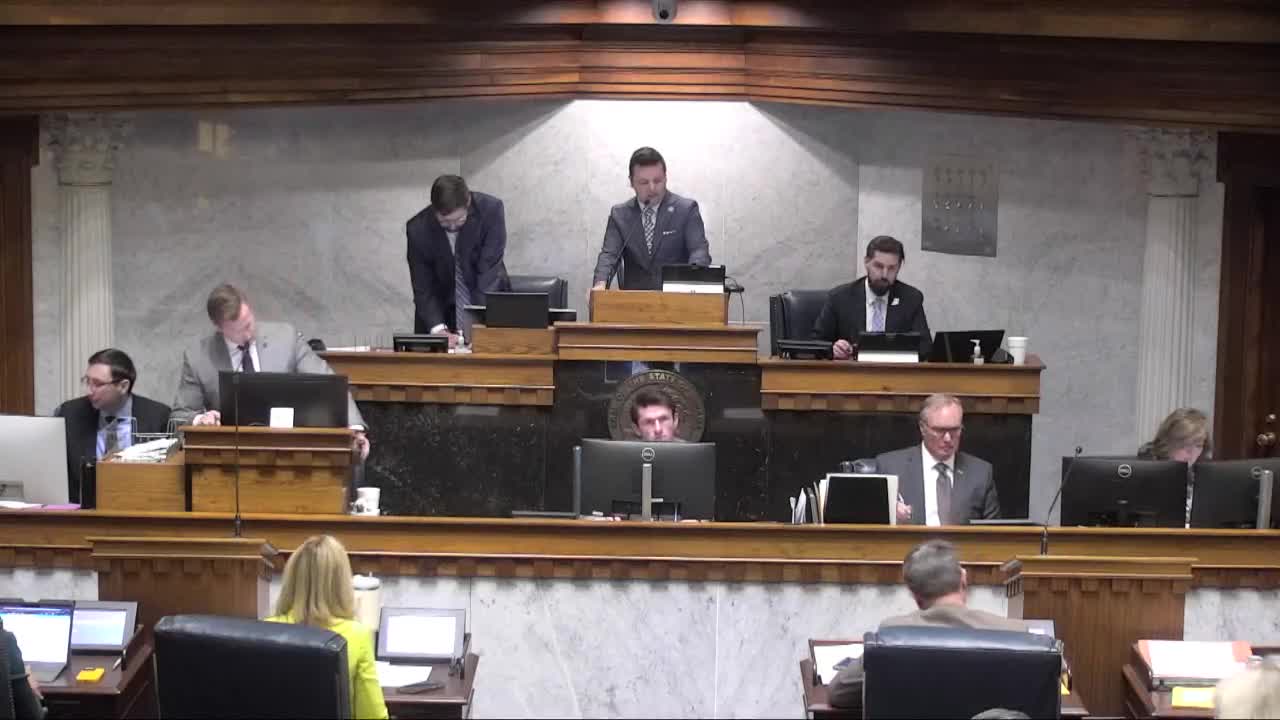
INDIANAPOLIS — The Indiana Senate on March 11 passed House Bill 11 22, a measure that keeps a 25-foot “reactionary gap” around law enforcement officers but narrows enforcement to situations where an officer reasonably believes continued encroachment would interfere with official duties. The bill passed on the floor, 39 ayes to 10 nays.
Supporters, led by bill author Senator Mark Baldwin, said the change responds to a court challenge that found prior language ambiguous. Baldwin said the bill is targeted at “interference,” not mere presence, and added that officers must be able to explain in court why they believed a person’s actions would impede their duties.
Opponents focused on how the statute will be enforced in practice. Senator Don Young and others asked how a citizen could prove they were outside the 25-foot boundary if an officer later says they were inside it. Young said he feared people could be convicted without a practical way to disprove the officer’s measurement at the time of an alleged violation. Senator Aaron Taylor said the bill expands officer discretion and could lead to people being ordered away from private property; he said he would vote no.
Senator Baldwin and other backers said the statute creates an objective metric — the 25-foot reactionary gap — combined with a reasonable-belief standard about interference, which they argued addresses the district court’s vagueness concern. Baldwin noted that safety and interference are different legal concepts and that the bill addresses only interference; he said an officer could still order someone farther back if the officer reasonably believed a safety threat existed.
Floor exchanges included hypothetical scenarios about being inside a house while a relative is arrested and whether an officer could require someone to leave the room. Members also discussed evidentiary issues — whether body cameras, later measurements or court recreation would resolve disputes about distance — and cited past litigation over distance-based rules.
After debate, the Senate placed the bill upon its passage and opened the machine vote. The clerk reported 39 ayes and 10 nos; the bill was recorded as passed and will proceed to the governor.
The text adopted keeps the 25-foot number and adds the phrase that a person who approaches within that space may be subject to an order to stop “if the officer reasonably believes further encroachment would interfere with the officer’s official duties.” The transcript shows questions from multiple senators about whether the bill mirrors language suggested by the district court and whether the 25-foot metric itself is the source of vagueness.
Several senators urged caution about the measurement issue; Senator Young said that, practically, civilians cannot be expected to prove being two inches outside a statutory boundary. Proponents pointed to body-worn cameras and post-incident recreations as tools that would be available in court.
Votes at a glance for this item: machine vote recorded 39 ayes, 10 nos. No roll-call-by-name is recorded in the transcript.
Looking ahead, the bill’s combination of a numeric buffer and a subjective reasonable-belief standard makes it likely to be tested in court if challenged, a point several senators raised during floor debate.