Get Full Government Meeting Transcripts, Videos, & Alerts Forever!
Get email alerts on the State Legislation topic
No spam. Unsubscribe anytime.
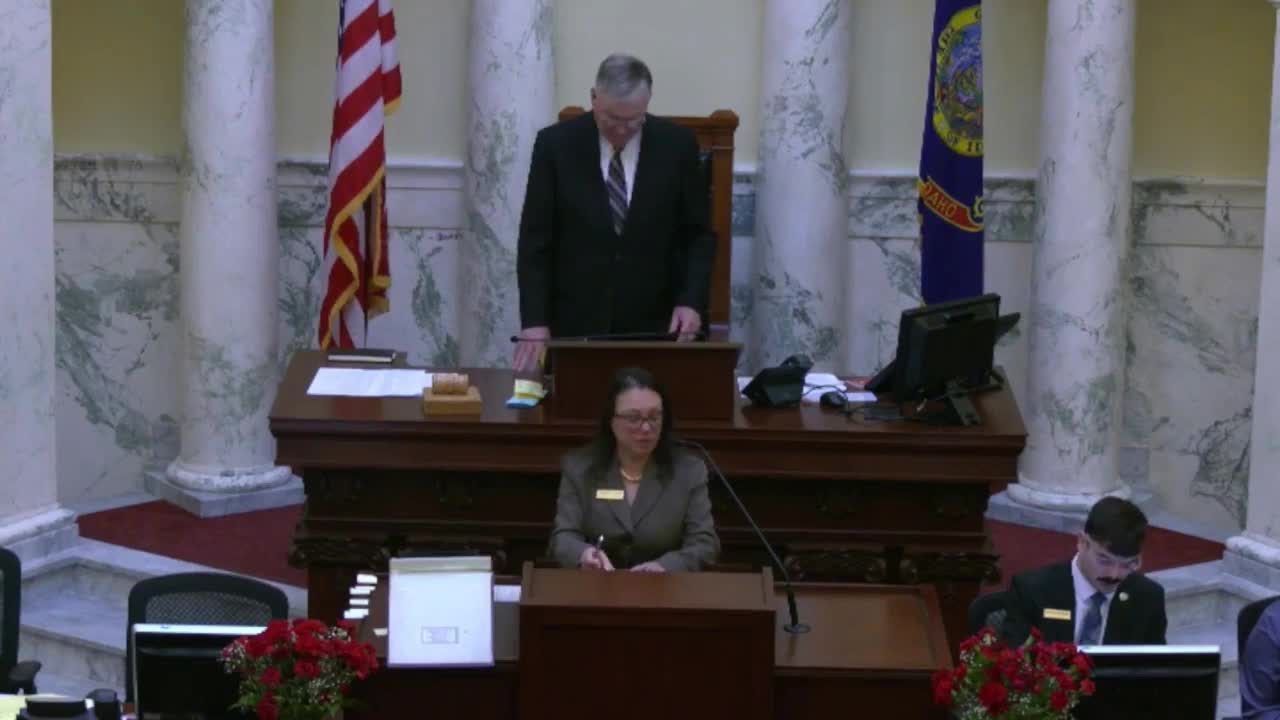
Idaho Senate passes immigration measure, rejects wildfire liability bill; Medicaid and other appropriations advance
Summary
At its March 11, 2025 session the Idaho Senate approved a suite of measures including a state immigration enforcement bill and a constitutional amendment limiting initiative legalization of drugs, moved a Medicaid reform package and several appropriations, and defeated proposed standards that would shield utilities from wildfire liability.
BOISE, Idaho — The Idaho Senate on March 11 approved a state-level bill aimed at tightening responses to undocumented criminal suspects, advanced a Medicaid reform and a number of agency appropriations, and rejected a proposed utility wildfire liability standard after heated debate.
The most consequential votes included final passage of a criminal-entry bill (House Bill 83), a constitutional amendment resolution to limit citizen initiatives legalizing controlled substances (House Joint Resolution 4), and approval of a Medicaid reform and cost-containment measure (House Bill 3 45). Separately, the chamber defeated Senate Bill 11 24, a measure that would have set wildfire standard-of-care rules for electric utilities and altered civil liability.
Why it matters: The immigration measure and the constitutional amendment mark a clear policy direction by the Legislature on public safety and on preserving legislative control over substance laws; Medicaid changes reshape how the state administers expansion-era coverage; the wildfire bill’s defeat preserves existing tort law and leaves the state without the new liability framework sponsors argued would protect utilities and ratepayers.
Bills and outcomes - House Bill 83 (illegal entry / reentry, cooperative enforcement with federal authorities) — passed by the Senate 29–6. Sponsor and floor manager described the bill as a cooperative framework with federal agencies and said it focuses state resources on persons detained for other criminal activity before addressing immigration status. Debate centered on constitutionality and potential profiling; supporters said the bill emphasizes cooperation with ICE and DHS and removed a court-ordered deportation mechanism present in earlier drafts.
- House Joint Resolution 4 (constitutional amendment to reserve legalization authority to the Legislature) — adopted by the Senate 29–6. Proponents framed the resolution as a way to let Idaho voters decide in a statewide referendum whether the Legislature alone should have authority to legalize marijuana, narcotics and other psychoactive substances; sponsors said the measure would then appear on the 2026 ballot for final voter ratification.
- House Bill 3 45 (Medicaid reform / cost-containment, implementation measures including MCOs and work/verification provisions) — passed by the Senate 29–6. Supporters said the bill moves Idaho from the voter-approved expansion toward a managed, state‑overseen model with verification steps and work-related reporting; opponents warned about administration costs and coverage churn seen in other states that used work requirements.
- Senate Bill 11 24 (wildfire mitigation standard of care for utilities; liability and subrogation rules) — failed in the Senate, 16 ayes to 19 nays. Sponsors argued the measure would establish minimum mitigation plans, let the Public Utilities Commission review and approve plans, and limit catastrophic damages in cases where utilities “substantially comply.” Opponents and several insurance and lands‑interest speakers warned the bill shifted potential costs to ratepayers, taxpayers and landowners and could reduce insurers’ subrogation rights.
Other notable actions - Senate Bill 11 39 (POST certification discretion for certain applicants with prior nonviolent felonies) — passed (34–1). Sponsor said the change gives the Peace Officer Standards and Training council discretion to certify applicants whose felony records were set aside, expunged, pardoned or reduced, while keeping violent felonies barred per Idaho Code 18-310(2).
- Senate Bill 11 54 (appropriation for the Idaho Commission on the Arts) — passed (18–16, 1 absent). Sponsor said the $2,335,000 appropriation provides federal match and grants for arts education, veterans programs and rural arts activity; the bill includes contingency language reverting state match if the federal grant is not awarded.
- Senate Bill 11 55 (appropriation to Idaho State Liquor Division) — failed (8–26, 1 absent). The measure would have provided $1,521,700 in dedicated funds (about $131,400 ongoing, $1,390,300 one‑time) for wage adjustments, document management, website accessibility upgrades and replacement equipment. Critics questioned parts of the one‑time requests, including a $100,000 website line and a $72,000 “shrink-wrap” item for warehouse pallet wrapping.
- Senate Bill 11 48 (salary adjustments / CEC for state commissioners) — passed (19–15, 1 absent). Sponsors described this as a relatively small ongoing appropriation (about $39,600 total) to align commissioner compensation adjustments with broader classified salary changes.
- Senate Bill 11 60 (appropriation for Department of Health and Welfare replacement items and IT) — passed (24–11). Sponsors said the bill contains replacement items and IT refreshes and that the JFAC subgroup cut multiple items after review; opponents questioned replacement-vehicle cycles and aggregate percentage increases above maintenance budgets.
- Senate Bill 11 61 (spending authority for the Office of Species Conservation) — passed (22–12, 1 absent). Sponsors described the $30,000 as spending authority tied to potential federal or private grants and emphasized that if grants fail to materialize, the authority does not create state spending.
- Senate Bill 11 45 (allowing districts to use certain K–12 special education funds for early literacy interventions) — failed (14–21). Sponsors said the bill would let local districts target existing special education dollars toward early reading interventions for 4–5-year-olds without new state spending; opponents called it an expansion of state involvement in early childhood and warned of future costs.
What senators said (selected quotes) - On POST certification (SB 11 39), sponsor Senator Leahy said: "This legislation provides more appropriate discretion and specific consideration on POST's ability to certify peace officers." (Senator Leahy, floor debate.)
- On the arts appropriation (SB 11 54), sponsor Senator Ward Engelking said: "The Idaho Commission on the Arts is a state agency dedicated to bringing the arts to all Idahoans... they provide art education in rural schools and for veterans." (Senator Ward Engelking, opening remarks.)
- On the wildfire bill (SB 11 24), sponsor Senator Woodward described the measure as establishing "a standard of care for mitigation efforts by electric utilities" and said the Public Utilities Commission was the appropriate reviewer of utility mitigation plans. Opponents warned the bill could leave insurers and the state bearing costs if subrogation or indemnity paths were narrowed.
Outlook and next steps The immigration bill moves to the House for concurrence or action; the state constitutional amendment (HJR 4) will be placed on a future ballot for voter ratification if the House likewise approves and the required procedures follow. Opponents of the failed wildfire standard signaled plans to continue talks; proponents said they will return with edits. Medicaid reform implementation will require significant administrative work by the Department of Health and Welfare, including oversight of managed‑care contracts and customer‑service front‑loading to avoid coverage gaps.
Ending note: The March 11 floor session produced a mix of narrow votes and broad majorities, reflecting continuing tensions between statewide cost controls, regulatory oversight, and local control in education, public safety and utility management.