Get Full Government Meeting Transcripts, Videos, & Alerts Forever!
Get email alerts on the Criminal Justice Ai Deepfakes topic
No spam. Unsubscribe anytime.
Senate adopts trio of bills criminalizing AI-generated child sexual imagery and deepfake explicit media
Summary
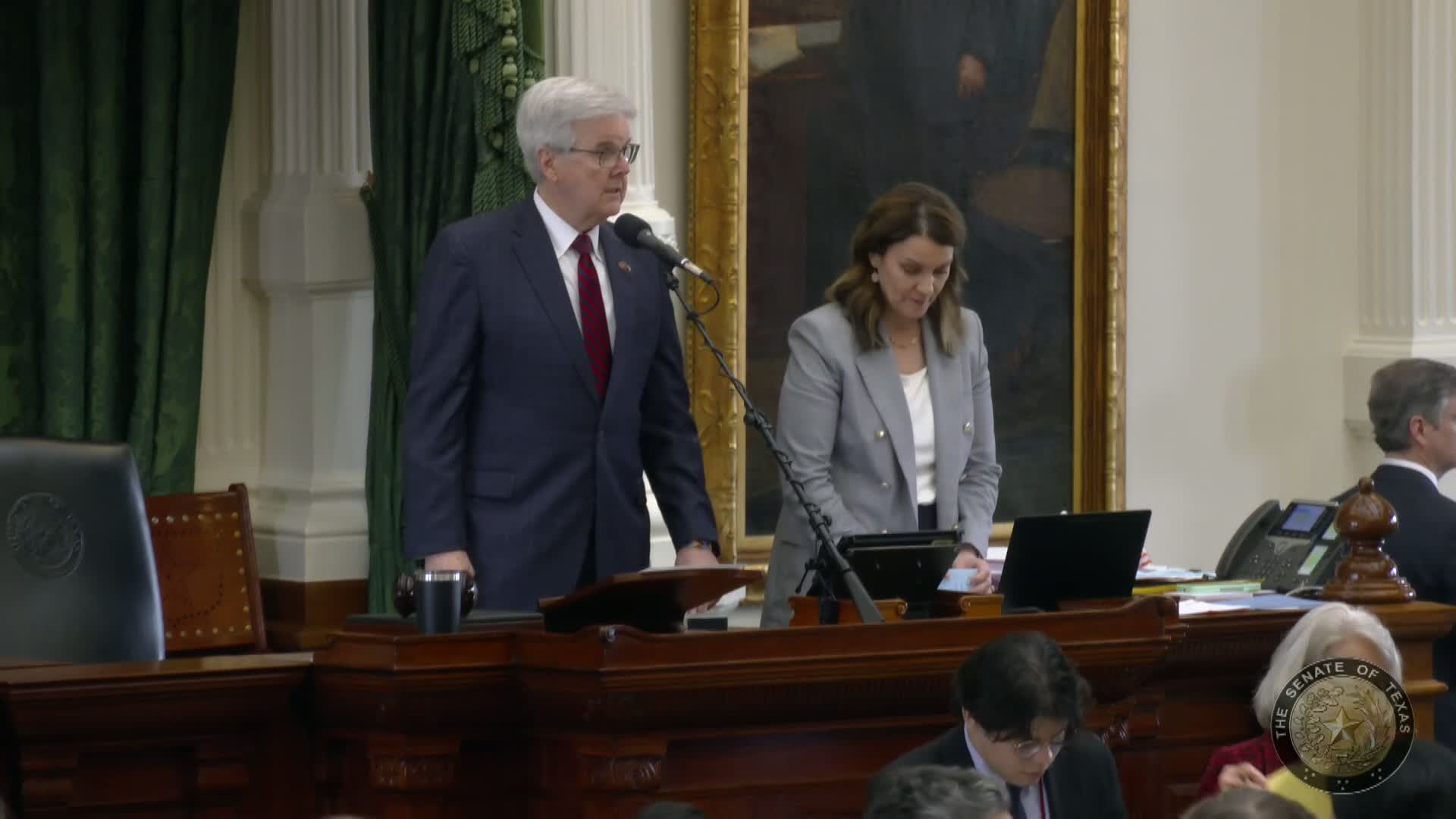
The Texas Senate on March 12 passed three bills to criminalize possession, promotion, production or distribution of obscene visual material that appears to depict children and to outlaw nonconsensual explicit deepfake media, sponsors said the measures reflect prosecutor input to address AI-era harms.
The Texas Senate on March 12 passed three separate bills aimed at closing gaps in state law around AI-generated and other non-photographic sexual imagery involving minors, voting to send each measure to the House after adopting floor amendments.
Senate Bill 20 (Flores), Senate Bill 442 (Hinojosa) and Senate Bill 1621 (Huffman) create or revise criminal offenses that prosecutors and sponsors said are necessary because modern computer-generated images and deepfakes can be used to groom, exploit or harass children even when no actual child was photographed.
Supporters said the bills were drafted with input from prosecutors and law enforcement to give them usable tools. “SB 20 creates a new criminal offense related to obscene visual material,” said Senator Sergio Flores, the bill’s author. Flores and other sponsors said the measures cover visual depictions regardless of whether the image is photographic, animated or AI-generated.
Key provisions and penalties vary by bill. Under SB 20 the sponsor said the bill adds Texas Penal Code section 43.235 and makes it an offense to knowingly possess, access with intent to view, or promote obscene visual material that appears to depict a child; the offense is a state-jail felony with escalations for prior convictions. SB 1621, as described by its author, rewrites the child-sexual-material statute to add definitions for a depiction of a child and a computer-generated child, creating a third-degree felony for depictions of real children and a state-jail felony for computer-generated children, with sentencing enhancements for prior convictions or young victims. SB 442 targets unlawful production or distribution of certain nonconsensual explicit deepfake media and includes misdemeanor and felony penalties for repeat or aggravated conduct.
The Senate adopted two floor amendments on SB 20 that sponsors said prosecutors requested. Senator Flores offered an amendment he described as giving prosecutors “more flexibility to be able to address these predators under this law or any other law,” language the author said would avoid forcing prosecutors into a single statute. Senator Kelly Parker offered an amendment that permits judges to run sentences consecutively for multiple applicable offenses; Parker said the change would bring SB 20 “in line with” how traditional child sexual-abuse offenses are handled and give judges discretion. Flores accepted Parker’s amendment.
Senator Menendez asked whether the bill should take immediate effect; Flores said the bill had been drafted with prosecutors’ input and that sponsors were open to an amendment for immediate effect later in the process but that the bill as filed used the session’s standard effective date language. The transcript records the author explaining the bills were drafted to reflect prosecutors’ needs and to allow either this new section or other existing statutes to be used when appropriate.
All three bills passed the Senate on final passage votes recorded in the transcript: SB 20 (31 ayes, 0 nays), SB 442 (31 ayes, 0 nays) and SB 1621 (31 ayes, 0 nays). Senators emphasized that the measures are intended to give prosecutors tools for modern technology while preserving prosecutors’ ability to use other statutes where appropriate.
The measures now move to the House. Sponsors and floor managers said they expect additional amendments as the bills proceed, and that prosecutors’ offices will be consulted on drafting implementation details.
A note on scope and limits: the bills as presented in the Senate create or expand criminal offenses described in the transcript; the record does not show final House action or implementation guidance. The bills reference changes to the Texas Penal Code (including adding a section cited in the Senate debate) and include statutory classifications (state jail felony, third-degree felony, second-degree felony for repeated offenses) as described on the floor.