Get Full Government Meeting Transcripts, Videos, & Alerts Forever!
Get email alerts on the Inactive Wells Plugging topic
No spam. Unsubscribe anytime.
Senate committee hears bill to require plugging or reactivation of long‑inactive oil and gas wells
Summary
Senate Bill 1150 would require wells inactive for 15 years (or 25 years since completion) to be plugged or returned to production under a Railroad Commission‑approved compliance plan phased in through Sept. 1, 2040; the committee left the bill pending and asked the author to continue stakeholder work.
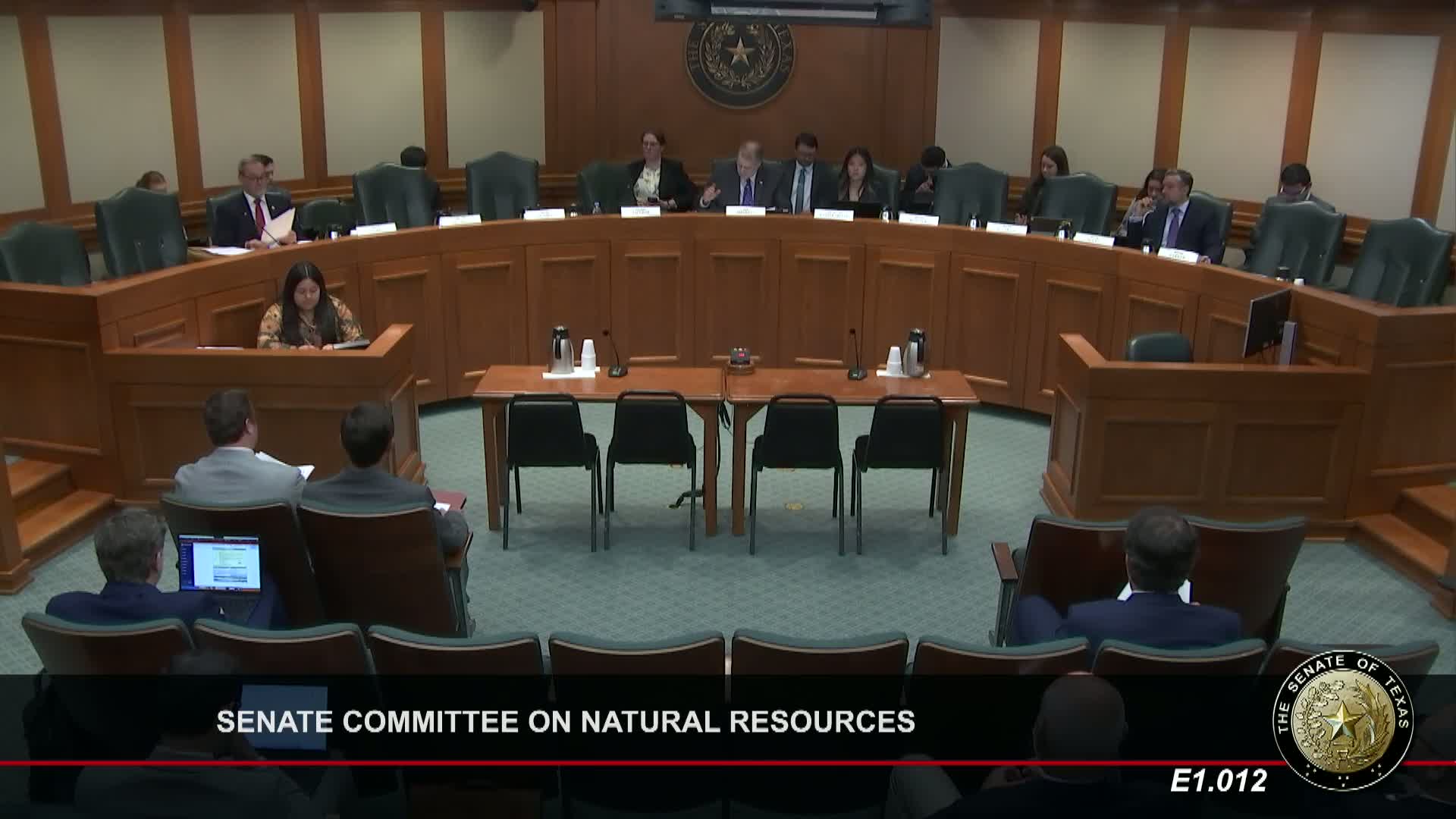
Senators on the Committee on Natural Resources & Economic Development heard testimony and questions on Senate Bill 1150, filed by Senator Middleton, which would require owners of certain inactive oil and gas wells under Railroad Commission jurisdiction either to plug them or restore them to production after specified age and inactivity thresholds and to file compliance plans with the Railroad Commission.
The measure would require wells that have been inactive for 15 years and wells 25 years past their completion date to be plugged or returned to production unless an operator obtains Railroad Commission approval of a compliance plan. The bill phases in compliance and reporting requirements, with a compliance-plan end date of Sept. 1, 2040, and would add an annual Railroad Commission report to the Legislature on the state’s inactive‑well portfolio, the author said.
Senator Middleton said the bill aims to reduce the state’s orphaned‑well population and the long‑term cost to taxpayers. “Wells can be inactive forever with the current law and rules, and that's why I believe this bill is needed here today,” he told the committee. He said the committee substitute adds a per‑well bonding option and an exception process for proven financial hardship decided in a Railroad Commission hearing.
Why it matters: witnesses and committee members cited data and costs showing the scope of the issue. The author said Texas had nearly 160,000 inactive wells; Railroad Commission plugging in 2024 cost about $34 million to plug 1,012 wells, while the orphan well count increased by roughly 460 wells. Industry witnesses and trade associations said they support measures to address the growing inventory but warned about unintended effects on small operators and the market for well‑plugging services.
Industry representatives described the bill’s features and remaining concerns. Todd Staples, president of the Texas Oil and Gas Association, said industry supports many provisions and noted that “industry is plugging about 85% of all wells that are plugged every year.” Michael Lozano of the Permian Basin Petroleum Association said the bill should recognize that many inactive wells are legacy vertical wells and that available plugging crews and equipment are a limiting factor. Carr Ingham, president of the Texas Alliance of Energy Producers, summarized the trade‑offs: “There are no solutions, only trade offs,” and urged careful calibration to avoid undue harm to smaller operators.
Committee members probed multiple implementation issues. Questions focused on: how the bill treats small or marginal operators that acquire plugging liability; whether an operator can transfer an exception or stay to a subsequent owner (the author said it cannot be transferred); how to define “completed” for the 25‑year clock (the author said definitions tied to first production or first sales are under consideration); and how to determine and document “financial hardship” in Railroad Commission hearings. Senators also expressed concern about the availability and capacity of plugging contractors and the potential for a short‑term spike in plugging costs if many wells are scheduled at once.
Public commenters and landowner advocates urged a shorter timeline and stronger notice to surface owners. Skyler White, a landowner in the Permian Basin, urged active notice to landowners of compliance plans and field testing, saying Railroad Commission systems are understaffed and landowners can help monitor operator compliance. The Texas Land and Mineral Association urged consideration of a 10‑year threshold rather than 15; environmental groups asked for tighter timelines and stronger bonding rules, and suggested boosting the Railroad Commission’s data on plugging costs by region.
What the bill would do and what remains unresolved: key provisions in the committee substitute include (1) a 15‑year inactivity / 25‑year‑since‑completion threshold; (2) an option to post a plugging bond tied to per‑well cost estimates; (3) a compliance‑plan pathway to phase work in through Sept. 1, 2040; (4) a Railroad Commission hearing process to consider demonstrated financial hardship; and (5) an annual report aligned to the Railroad Commission’s orphan well reporting calendar (changed to Dec. 1 in the substitute). The bill does not automatically impose immediate plugging on wells that are already inactive; instead it creates deadlines and a compliance mechanism.
Committee outcome and next steps: the committee left SB 1150 pending and the chair invited Senator Middleton to continue negotiating technical fixes with industry, the Railroad Commission, landowners and environmental stakeholders. No formal vote was taken in the hearing.
Ending: supporters and opponents told the committee they back the goal of reducing orphan wells but differ on timelines, hardship standards and market timing. The author said he intends to work further with stakeholders and may return with a revised committee substitute in coming weeks.