Get Full Government Meeting Transcripts, Videos, & Alerts Forever!
Get email alerts on the Negligent Security topic
No spam. Unsubscribe anytime.
Georgia hearing on SB 68 pits crime victims and housing/business interests over negligent-security changes
Summary
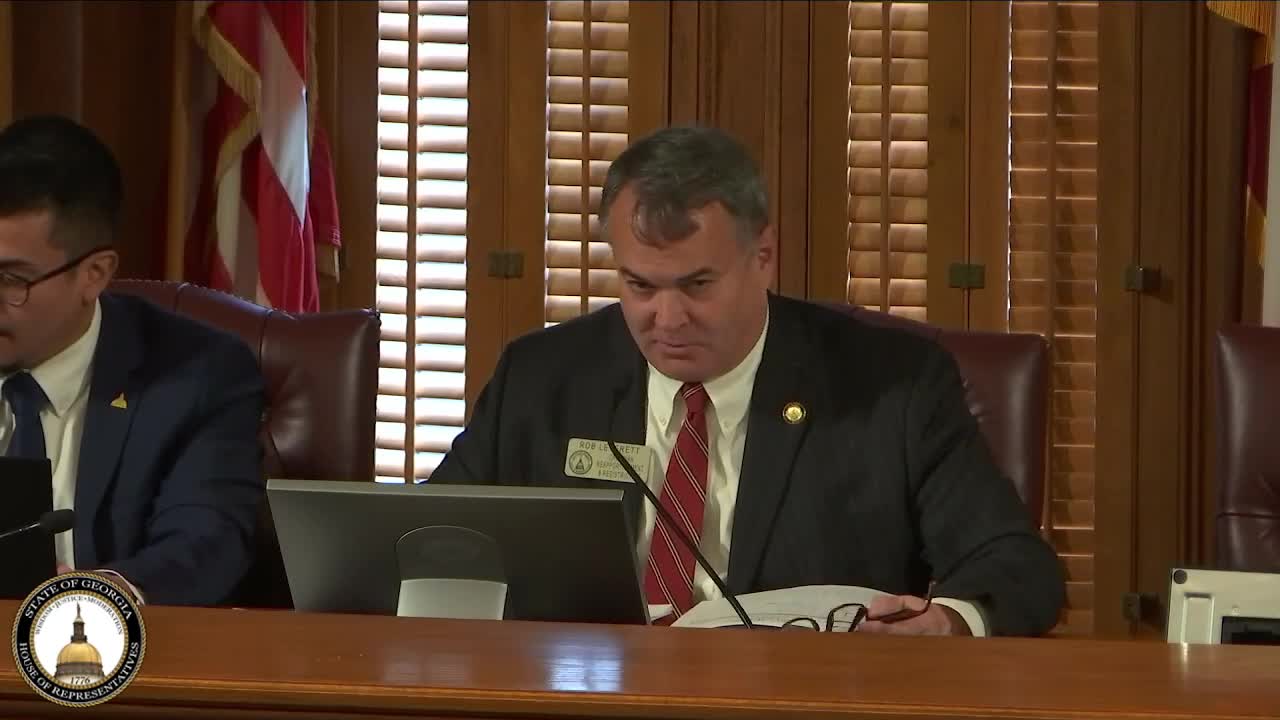
The House Rules Subcommittee on Lawsuit Reform convened March 11 for a multi‑hour hearing on section 6 of Senate Bill 68, the bill that would rewrite negligent‑security law and limit certain civil claims against property owners and security contractors.
The House Rules Subcommittee on Lawsuit Reform held a marathon public hearing March 11 on section 6 of Senate Bill 68, the measure that would reshape negligent-security law and the civil claims victims can bring when a third party commits a crime on commercial or residential premises. Subcommittee chair Rob opened the panel by saying the hearing would focus on “section 6 of Senate Bill 68.”
Supporters of SB 68, including corporate and retail representatives, told the committee the current case law lacks a clear standard and has driven insurance carriers from parts of the Georgia market. John Favier, vice president of security for Waffle House, said rising costs force companies to self-insure more of their risk and that in recent years Waffle House’s insurance costs have risen far faster than its expansion. ‘‘The cost of risk at Waffle House has gone up dramatically,’’ he said, adding that 20% of Waffle House restaurants are in Georgia but 83% of the company’s legal costs are incurred there. Convenience-store and franchise owners reported large premium increases and fewer available carriers in renewal markets; a McDonald’s franchisee said the pool of carriers quoting his multiunit risk dropped from six in 2022 to three in 2025, and his renewal this year rose about 85% over 2024.
Opponents — including survivors of sexual assault, trafficking and other violent crime, victim advocates and several personal-injury lawyers — said SB 68 would erect near-insurmountable legal barriers for people seeking civil accountability. Multiple survivors and advocates described long recovery processes and how damages awards enabled access to medical and mental-health care. Michelle Maggard, a trauma therapist, warned bifurcated trials and repeated fact-finding could retraumatize sexual-assault survivors. Survivor Michael Roseberry urged an explicit carve-out for trafficking victims: ‘‘These lawsuits are about so much more than financial independence. … Please, what I ask, and I ask just short of begging you to make a full exception for survivors of trafficking.’’
Plaintiff lawyers and trafficking litigators described practical effects they expect if SB 68 passes as written. Jonathan Tonj, who has litigated many trafficking cases in Georgia, said the bill’s revisions would eliminate longstanding negligence and nuisance claims that can shut down repeat-offender properties, leaving only a high‑threshold statutory cause of action passed in 2021 that has limited appellate guidance. Tonj warned that the statute’s new definitional and knowledge elements — including a requirement in several places that an owner “consciously understand” a third party is likely to imminently engage in wrongful conduct — shift burdens to victims and will be difficult to prove in practice.
Defense-side and business witnesses framed the problem differently. Insurance and risk-management witnesses urged clearer statutory rules to restore market certainty and carrier participation. Mike Moran, a longtime negligent-security practitioner, told the panel he could not identify a real-world negligent-security case that would survive the bill as drafted; he highlighted provisions that would require plaintiffs to prove a ‘‘particularized warning’’ or that crimes occurred because a third party exploited a ‘‘specific physical condition’’ of the premises, and he warned the bill raises the burden of proof in places to clear-and-convincing evidence.
Housing developers and property managers said SB 68’s effects could be especially acute for multifamily affordable housing and community redevelopment. Columbia Residential’s asset manager described repeated settlement-driven exclusions at renewal and said investor and lender requirements (including Fannie Mae/Freddie Mac underwriting) complicate coverage when insurers file broad exclusions.
Committee activity: no formal votes were recorded during the hearing; legislators asked clarifying questions and signaled further committee work. Subcommittee members indicated they will hold another hearing to complete the record and expect further drafting and amendment discussions in the coming week.
Why it matters: the bill would change who can sue property owners and security contractors after third-party criminal acts; industry witnesses said that change is necessary to stabilize insurance markets and keep businesses and services operating, while victim advocates and plaintiff lawyers said the measure would remove civil accountability and leave many victims without recovery or leverage to push dangerous properties to change. The committee did not take formal action and scheduled additional meetings to work through the remaining sections.
Evidentiary quotes from the hearing include: Meredith Watts, a plaintiffs’ attorney, saying the draft’s ‘‘specific physical condition of the premises’’ language could be used to ‘‘insulate property owners’’ from liability; Michelle Maggard, a trauma counselor, saying SB 68 ‘‘would place insurmountable legal and emotional barriers in front of survivors;’’ and Jonathan Tonj, a trafficking litigator, saying the version that passed the Senate ‘‘protects that civil cause of action that we don't know what it is … It does not protect a negligence claim or a nuisance claim.’’
The committee is expected to reconvene to hear additional testimony and consider amendments so the final bill better balances insurer and business concerns with access to civil remedies for victims.