Get Full Government Meeting Transcripts, Videos, & Alerts Forever!
Get email alerts on the Energy Grid Large Loads topic
No spam. Unsubscribe anytime.
Senate committee adopts substitute to Senate Bill 6 to tighten rules for large electricity customers
Summary
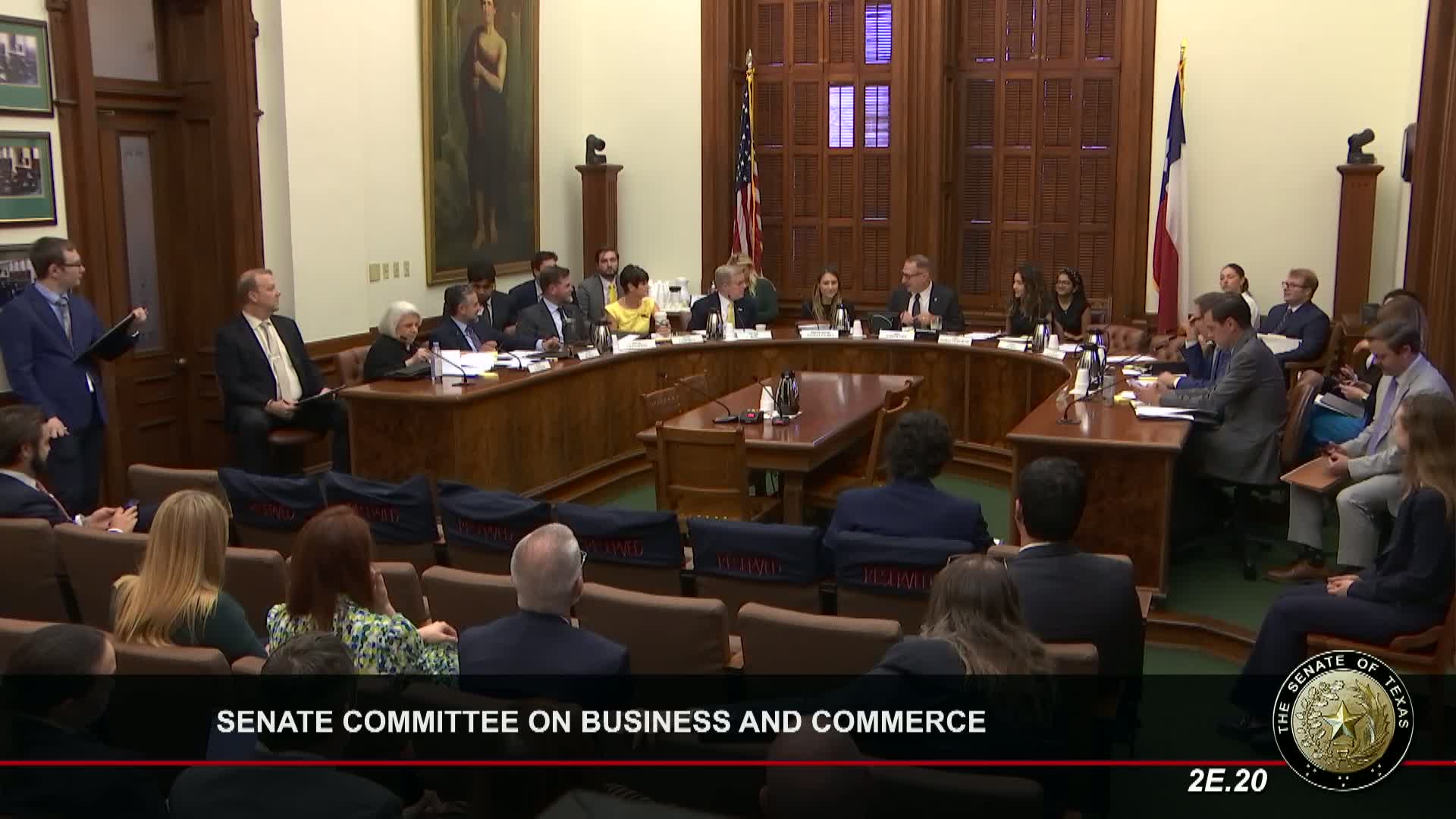
Senate Committee on Business & Commerce Chair Senator Schwertner opened a brief October committee meeting saying, “This is a quick meeting for the purpose of discussing and voting out on the committee substitute to Senate Bill 6.”
Senate Committee on Business & Commerce Chair Senator Schwertner opened a brief October committee meeting saying, “This is a quick meeting for the purpose of discussing and voting out on the committee substitute to Senate Bill 6.”
The committee unanimously adopted the committee substitute to Senate Bill 6, a measure that would change how Texas regulators treat very large electricity customers — including data centers and other “large loads” — by creating an interconnection charge for new connections, tightening forecasting and reporting requirements to ERCOT, and requiring reliability reviews before existing on‑site generation is removed from the grid.
Why it matters: Committee members framed the changes as shifts meant to protect homeowners and small businesses from higher costs and to reduce reliability risk as large, fast‑growing loads come online. Sponsor Senator King said the substitute closes loopholes left in the original filing and gives the Public Utility Commission of Texas (PUC) and ERCOT rulemaking authority to set formulas and implementation details.
Senator King, the bill sponsor, walked the committee through the major substantive changes. He described a new “interconnection charge” — likened to a local impact fee — that the PUC and ERCOT would set by rule to allocate costs from new large loads to the entities causing those costs rather than passing them to other customers. King said the substitute directs the PUC to evaluate the current 4 CP (coincident peak) method used to allocate transmission costs and to implement rulemaking based on that evaluation, including consideration of seasonal peaks and differing daily intervals.
The substitute also broadens the set of interconnection reporting criteria ERCOT can require. The bill as filed limited enhanced reporting to projects of 75 megawatts and larger; the substitute allows the PUC to set standard criteria by rule that can apply to smaller interconnections as well so ERCOT’s transmission load forecasting reflects ramp schedules, site control, backup generation and other attributes that affect whether proposed loads are likely to materialize.
On net‑metering and existing on‑site generation, the substitute removes a prior bypass and requires a reliability review by ERCOT and the PUC before generation can be removed from the grid. The committee language envisions an expedited review (sponsor remarks referenced a 180‑day expedited target in prior drafts) and limits interveners in those reviews to parties directly involved in the net‑metering arrangement. The substitute also allows the PUC to certify conditions that may be temporary so measures required to secure reliability do not become permanent obligations beyond their useful life.
Senator King also described new sections requiring utilities and large customers to adopt protocols for any necessary disconnect devices and to coordinate responsible load shed. He said the intent is to set up voluntary flexible load programs for large customers that could be compensated for going offline in EEA (emergency energy) events while preventing situations in which a single large customer remains powered while nearby neighborhoods suffer outages.
Senator Menendez asked clarification questions about scope and timing. He asked, “Does this apply only to transmission cost, or does it also include generation infrastructure?” Senator King replied that the draft removed the word “transmission” so the statute would apply to both distribution and transmission‑level voltage and therefore capture generation or distribution‑level facilities placed onto a utility’s system.
Menendez also asked how “single site” and “load ramp milestones” would be defined; King said the PUC would adopt implementing rules to define those terms and that milestones are the commonly used staged increases projects report so planners neither overbuild nor underbuild transmission. On how quickly utilities could direct customers to use on‑site backup or curtail loads, King described a negotiated process in which utilities would work with each large customer to develop a tailored protocol and referenced the expectation that most events give days' notice and that some responses can occur within minutes in extreme events.
Votes at a glance: Senator King moved adoption of the committee substitute and that the substitute be reported favorably to the full Senate. A roll call produced the following recorded ayes: Senator Blanco; Senator Campbell; Senator Johnson; Senator Menendez; Senator Middleton; Senator King; Senator Schwertner. The clerk announced “There being 7 ayes and 0 nays” and the committee reported the substitute favorably.
The committee’s chair closed the brief session and recessed the committee subject to the call of the chair. The substitute directs the PUC and ERCOT to undertake rulemaking and technical implementation steps before many of the statute’s effects would appear in practice.
Minor technical edits and additional clarifications were included throughout the substitute, according to the sponsor, including tightened language on “substantially similar” applications and changes to how affiliated or unaffiliated projects are treated to avoid gaming of thresholds.