Get Full Government Meeting Transcripts, Videos, & Alerts Forever!
Get email alerts on the Court Procedure Mental Health topic
No spam. Unsubscribe anytime.
Committee considers streamlining court filing and notice rules for mental-health proceedings
Summary
Senate Bill 53 would update notice and filing requirements in court proceedings involving persons with mental illness, including clarifying that sheriffs, constables, and deputies may personally serve notices; invited witnesses explained the bill updates antiquated requirements dating to the era of faded fax originals.
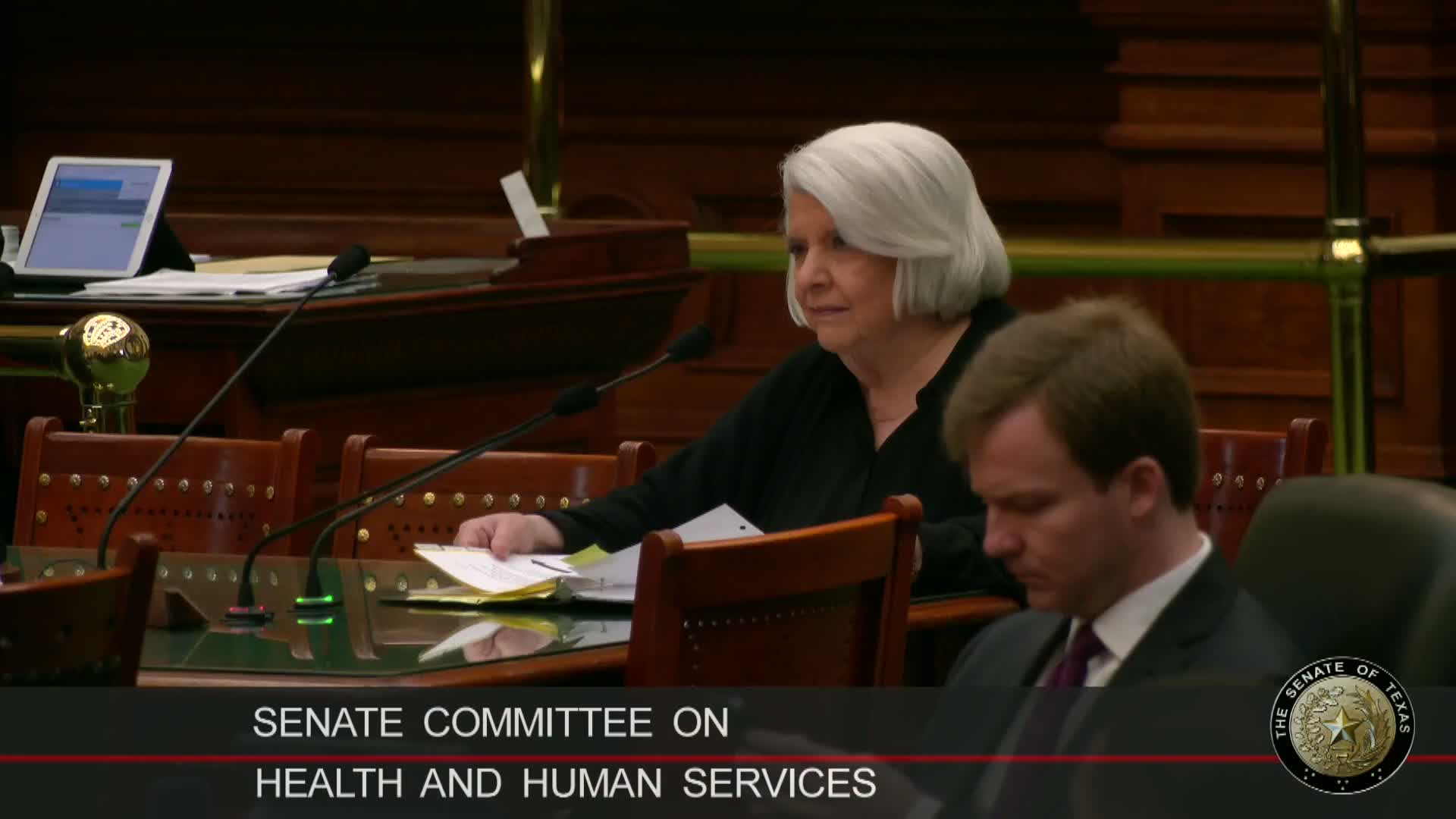
The Committee on Health & Human Services considered Senate Bill 53, authored by Sen. Judith Zaffirini, which would update certain notice and original-document filing requirements for courts with mental-health jurisdiction.
Zaffirini told the committee the bill would eliminate an outdated requirement that an original paper document be filed within 72 hours after an electronic filing — a rule rooted in concerns that ink on paper and faxed documents faded. She said modern electronic filing, faxing and email have made that requirement unnecessary and inefficient.
The bill also clarifies that in courts with mental-health jurisdiction a constable, sheriff or deputy sheriff may provide personal service for notices in mental-health cases; witnesses said a lack of explicit authorization in the Health and Safety Code left some local law enforcement hesitant to participate in some counties.
Judge Guy Herman, a presiding statutory probate court judge, testified in support and corrected a technical point on burden of proof: he said the burden in mental-health civil-commitment proceedings is “clear and convincing evidence,” while the burden for intellectual disability commitment in an SSLC (state-supported living center) is “beyond a reasonable doubt.” Herman said courts and hospitals already maintain records and that modern procedures make routine physical filing unnecessary; records can be subpoenaed if the court needs originals.
Committee members asked clarifying questions. The chair closed public testimony and left SB 53 pending for further consideration.
Why it matters: The bill aims to remove procedural requirements that witnesses and the sponsor described as obsolete and to clarify law-enforcement authority to serve notice, which could affect how mental-health court proceedings operate across counties.
Outcome: No vote; bill left pending.