Get Full Government Meeting Transcripts, Videos, & Alerts Forever!
Get email alerts on the Tenncare Budget Fy25 topic
No spam. Unsubscribe anytime.
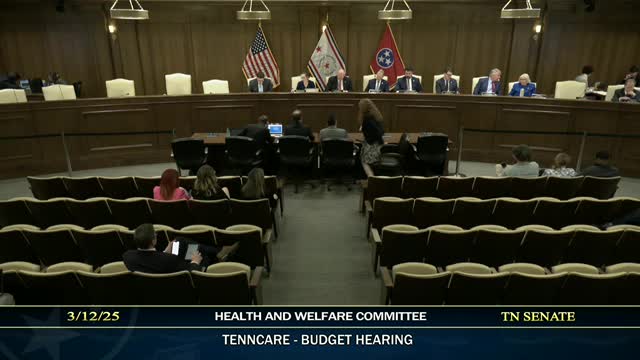
TennCare director details FY‑25 budget, shared‑savings investments and rising pharmacy costs to Health and Welfare Committee
Summary
TennCare Director Steven Smith told the Senate Health and Welfare Committee that TennCare 3 has generated nearly $1 billion in shared savings over three years and presented FY‑25 proposals to expand Choices program capacity, fund workforce and nursing facility grants, and address rising pharmacy costs tied to GLP‑1 drugs.
TennCare Director Steven Smith and senior agency officials presented the agency’s FY‑25 budget to the Senate Health and Welfare Committee and described how funds from the TennCare 3 waiver’s shared savings would be used to expand long‑term care services, stabilize workforce shortages and address other program needs.
Smith said the TennCare 3 waiver has produced nearly $1 billion in shared savings in its first three years, money the agency is using for a mix of nonrecurring and targeted recurring investments. The agency has proposed using $100 million of year‑three shared savings for hurricane relief to impacted communities and proposed allocating $240 million toward long‑term care initiatives, including enrollment growth for Choices program participants and improvements in home‑and‑community‑based services (HCBS).
As part of the FY‑25 request, TennCare proposed additional capacity for the Choices program — including funding to serve an additional 2,000 people in Choices 3, which supports adults with physical disabilities and seniors at risk of institutionalization — and workforce supports for providers. In his remarks, Smith described a workforce and retention proposal that the agency framed as a $50 million effort (described in the hearing record as “$10 million per year for five years”) to be distributed to providers serving affected populations; TennCare also proposed $50 million in grants for nursing facility infrastructure and workforce needs. TennCare said those would be administered as grant programs, similar to last year’s rural health resiliency grants run through the Department of Health.
The presentation also flagged pharmacy trend increases driven largely by rising use of GLP‑1 drugs (brand names such as Ozempic and Wegovy). Dr. Victor Wu, TennCare’s chief medical officer, told senators TennCare already covers GLP‑1 drugs for certain indications for adults and children (for example, diabetes) and that new FDA‑approved indications have expanded use for adults; TennCare officials told the committee the budget includes approximately $2.6 million in state funds to cover obesity‑only treatment under new criteria and that the broader pharmacy trend increase reflects many new indications and increased utilization.
Smith described the Choices 3 enrollment experiment as a success: the agency enrolled roughly 1,750 new members and observed that enrollment delayed higher‑cost institutional placement by an average of 13 months, producing an estimated $60 million per year in ongoing savings; because of that demonstrated savings, TennCare proposed returning that portion of funding to the general fund while continuing the program investments that produced the savings.
The agency also reviewed long‑standing financing mechanisms. Sen. Hale summarized the hospital assessment proposal — continuing the assessment at 6% — which TennCare said generates state matching dollars and federal draws that fund supplemental payments and support core TennCare services. In committee discussion later, TennCare’s CFO, Zane Seals, and staff explained how an increased hospital assessment would affect HMO premium tax flows: the MCOs are expected to pay additional premium tax as the assessment increases, generating state budget authority that draws federal matching funds.
Committee members asked detailed questions about access and adequacy, including dental provider shortages, network adequacy, and whether rate increases and managed‑care negotiations are producing improvements in provider participation. Smith and staff pointed to multiple channels of recent provider investment — negotiated MCO rate changes, pandemic era enhanced federal funds, hospital assessment flows and other actions — and provided aggregate figures showing recurring and nonrecurring provider investments in recent years. Zane Seals explained the HMO premium tax mechanics and quantified the expected state and federal flows tied to the increased hospital assessment.
After discussion the committee voted to approve the budget motion by roll call. The committee recorded nine ayes and advanced the budget in committee.
TennCare agreed to provide committee members copies of the presentation slides and follow up with requested data on enrollment utilization, network adequacy metrics, and the status of proposed and unobligated shared‑savings commitments.