Get Full Government Meeting Transcripts, Videos, & Alerts Forever!
Get email alerts on the Battery Safety topic
No spam. Unsubscribe anytime.
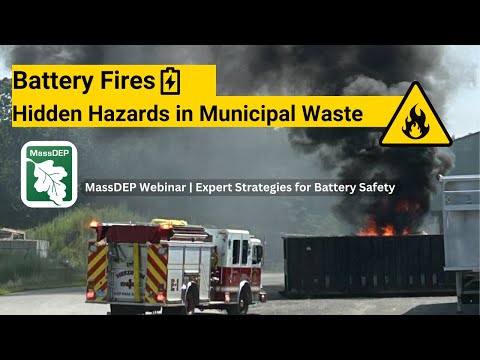
MassDEP webinar: municipalities, fire and police warn lithium batteries are rising cause of MRF and transfer-station fires
Summary
A Massachusetts Department of Environmental Protection webinar on battery safety brought municipal recycling managers, waste processors, Call2Recycle, fire officials and the state police bomb squad together to review recent fires, handling best practices and a push for statewide extended-producer-responsibility for batteries.
A Massachusetts Department of Environmental Protection webinar on battery safety on Feb. 1 brought municipal recycling managers, waste processors, Call2Recycle, fire officials and the state police bomb squad together to review recent fires, handling best practices and plans for an extended-producer-responsibility law for batteries.
Speakers said lithium-ion batteries have become an increasingly frequent cause of fires at materials recovery facilities (MRFs), municipal transfer stations and in homes, and they urged stepped-up public education, consistent on-site handling, stronger partnerships with fire departments and new statewide funding and collection systems.
The session opened with Carrie Parcel, municipal assistance coordinator at the Massachusetts Department of Environmental Protection, saying the meeting would cover “batteries and battery safety, collection, handling, identification, and what to do.” That framing set the tone for roughly 90 minutes of presentations and a wide-ranging Q&A with municipal staff, industry and first responders.
Why this matters
Speakers described repeated, costly and sometimes dangerous incidents that can begin when consumers discard or bring damaged rechargeable batteries mixed with curbside recycling or scrap metal. Brendan Farrell, plant manager at Waste Management’s Avon MRF, said the facility sees “about one fire a month” tied to lithium-ion cells and described a July incident that damaged equipment and forced a shutdown for weeks. Farrell told attendees that MRF environments — heavy machinery, conveyors and balers processing hundreds of tons daily — can physically rupture cells and trigger thermal runaway.
Matthew Demeray, superintendent of recycling and solid waste for Needham, recounted a July 2024 container fire in a 40‑yard scrap metal bin that required 30 minutes of active firefighting and an additional hour of cooling. Demeray said that, in another incident, staff who poured water on a hot battery experienced breathing problems from the vapor and had to be treated. “That’s the power of a lithium battery,” he said, describing how compromised batteries can continue to burn and emit toxic gases.
What municipalities and processors are doing
Speakers described stepped-up local procedures that aim to keep batteries out of processing streams and to isolate and transport damaged units safely.
- At curbside and drop-off sites: Liz Antanavica, trash and recycling administrator for Bedford, outlined a staffed universal-waste shed where residents can leave batteries in clearly labeled bins. Bedford sorts by chemistry, tapes small cells, stores containers in screw‑lid five‑gallon buckets labeled as “universal waste,” and conducts packaging work twice a week. Antanavica said Bedford collected 1,600 pounds of batteries in fiscal 2024 and roughly 1,200 pounds so far this year with five months remaining.
- At MRFs: Farrell said Avon processes roughly 375 tons per day across three shifts and about 25 contracted towns; its sorting lines, screens and balers can crush batteries and ignite surrounding fiber or plastics. He urged aggressive public education and better sorting at the source.
- Handling damaged/defective/recalled (DDR) batteries: Bedford recommends isolating visibly swollen or damaged batteries, placing them in a plastic bag, using a battery-safe kit (Cellblock EX and similar products were discussed) or impermeable absorbent media such as vermiculite/speedy-dry if a certified kit is not available, and scheduling expedited pickup from a qualified recycler.
- Fire-service cooperation and chain of custody: Jeff Marchetti, deputy chief of the Brockton Fire Department, described joint protocols his department developed with the local DPW: crews “overpack” compromised batteries with suppression media, place them in drums that are allowed to vent (he advised not to clamp sealed lids), sticker and date packages, let them sit for about 30 days in a secured area, and then turn them over to a recycler for repackaging and shipment under the receiver’s instructions. Marchetti said drums should be able to vent to avoid pressure buildup.
National and statewide collection roles
Mark Stedman, program manager for Call2Recycle, outlined how that stewardship organization and its manufacturers-funded stewards support state programs, retail drop-offs and large-scale collection initiatives. Stedman said Call2Recycle supports state-mandated collection programs and national retail takebacks and reported the program moved in the “tens of millions of pounds” of batteries last year while noting final figures were being confirmed.
Push for extended producer responsibility (EPR)
Juanita Waddida of the Massachusetts Product Stewardship Council (housed at MassRecycle) described a campaign to file battery EPR legislation this session modeled on an Illinois bill. Waddida said stakeholders including fire chiefs, haulers and retailers have been engaged and that an EPR law would obligate producers to fund statewide collection networks, education and safe transport. She urged participants to send photos and incident-cost data to the council to support legislative advocacy.
Safety guidance for residents and staff
Panelists emphasized simple, practical steps residents and municipal staff can take to reduce risk: tape battery terminals (clear tape is preferred), do not leave high‑energy packs charging unattended for long periods, separate and label battery drop-offs, and call 911 if a battery is visibly hot, off‑gassing, smoking or otherwise behaving dangerously. Trooper Jerry Harris of the Massachusetts State Police Bomb Squad added that bulging or physically altered devices encountered in airports or workplaces are treated with caution and can trigger evacuations until a safe assessment is made.
Reporting and data collection
Speakers noted a gap in standardized incident reporting. Marchetti and others encouraged departments to file battery-related incident reports with state fire officials; local reporting helps justify grant funding and shared equipment purchases. The state fire marshal’s guidance and a DFS form for lithium-ion incidents were cited as local reporting mechanisms.
Next steps and resources
Presenters urged municipalities to: strengthen signage and public outreach; staff drop-off points; adopt simple job aids for on-site packaging; build cooperative agreements with local fire departments; keep contact information for qualified recyclers such as Complete Recycling Solutions and Call2Recycle; and support the Product Stewardship Council’s EPR campaign. The presenters said slides, job aids and sample signage would be shared and noted a MassRecycle conference and a public Product Stewardship Council meeting as upcoming venues to continue the work.
The webinar underscored that lithium-ion batteries are now an operational and safety priority for transfer stations, MRFs, municipal recycling programs and emergency responders, and participants recommended stepped-up prevention (public education), safer on-site practices and legislative change to create a sustainable, producer-funded collection system.