Get Full Government Meeting Transcripts, Videos, & Alerts Forever!
Get email alerts on the Criminal Justice topic
No spam. Unsubscribe anytime.
Committee approves bill to criminalize 'knowing' mass-violence threats beyond schools
Summary
House Bill 13,014, amended to require a "knowing" terroristic threat standard, was sent to full judiciary. Department of Safety and Homeland Security witnesses told the committee the measure would help address threats originating in other states and juvenile cases.
The House Judiciary Committee voted to advance House Bill 13,014, as amended, to full judiciary after adopting language that raises the culpability threshold from "recklessly" to "knowingly." The committee recorded the disposition as 5 ayes, 0 nays and 1 present not voting.
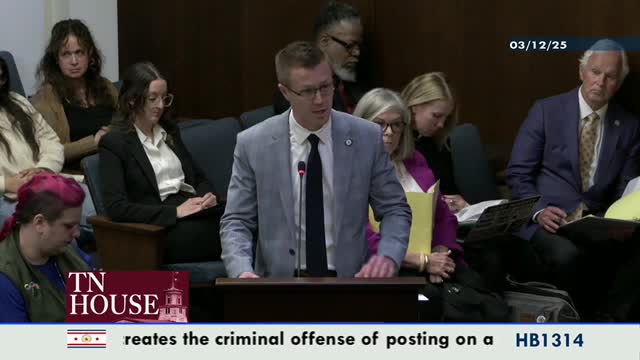
Sponsor Leader Cochran told the committee the bill creates an offense for "persons who make those terroristic threats, with the intent to intimidate, or coerce the population." He said the change to a "knowing" standard was deliberate: "We wanna make sure that we are capturing the correct people, right? That it's not something that wasn't just a reckless, a comment, but one that was planned."
Witnesses from the Department of Safety and the Tennessee Office of Homeland Security described cross-jurisdictional investigative practices and how law enforcement typically works with federal and out-of-state partners to identify and prosecute people who post threats from outside Tennessee. Elizabeth Stroker, legislative director and assistant general counsel for the Department of Safety, testified that the department has seen "situations like that before where threats have come in from other states or people outside of Tennessee." Deputy Commissioner Greg Mays said such investigations often require working with federal partners or using civil processes to obtain platform records.
Juveniles and prosecutorial discretion: The panel asked whether the law would apply to juveniles and how cases involving alleged diminished capacity would be handled. Stroker said the statute would be applicable to anyone who makes a threat. Deputy Commissioner Mays noted that prosecutorial discretion and existing processes often account for mental-capacity issues: "People who make threats or who don't understand what they're doing are going to be treated a little differently in the system than those who do know what they're doing."
Scope and intent: Sponsors said the bill extends tools now available for school threats to other public places, such as post offices or government buildings. The sponsor said existing law addressing school threats appears to have had a deterrent effect and that this bill would expand a similar tool beyond schools.
Outcome: House Bill 13,014 as amended passed committee and will move to full judiciary (committee roll-call recorded as 5 ayes, 0 nays, 1 present not voting).