Get Full Government Meeting Transcripts, Videos, & Alerts Forever!
Get email alerts on the Criminal Justice topic
No spam. Unsubscribe anytime.
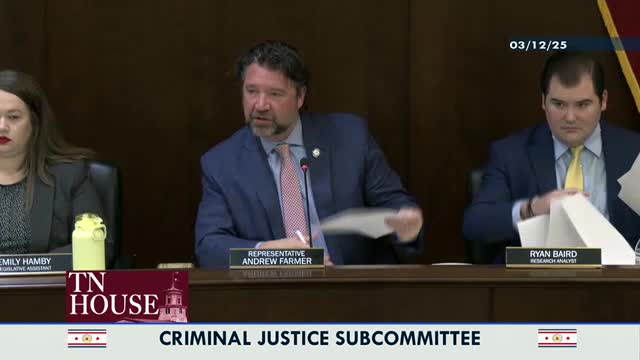
Judiciary committee advances bill to create domestic-violence offender registry after family testimony
Summary
The House Judiciary Committee voted to send House Bill 1,200, a proposal to create a public registry for repeat domestic-violence offenders, to full judiciary after testimony from the victim's family and clarifying questions about access and housing liability.
The House Judiciary Committee on Wednesday voted 7-0 to send House Bill 1,200, known in testimony as "Savannah's Law," to full judiciary. The bill would create a public registry for repeat domestic-violence offenders and require the Tennessee Bureau of Investigation to make the registry searchable online.
The bill’s sponsor, Representative Kumar, said the measure is intended to help people avoid violent partners and give citizens an option to check repeat offenders. "The idea of the bill and the reason for it is to protect citizens so that they do not fall into a bad relationship or a bad trap," Kumar said during the committee hearing.
Why it matters: Family members of a woman who worked in a sheriff’s office described the toll of her killing and urged lawmakers to approve a registry they said could have prevented the homicide. Kimberly Dodson, identified in testimony as the victim's mother, described her daughter’s death and asked lawmakers, "Why would you not put someone like this evil man on a registry?" Dodson said the bill targets repeat offenders who have been convicted by a judge and that identifying information such as exact addresses would not be published.
What the bill would do: Testimony and sponsor remarks said the registry would list offenders’ names, a photograph and the location and year where the offense occurred, while protecting victims’ identities and withholding personal identifying data such as addresses and Social Security numbers. The sponsor said the registry would place a repeat offender on the list for five years after a second conviction and increase the length of listing for subsequent offenses.
Access and housing questions: Committee members pressed staff on how the registry would be searchable and whether landlords could use it to screen prospective tenants. Michelle Fogarty of the Office of Legal Services said, "The bill states that the TBI shall make the list available, for public inquiry on the Internet." When asked if landlords would face liability for renting to listed individuals, Fogarty said, "The bill does not, state anything in that regard." The sponsor also said the bill would not include addresses but would allow landlords to cross-check a person they already know by other identifying information.
Public testimony: Two women who said they had personal encounters with the same man who later killed the deputy described patterns of controlling behavior and stalking. Britney Mullenacs described escalating psychological abuse and called psychological coercion a form of domestic violence that can escalate to physical harm.
Outcome: House Bill 1,200, as amended, passed committee on a voice and roll call vote recorded as 7 ayes, 0 nays and moves to full judiciary.
What’s next: The sponsor said funding is necessary to operationalize the registry and that funding was promised last year but "didn't materialize," and vowed to seek funding during the next budget cycle.