Get Full Government Meeting Transcripts, Videos, & Alerts Forever!
Get email alerts on the Renewable Energy Wind topic
No spam. Unsubscribe anytime.
NextEra presents Jackalope Wind project: developers outline 600 MW plan and local economic benefits
Summary
NextEra Energy representatives briefed the Sweetwater County Planning and Zoning Commission on the Jackalope Wind Project, a proposed 600 MW wind development that would require BLM and industrial-siting permits and is projected to generate substantial local tax revenue and a large temporary construction workforce.
NextEra Energy’s development team presented the Jackalope Wind Project to the Sweetwater County Planning and Zoning Commission, describing a proposed 600-megawatt wind farm, an estimated $1 billion-plus capital investment, and projected local economic benefits including construction payroll and long-term property-tax revenue.
Glenn Schober, lead developer for the Jackalope Wind Project, said the proposal is a 600-megawatt facility using GE turbines and would include roughly 213 turbines within an initial project boundary of about 149,000 acres; the expected permanent project footprint after construction is about 5,000 acres. He said the company has contracted sale of the project’s energy to Idaho Power Company and holds an interconnection agreement to tie into the Jim Bridger substation.
Schober gave economic estimates the company provided to the county: peak construction employment of about 425 workers, an average of about 273 workers across the 15-month construction window, and approximately 18 permanent local jobs for operations and maintenance. Using current mill levies and the project assumptions, the company estimated roughly $184 million in ad valorem taxes for the county over the life of the project, about $25 million in sales-and-use tax revenue during construction, and approximately $39 million over the project life from the wind-generation excise tax (which accrues starting in year four after a three-year exemption), producing a combined county revenue estimate of roughly $248 million. Schober also said the Industrial Siting Council process could make approximately $15 million in impact-assistance funds available to affected counties.
Schober said the company selected Sweetwater County because the site meets the four primary development criteria: available transmission capacity (Jim Bridger substation and expanding transmission corridors), a market/demand for energy (project energy already sold), high wind resource, and sufficient buildable land. He said the nearest populated place to turbines would be Wamsutter at about 16 miles away; project siting seeks to avoid sage-grouse core areas, areas of critical environmental concern, and big-game crucial ranges and follows U.S. Fish and Wildlife Service buffer recommendations for occupied raptor nests.
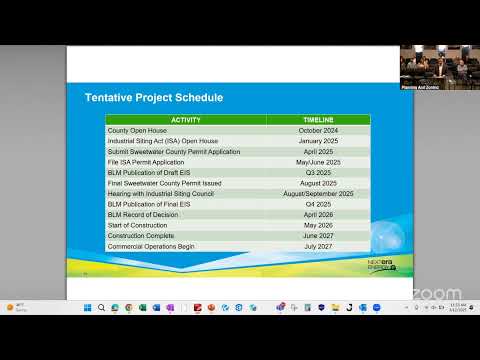
On process, Schober said NextEra will submit a county permit application and then an Industrial Siting Act (ISA) application; the company is also pursuing a BLM NEPA process. He described a tentative schedule that includes county application submission in the coming month, an ISA application shortly after and a draft EIS from the BLM toward the end of the year; the company noted a record of decision is currently scheduled for April 2026 and that construction could begin after required approvals and permitting. Commissioners asked about turbine-blade recycling; Schober said industry-level recycling solutions exist but are not yet scaled to accommodate all decommissioned blades and that the company is working with recycling start-ups. He said turbines are designed for about 35 years of operation.
Commissioners asked how the project will coordinate with mineral owners across checkerboard ownership; Schober said the developer will negotiate accommodation agreements with mineral-rights owners to coordinate offsets and operations. Schober closed by saying NextEra expects to file permit materials and will include visual analyses, biological and cultural surveys, and 47 key observation points chosen in coordination with county staff.