Get Full Government Meeting Transcripts, Videos, & Alerts Forever!
Get email alerts on the Zoning Ordinance Rewrite topic
No spam. Unsubscribe anytime.
Jackson County zoning commission reviews draft rewrite of A-1 district, adds placeholders for solar and wind rules
Summary
At a March 17 work session, Jackson County zoning commissioners reviewed a reorganized draft of the county’s zoning ordinance focusing on the A-1 agricultural district, land-use/parking matrices, signs, setbacks and supplemental district rules; staff said the draft adds consumer-scale solar rules and placeholders for utility-scale solar and wind.
Jackson County Zoning Commission members examined a reorganized draft of the county zoning ordinance during a March 17 work session, focusing on clearer formatting for the A-1 agricultural district, a new land-use/parking matrix, and supplemental district regulations that include consumer-scale solar rules and placeholders for future wind- and utility-scale solar regulations.
The draft, presented by Laura Carston, is intended to modernize an “antiquated” ordinance by adding definitions, charts and hyperlinks to make requirements easier to find, she said. "This is the draft rezoning ordinance. We've been working on an antiquated zoning ordinance. This is a draft that brings us up to speed with the changes that are occurring in our community," Carston told the commission.
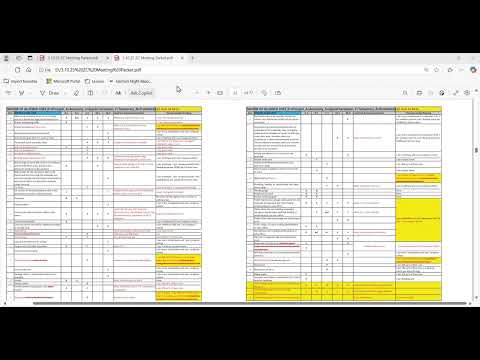
Commissioners and staff said the rewrite is primarily organizational: moving material to clearer sections, converting lengthy paragraphs into tables and charts, and creating a consistent template across districts. Carston said changes visible in the packet were shown as redlines and that the packet posted online includes both redline and a cleaned “final” view. "Any changes are shown in red. Those are our recommended changes," she said.
Key changes highlighted at the meeting included: - A land-use/parking matrix that groups related uses and shows recommended parking rates, with new notes about parking variations for particular uses. - Reorganized A-1 agricultural district text into tables for principal uses, accessory uses, special-exception uses and temporary uses; new special-exception items noted include garden centers and event venues. - Conversion of sign rules, setback rules and other district requirements into chart form to improve readability. - New sections and illustrations in “Supplemental District Regulations,” including diagrams for intersection/site-visibility triangles and illustrations for solar arrays. - Placeholder entries for consumer-scale solar regulations (building-mounted and freestanding arrays), and placeholders for utility-scale solar and commercial wind-energy conversion systems under separate ordinance workstreams.
Carston said consumer-scale solar rules were drafted for homeowners, farms and businesses; she described the utility-scale solar and wind-energy entries as placeholders pending separate review. "These are placeholders for solar energy, wind energy, that will be coming up in the future," she said. She also noted accessory-dwelling units are currently under consideration at the state level and the county kept text in reserve pending any state action.
Commissioners raised several implementation questions. Commissioner Monica McHugh asked whether the county can regulate signage along Highway 61, noting the state Department of Transportation has jurisdiction on state highways; Carston said she would check with staff and report back. Commissioner Lori (surname not specified) asked the county engineer to review the intersection-visibility diagrams and consider how roadside crops and farm practices should be treated; staff agreed to do so.
Carston and staff stressed the packet is a work session draft and that more components will be returned to the commission in subsequent meetings for review. She told the public that the packet is posted on the project website and that hard copies could be provided on request.
The commission did not take any formal votes on the ordinance text at the meeting; Carston said the work will proceed by chapter and that the commission will bring additional sections back in future meetings.
The rewrite is meant to clarify cross-references and application checklists for planned unit developments (PUDs), to add illustrative diagrams for technical rules, and to centralize temporary-use and zoning-administrator approvals. Carston said the overall goal is a more user-friendly ordinance where definitions and requirements are reachable via hyperlinks in the online version.
Commissioners scheduled follow-up work and asked staff to return with clarifications on highway signage, site-visibility triangles, and suggested language revisions for off-street parking in residential front yards.
The work session lasted roughly two hours and covered multiple sections of Chapter 2 (district regulations) and related supplemental material; commissioners said they will continue reviewing remaining chapters in upcoming meetings.