Get Full Government Meeting Transcripts, Videos, & Alerts Forever!
Get email alerts on the State Historical Society Budget topic
No spam. Unsubscribe anytime.
State Historical Society asks lawmakers for staff, archives upgrades and funding for military gallery, Medora transit and theater grants
Summary
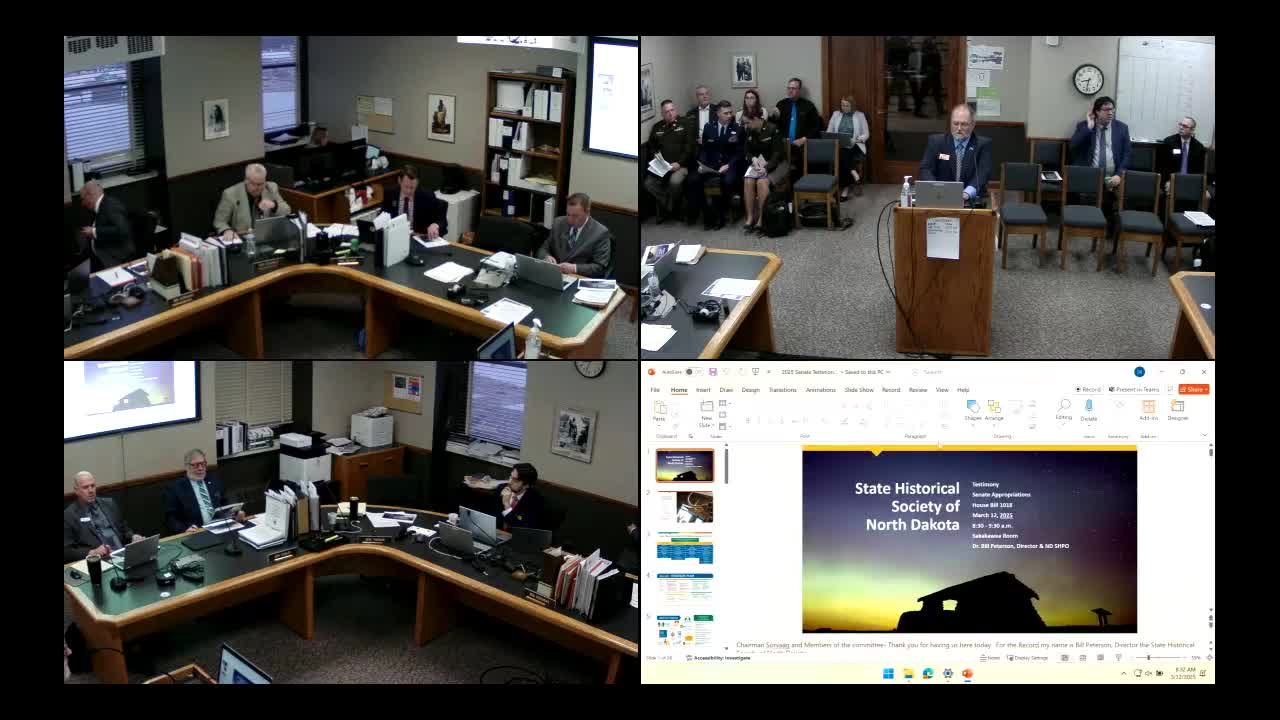
Bill Peterson, director of the State Historical Society of North Dakota, told the Appropriations - Education and Environment Division that the agency seeks additional staff and project funding to handle rising workloads, comply with new federal rules and complete several one‑time projects included in House Bill 1018.
Bill Peterson, director of the State Historical Society of North Dakota, told the Appropriations - Education and Environment Division that the agency seeks additional staff and project funding to handle rising workloads, comply with new federal rules and complete several one‑time projects included in House Bill 1018.
Peterson said the agency employs 83.5 full‑time equivalent positions, manages a collection of artifacts he described as “around 11,000,000 objects,” and provides services ranging from archaeological reviews of federally funded projects to public programming and the State Archives. “We reach more than 600,000 North Dakotans every year,” Peterson said, adding that combined in‑person visits, web users and social media reach about 2,000,000 people.
The request matters to communities across the state because it bundles operating and one‑time funding for preservation projects, staffing for archives and education programs, and a large expansion project at the Heritage Center. Peterson told the committee the agency has seen a 42% increase in archaeology and historic‑preservation workload since 2022 and a near‑67.7% increase in exhibit work since 2021, driven in part by federal infrastructure projects and rising energy development.
Agency priorities and staffing requests
Peterson described several personnel and capacity needs the agency has asked the Legislature to fund: - Additional FTEs in archaeology and historic preservation to handle increased project reviews and to expand in‑house use of non‑destructive field technologies. - Temporary and permanent positions in the State Archives to address a legacy backlog; Peterson said the archives receive about 1,000 linear feet of paper and 49,000 digital records biennially, while current staffing processes roughly 20 linear feet and 20,000 digital files per biennium. - Education positions to support National History Day and curriculum work after participation rose sharply (National History Day participation grew from about 140 students to roughly 800 in recent cycles).
Peterson also detailed internal budget transfers and vacancy savings used to improve employee compensation. He said the agency had transferred $569,877 in special‑fund authority for recently authorized positions and expects additional general‑fund requests for continued operations and to fill capacity gaps.
NAGPRA, tribal consultation and archival work
Peterson told lawmakers that revised Department of the Interior regulations implementing the Native American Graves Protection and Repatriation Act (NAGPRA) shift certain decision‑making authorities to tribal communities, which the agency said will substantially increase workload for collections management and repatriation processes. “The new regulations change the decision making authority from institutions to tribal communities,” Peterson said. The agency requested $100,000 in general funds to hire a tribal consultant to support NAGPRA consultations and compliance.
He also reported the agency has asked for one temporary records‑processing position (estimated $176,000) to process and rehouse legacy records, and said recent inventory work shows archives storage will reach capacity within about 12 years at current growth rates.
Military gallery expansion and financing
Peterson described the military gallery expansion as a priority and said the project is in the construction‑document phase. He said the plan envisions a roughly 20,000‑square‑foot gallery with a regimental room that will seat up to 400 guests. The agency holds an existing $20 million line of credit from the Bank of North Dakota; Peterson said $2.3 million of that had been spent as of January 31, 2025, and that private fundraising is ongoing.
Mitch Johnson, adjutant general for the North Dakota National Guard, testified in support of the military gallery and the agency’s request. Johnson said the North Dakota National Guard Foundation is the fundraising lead and has contracted a professional fundraising firm. He reported $7,580,000 in pledges to date and said there are about $14,000,000 in prospects and a larger pool in cultivation. “The goal of the project is to build a world class facility with exhibits and experiences that tell the story of North Dakota military history,” Johnson said.
Project governance and vendors
Peterson said Zurburg Architects and BWBR were selected for architectural services and Ralph Applebaum and Associates was retained for a virtual concept study; Kraus Anderson was selected as construction manager at risk. The agency asked the committee for funding to complete the project’s next phases.
One‑time projects, grant programs and local requests
Peterson summarized one‑time and grant items included in the House package: grants and SIF (State Investment Fund) pass‑throughs for historic‑structure restorations (examples he listed included the Fargo Historic Theater and the Ellendale Opera House), funding to revamp Pembina State Museum exhibits, archive storage upgrades, and several infrastructure and repair projects at state historic sites (Fort Totten, Fort Buford, Welk Homestead and others).
He said the agency’s general cultural‑heritage grant program was zeroed out under a 3% budget reduction but the House provided $2.9 million in project‑specific grants. The agency requested the Senate reinstate a general grant program and discussed a $5,000,000 ask as a placeholder for negotiations.
Medora transit and community planning testimony
Clarence Sitter, chief operating officer of the Theodore Roosevelt Medora Foundation, testified in support of a $1 million Medora transportation grant included in HB1018. Sitter described a plan developed with the foundation, the presidential library project and the North Dakota Department of Transportation that would fund two themed trolley‑style buses (capacity ~30 each) and seed operational funds. He said purchase quotes range from about $250,000 to $350,000 per trolley and that the foundation intends to operate the service as a free guest transit system initially.
Sitter and Peterson also discussed $3.5 million in planning funds for Medora (referred to in testimony as SIF funds) intended to develop construction documents and more detailed designs for visitor facilities and riverfront improvements; lawmakers asked for additional detail on scope and cost breakdowns before advancing that request.
Fargo Theater matching grant
Emily Beck, executive director of the Fargo Theatre, requested a $1.1 million one‑time matching grant with a 2:1 private match to support capital work for the theater’s approaching centennial. Beck described the project’s scope — HVAC, plumbing and production‑technology upgrades, seating replacement and structural assessments — and said the theater welcomes about 80,000 guests annually. She said feasibility work and community backing give the project momentum.
Committee questions and next steps
Lawmakers pressed agency staff for detail on budgets, project matches and timelines. Andrea Wiecki, director of administration for the State Historical Society, provided a line‑item overview for operating and one‑time items and said the House added funding that reflected costs tied to the military museum expansion and other SIF projects. Several senators asked for written breakdowns of America250 funding, the Medora trolley plan, Medora planning scope and Fargo Theater match details.
No formal votes were recorded during the hearing; the presentation closed after the committee heard public and organizational testimony and asked staff to provide additional documentation. Senator Meyer was named lead on the budget for subsequent committee work.
Sources: Testimony and exchanges at the Appropriations - Education and Environment Division hearing by Bill Peterson (director, State Historical Society of North Dakota); Andrea Wiecki (director of administration, State Historical Society); Mitch Johnson (adjutant general, North Dakota National Guard); Clarence Sitter (chief operating officer, Theodore Roosevelt Medora Foundation); Emily Beck (executive director, Fargo Theatre).