Get Full Government Meeting Transcripts, Videos, & Alerts Forever!
Get email alerts on the Higher Education Facilities topic
No spam. Unsubscribe anytime.
NDSCS urges state help as foundation debt and facility shortfalls threaten programs
Summary
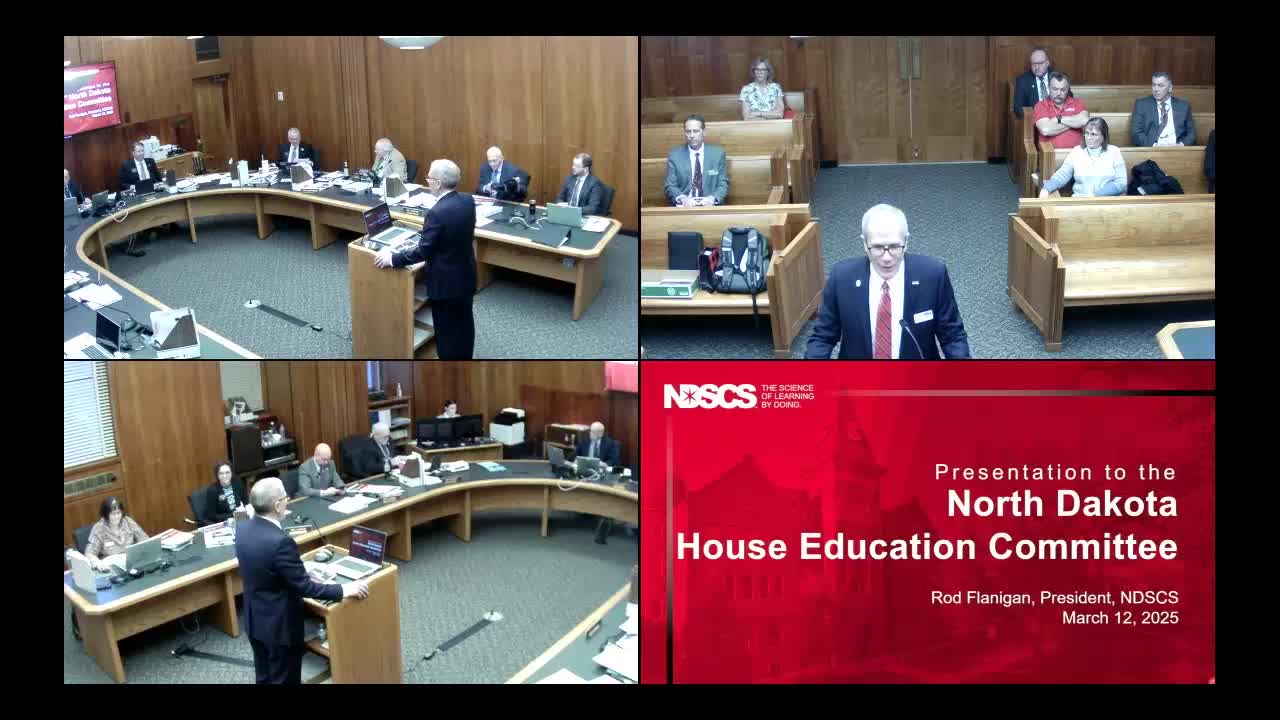
Rod Flanagan, president of the North Dakota State College of Science, told the Appropriations — Education and Environment Division committee that NDSCS needs state help to protect buildings and growing workforce programs tied to a Fargo site the college does not own.
Rod Flanagan, president of the North Dakota State College of Science, told the Appropriations — Education and Environment Division committee that NDSCS needs state help to protect buildings and growing workforce programs tied to a Fargo site the college does not own.
Flanagan said the college will not pursue a $24,700,000 renovation of its library this session after the Senate declined to fund that project, and instead is prioritizing smaller, immediate needs including demolishing three vacant dorms and seeking state help for a career-training facility in Fargo.
The library work, Flanagan said, “would have moved some academic programs in there,” but the college will not press that request during this session. He told lawmakers that the library project was removed from the active ask because there is little appetite statewide to fund large higher-education projects this year.
Why it matters: the Fargo property houses TrainND noncredit workforce training, welding, and the college’s new aviation maintenance lecture and small-lab space — programs Flanagan said are “critical” to NDSCS’s mission to deliver career and technical education for the region.
Flanagan asked the committee for three near-term items: $3 million to raze three dorms that have been vacant for more than 15 years; $5.6 million for the state to assume ownership of a 19th Avenue facility in Fargo that the college’s foundation currently owns; and authority to pursue public–private financing for new student housing on the cleared dorm site.
Flanagan said the dorm demolition would clear land where the college expects future residence halls will be built under a public–private partnership. “This is the place where it would happen,” he told the committee.
On the 19th Avenue building, Flanagan said the foundation still carries roughly $800,000–$900,000 in debt on the facility and had pledged $3 million toward a separate Career Innovation Center (CIC). He told lawmakers that selling the building to pay that pledge would disrupt several programs now located there, including TrainND, CDL and CNA training, the welding program, and a planned aviation maintenance program that Flanagan said is scheduled to start in August 2025.
Kim Nelson, executive director of the NDSCS Foundation, told the committee the foundation has raised roughly $18 million for local projects and contributed $4 million in donated land for the CIC. “The foundation isn’t making any money on Nineteenth Avenue,” Nelson said. She described the foundation’s proceeds as used primarily to pay down the building’s loan and to help the college with scholarships and program support.
Lawmakers asked for specifics about the CIC and the foundation’s commitments. Representative Martinson asked the presenter to identify what the Senate did or did not approve. Representative Swantek pressed whether the college could use Tier funds for large projects; Flanagan said the college’s existing portfolio of buildings already uses most Tier funding for maintenance and would not cover a $24 million renovation.
On the aviation program, Flanagan said the location next to the Fargo hangar is strategic and estimated the program could enroll about 50 students within five years and perhaps 100 at full scale. He said much of the noncredit workforce training under TrainND occurs in the same facility and that losing the building to a sale would “kill the pathway program with NDSU,” reduce welding capacity and limit space for high-demand programs.
The college’s presentation included enrollment and labor-market data tied to its requests. Flanagan said about 80% of students on the Wahpeton campus participate in some form of career and technical education and that many programs rely on donated equipment from manufacturers.
What’s next: Flanagan said he will provide the committee with a bottom-line figure for the college’s outstanding facility and foundation obligations when requested.
Ending: Committee members thanked the presenters and signaled they would revisit the college’s budget requests in later hearings.