Get Full Government Meeting Transcripts, Videos, & Alerts Forever!
Get email alerts on the Digital Forensics Fund topic
No spam. Unsubscribe anytime.
Bill to add fee for convictions to fund digital forensics, internet‑crime investigations draws support from law enforcement
Summary
Senate Bill 2167 would add a fee on convictions where digital forensics are used and establish an Internet Crime Investigation Fund to pay for hardware, software, training and outreach. Law enforcement witnesses said the fund would help police keep up with growing cybercrime demands; revenue estimates were uncertain.
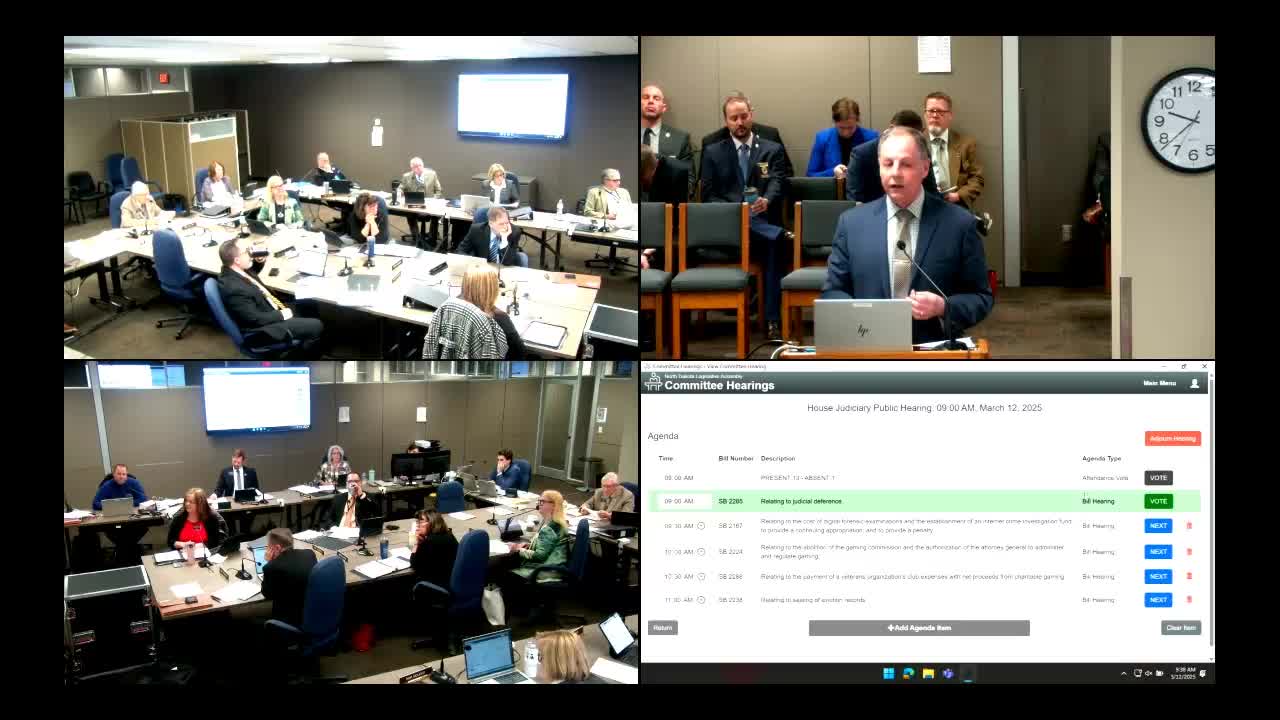
The House Judiciary Committee heard testimony supporting Senate Bill 2167, which would allow courts to assess a fee on certain criminal convictions and deposit those funds into a state Internet Crime Investigation Fund to pay for digital forensics equipment, software, training and Internet‑crimes‑against‑children prevention efforts.
Sen. Yana Bridal introduced the bill and said it is a response to a rise in online crimes targeting children and to growing demand for digital forensic work in many investigations.
Steven Harstad, chief agent with the Bureau of Criminal Investigation, told the committee the statutory structure would assess a single $100 fee in qualifying convictions where digital forensics (for example, extracting a cell phone) were used. Harstad said the fund would be held by the attorney general but available to any agency performing digital‑forensic work, including local police departments. “We'd rather not make it too burdensome in the long run,” Harstad said, explaining the bill limits the fee to a single assessment per defendant even if multiple convictions result.
Harstad outlined partial revenue context: there were about 21,000 felony or misdemeanor convictions statewide in 2023 and historic collection rates of roughly 62% for similar fees; however, he said it is unclear how many of those convictions involved digital forensics. He told the committee a rough working estimate would be that “50 to 80 percent” of cases might involve digital evidence, but he said precise revenue projections were not available.
Supporters included the North Dakota Peace Officers Association and the Bureau of Criminal Investigation; witnesses said several other states use similar mechanisms. Testimony said the fund would enable smaller departments to access specialized tools and training that are otherwise costly.
Committee members asked about waivers and fairness for low‑income defendants. Harstad said the bill’s language allows some flexibility in the fee amount and that courts already assess varying fees and fines; the committee considered whether waivers should be explicit.
Ending: With support from law enforcement groups and no significant organized opposition on the record, the committee closed the hearing and proceeded to the next item.