Get Full Government Meeting Transcripts, Videos, & Alerts Forever!
Get email alerts on the Child Welfare Behavioral Health topic
No spam. Unsubscribe anytime.
Proposal to let human services zones take custody of children with severe behavioral problems draws mixed reaction
Summary
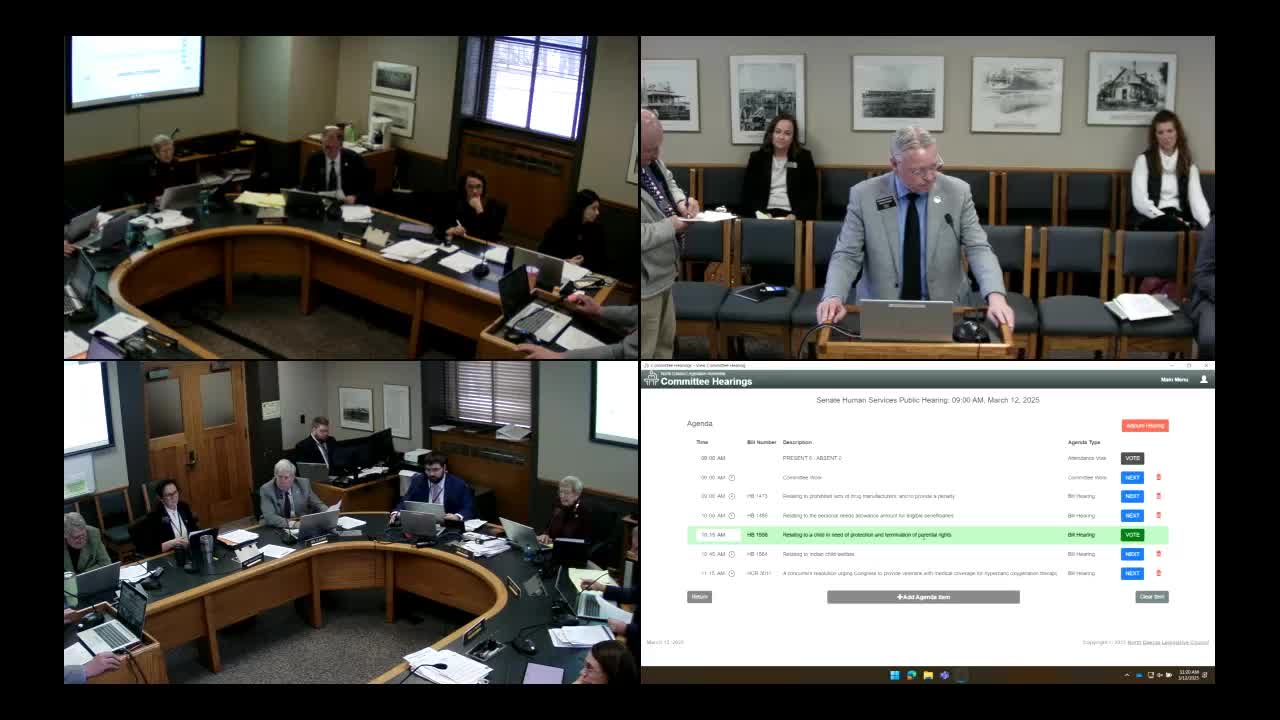
House Bill 1556 would expand the definition of "child in need of protection" to include children diagnosed with severe behavioral or mental‑health disorders who have committed violent acts and whose parents cannot provide control, supporters and agency counsel told the Senate Human Services Committee.
Representative Greg Steeman and Department of Health and Human Services counsel Jonathan Alm described House Bill 1556 as a narrow change to chapter 27.20.3 that would allow courts to place children with severe behavioral‑health conditions into temporary custody of a human service zone to receive care and to preserve the ability to pursue termination of parental rights where appropriate.
Alm told the committee the bill adds a new subdivision describing a child "who is in need of care and treatment," has been diagnosed with a severe mental‑health condition or behavioral disorder by a licensed child psychologist or psychiatrist, and has committed an act of violent or sexual nature against another family member in the household that would be a crime if committed by an adult. "All three elements described on page 2, lines 8 through 15, need to be present in order for this to be fitting underneath the definition," Alm said.
Supporters said the change would create a clearer legal pathway for families and courts to obtain services when a child’s behavior creates immediate safety concerns yet the family is not abandoning the child. Representative Steeman said courts and zones are already facing such situations and that the statutory language would let judges order disposition and treatment options aimed at preserving family connections where possible.
Several human‑services directors and juvenile‑justice and advocacy groups opposed the bill or urged caution. Rhonda Allery, director of Mountain Lakes Human Service Zone, said the proposed language risks routing children with delinquent or violent behavior into child‑protection proceedings rather than the juvenile‑delinquency system, where different processes, representation and placement resources exist. Brad Peterson of Protection & Advocacy said the measure could deprive children of due process rights afforded in delinquency proceedings and risks adding trauma by moving toward termination of parental rights when parents may still be seeking services.
Committee members probed whether the proposal would merely formalize current court practices or would shift responsibility from juvenile services and behavior‑health systems to child welfare. Committee members asked for data on the number of children who might meet the three‑part test and whether juvenile‑justice resources or additional placements exist for the children described in testimony.
The hearing ended without a committee vote; legislators and agency counsel said they expect further drafting and follow‑up on representation, placement options and fiscal and service capacity.