Get Full Government Meeting Transcripts, Videos, & Alerts Forever!
Get email alerts on the Prison Industries Credit topic
No spam. Unsubscribe anytime.
Committee advances tax credit to link Roughrider prison industries with private manufacturers
Summary
Senate Bill 2261 would create a small, capped income-tax credit to encourage private manufacturers to outsource components to Roughrider Industries, the Department of Corrections' prison industries program. Sponsors said it would keep 150'200 incarcerated workers busy and reduce recidivism; the committee voted to give the bill a "due pass," 10'
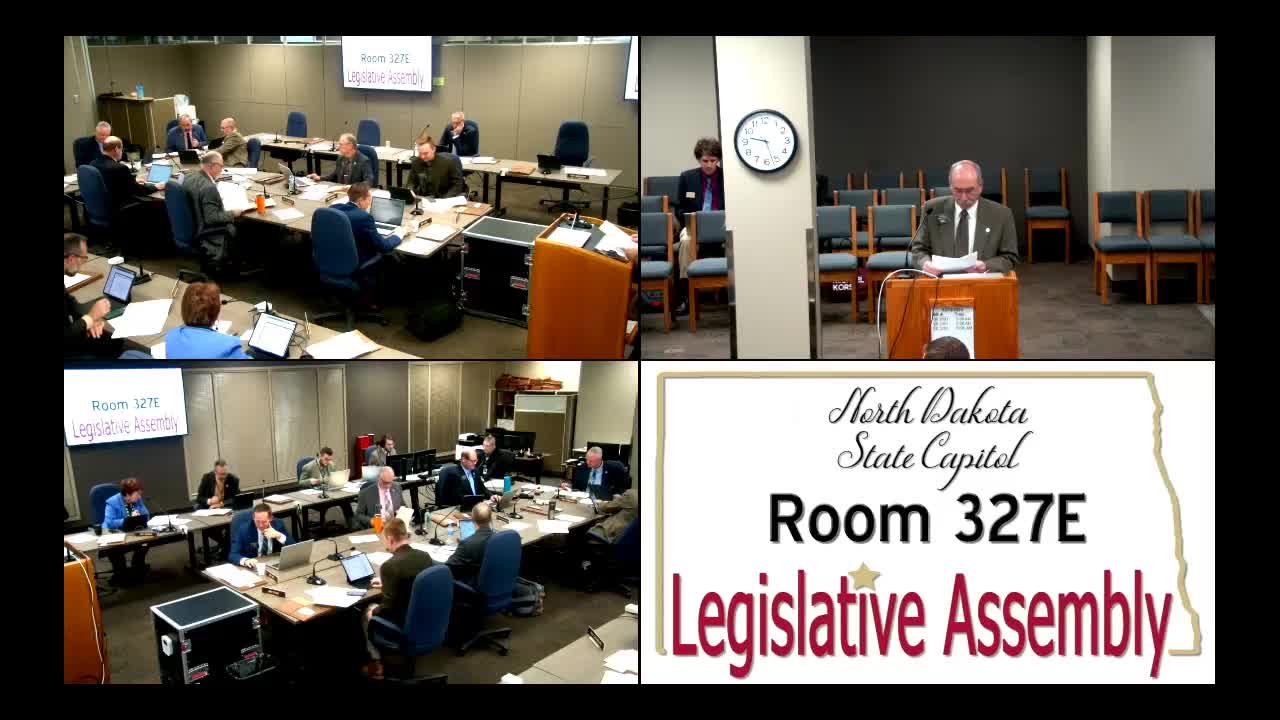
The Finance and Taxation Committee held a hearing on Senate Bill 2261, which would create a targeted income-tax credit to encourage private manufacturers to contract with Roughrider Industries, the Department of Corrections and Rehabilitation’s prison-industry operation.
Senator Jerry Klein, the bill sponsor (State Senator, District 14), described the proposal as an opportunity for North Dakota manufacturers to "work with Roughrider Industries" and said the program could help keep "anywhere from 150 to 200 folks busy." Klein said the bill was revised from its original form after stakeholder feedback and that the program is intended to avoid competition with private manufacturers while using Roughrider as a labor pool.
Why it matters: Proponents said Roughrider provides job training that lowers recidivism and that a small tax incentive could help private manufacturers outsource discrete components (for example, drawers or parts) to the prison workforce. The bill includes a statewide cap and a low fiscal exposure intended to keep the program administrable.
Key details and support: Andrea Fenigan of the Greater North Dakota Chamber testified the state’s manufacturers employ over 27,000 workers with average wages near $75,000 and said the credit could be a tool to connect employers with a talent pool. Fenigan and other witnesses described the credit as modeled on an existing automation tax credit: a percent-based credit (testimony described a 10% credit in committee) on qualifying payments, subject to a statewide cap of $45,000 per year. Senator Klein said he set the fiscal note below $50,000 on the Senate side; he told the committee the bill’s fiscal note was roughly $49,000.
Administration and fiscal mechanics: Matt Perot (Office of the State Tax Commissioner) said he worked with the sponsor to make the program administrable but warned that a statewide cap "kinda cuts both ways" because a prorated cap may reduce the benefit if demand exceeds the cap. He explained that if the cap is reached, participating taxpayers would see their available credit prorated downward.
Committee action: Representative Haggart moved a due-pass recommendation on SB 2261; Representative Olson seconded. The committee took a roll-call vote and recorded the following votes as read into the record during roll call: Chairman Hedlund (Yes), Vice Chair Hager (Yes), Representative Anderson (Yes), Representative Doctor (Yes), Representative Dressler (Yes), Representative Machtenbacher (Yes), Representative Nehring (Yes), Representative Olson (Yes), Representative Steiner (No), Representative Toman (No), Representative Foss (Yes), Representative Vista (Yes). The motion carried: "The due pass is carried" with a reported tally of 10 yes, 2 no, 2 absent.
Discussion and concerns: Representative Steiner opposed the motion and said the capped amount ($45,000) was too small and that the bill had drifted from its original intent. Other members supported the motion as a way to test interest and collect data on public-private partnerships with Roughrider.
Ending: The committee approved a due-pass recommendation as amended and the bill will move forward with a House carrier assigned. Supporters said they expect further work on the bill in subsequent steps.