Get Full Government Meeting Transcripts, Videos, & Alerts Forever!
Get email alerts on the Healthcare Pharmaceuticals 340B topic
No spam. Unsubscribe anytime.
Senate committee hears bill to block drug makers' limits on 340B contract pharmacies
Summary
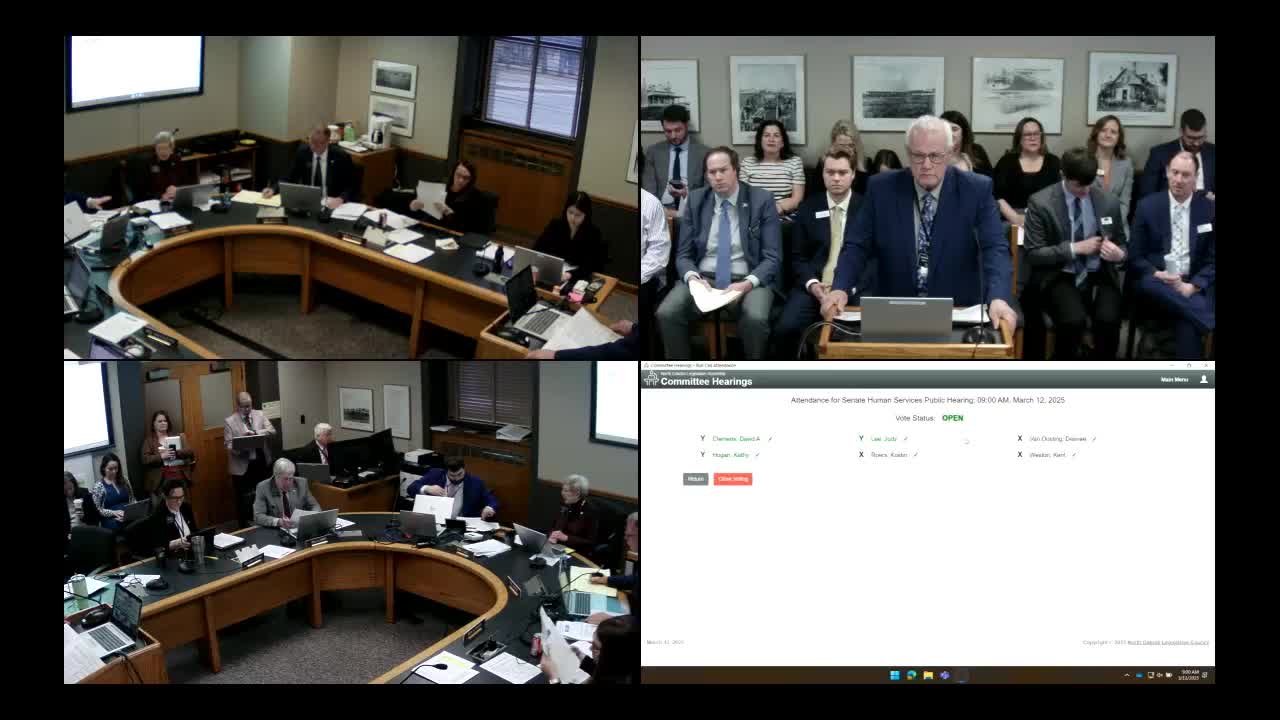
Representative John Nelson introduced House Bill 1473 to the Senate Human Services Committee, saying the bill would stop drug manufacturers from enforcing restrictions on participation in the federal 340B drug discount program.
Representative John Nelson, sponsor of House Bill 1473, told the Senate Human Services Committee the bill would stop drug manufacturers from imposing unilateral restrictions on how covered entities participate in the federal 340B drug discount program.
The bill, Nelson said at a committee hearing, "helps stop drug manufacturers from implementing their own requirements and mandates on a federally run program called the 340B program," which he described as critical to sustaining rural health care and access in North Dakota.
Supporters — including the North Dakota Pharmacists Association, the North Dakota Hospital Association, Sanford Health, Heart of America Hospital in Rugby, and community health centers — said contract pharmacies and 340B savings fund services that would otherwise be at risk in small and rural communities. Mike Schwab of the North Dakota Pharmacists Association summarized the program’s purpose: 340B enables certain covered entities to buy outpatient drugs at discounted prices and reinvest the savings in care for low‑income, uninsured and underinsured patients. Eric Christiansen, CEO of Heart of America in Rugby, described local uses of 340B revenue including subsidizing emergency medical services and charity care, and said without 340B his hospital would “be running in the red.” Jesse Breidenbach, vice president of pharmacy services at Sanford, told the committee the program is subject to HRSA recertification and audits and that covered entities maintain policies and documentation to meet federal requirements.
Opponents — including pharmaceutical manufacturers' lobbyists, GSK, PhRMA and several policy groups — warned HB1473 would accelerate program growth and raise costs for employers, state health plans and patients. GSK’s Mark Howell said the 340B program was created to benefit vulnerable patients but lacks federal guardrails requiring discounts be passed directly to patients. A PhRMA representative and others argued expanded contract pharmacy participation can shift manufacturer rebates out of employer and state benefit pools and cited fiscal studies claiming higher employer and state health-plan costs.
Committee members pressed witnesses on several technical points: whether 340B pricing increases outpatient drug charges at covered entities, how duplicate-discount safeguards operate between 340B and Medicaid, and whether state enforcement by the Board of Pharmacy (the bill would add prohibited-act language to statute and tie enforcement to existing penalty sections) is appropriate. Testimony cited federal actions and litigation: witnesses noted HRSA guidance allowing multiple contract pharmacies since 2010, and that courts in the Eighth Circuit have upheld state action to preserve program access; supporters pointed to a recent South Dakota law and an unsuccessful Supreme Court challenge in late 2024.
The hearing produced no vote. Committee staff and stakeholders noted areas for possible amendment, including reporting or transparency provisions, and the Board of Pharmacy said it could administer enforcement and reporting if the legislature directed it.
Votes at a glance: none taken; the bill was the subject of a hearing only.
Why it matters: HB1473 addresses a federal program that state hospitals and community health centers say underpins local services in rural North Dakota. Opponents say the bill could shift costs to insurers and employers without ensuring the discounts reach intended patients.
Next steps: The committee closed the hearing after testimony from supporters and opponents and did not take a final vote at that session.