Get Full Government Meeting Transcripts, Videos, & Alerts Forever!
Get email alerts on the Criminal Justice Habitual Offender topic
No spam. Unsubscribe anytime.
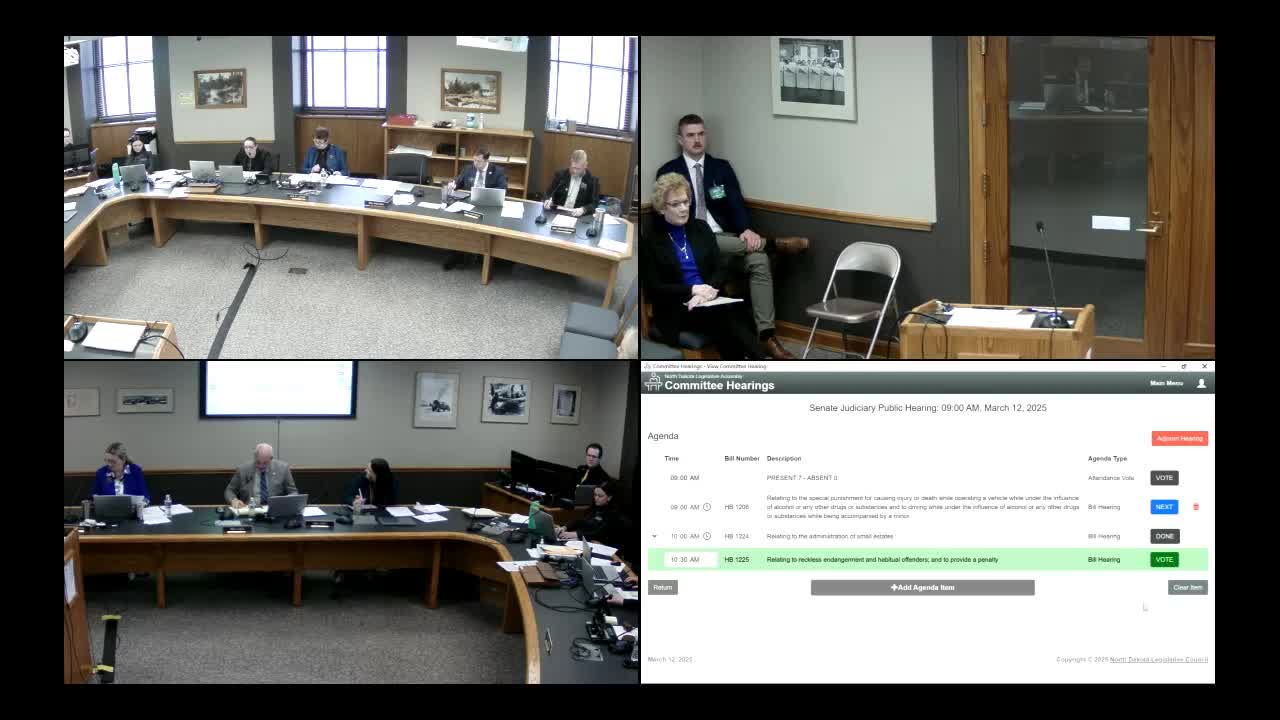
Committee approves amended bill raising penalties for firearm use in reckless endangerment and tightens habitual-offender standard
Summary
The Senate Judiciary Committee approved House Bill 1225 as amended to create a Class B felony when a firearm is used in reckless endangerment and to limit habitual-offender enhancements to prior felony convictions.
The Senate Judiciary Committee amended and gave a due-pass recommendation to House Bill 1225, which increases penalties for reckless endangerment when a firearm is used and adjusts habitual-offender enhancement language.
Ward County State's Attorney Rosa Larson introduced the bill on behalf of Representative Clamine and the North Dakota State's Attorneys Association. Larson said section 1 would add a Class B felony when a person uses a firearm in reckless endangerment and would retain Class C felony treatment in other circumstances. "You would think you could charge attempted murder, but actually attempted murder is an intentional act," Larson said, explaining why drive-by shootings and similar conduct can be charged as reckless endangerment where intent to kill a specific person is not provable.
Larson said the Class B felony recommendation follows case examples including a juvenile case where shots were fired through three apartments and prosecutors could not attach specific intent to an individual target. She also explained that if the enhancement to Class B is adopted, Department of Corrections and Rehabilitation (DOCR) guidance could yield longer mandatory terms: under a Class B felony the mandatory minimum is four years, whereas the Class C felony mandatory minimum is two years.
Travis Fink, executive director of the Commission on Legal Counsel for Indigence (the state agency responsible for public defense services), testified in opposition to parts of the bill as drafted. Fink said the commission did not oppose the bill's original goal to address drive-by shootings but raised two objections: (1) the house amendment that added "other dangerous weapon" could sweep ordinary motor-vehicle conduct into a Class B felony because North Dakota case law can treat a vehicle as a dangerous weapon; and (2) the habitual-offender provision as drafted would allow prior out-of-state convictions that are misdemeanors elsewhere (but carry more than 360 days) to count toward a North Dakota enhancement, raising due-process and full-faith-and-credit concerns.
Senator Myrtle offered an amendment that struck the "other dangerous weapon" language and replaced the habitual-offender language to require prior felony convictions (rather than convictions punishable by more than 360 days). The committee adopted the amendment on a voice vote.
After amendment, Senator Merdahl moved and the committee voted for a due-pass recommendation as amended; the committee referred the bill to the Appropriations Committee. The transcript shows the committee carried the motion with a majority of ayes recorded at the vote.
The testimony and floor discussion emphasized prosecutorial and defense concerns: prosecutors want a statutory vehicle to address drive-by shootings where specific intent to kill is difficult to prove; defense counsel raised procedural due-process and equal-treatment concerns if out-of-state misdemeanors were counted as felonies for enhancement purposes. DOCR's earlier fiscal estimates for the measure varied in the record (the transcript references a $13.6 million figure previously and a $2.5 million figure later) and witnesses said the fiscal impact depends on how many offenders would receive the longer mandatory sentences.