Get Full Government Meeting Transcripts, Videos, & Alerts Forever!
Get email alerts on the Probate Small Estates topic
No spam. Unsubscribe anytime.
Committee backs raising small-estate affidavit limit from $50,000 to $100,000
Summary
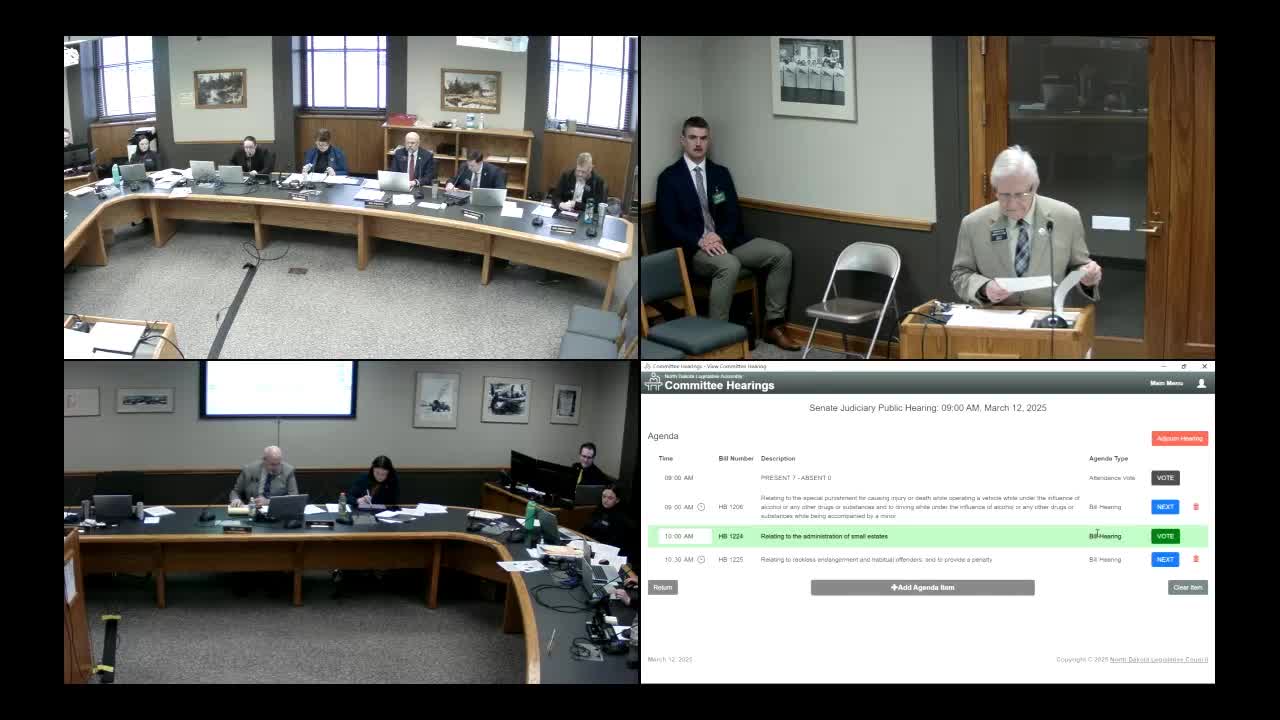
The Senate Judiciary Committee recommended a due-pass for House Bill 1224 to raise the small-estate affidavit limit from $50,000 to $100,000 under the Uniform Probate Code.
The Senate Judiciary Committee recommended a due-pass for House Bill 1224, which would raise the simplified small-estate affidavit threshold under the Uniform Probate Code from $50,000 to $100,000.
Representative Lawrence Clamine of District 47 in Bismarck presented the bill and described the small-estate affidavit procedure in North Dakota Century Code section 30.1-2301. "The affidavit must state that the value of the estate, wherever located, does not exceed $50,000 under current law," Clamine said, noting that the $50,000 limit has not been increased since 2005. He told the committee that, adjusted for inflation, $50,000 in 2005 equals more than $80,000 in 2025 and said $100,000 aligns North Dakota with neighboring states that use the Uniform Probate Code.
Clamine explained the summary procedure allows a successor to present an affidavit 30 days after death to an entity holding personal property (for example, a bank) and receive delivery without opening a probate case, and that the payor is discharged from liability after delivery under current law. Senators asked whether the threshold applies to cash only or to all personal property and whether estates exceeding the limit still must go through formal probate; Clamine answered it applies to all personal property and larger estates must be settled in district court.
Senator Lueck moved a due-pass recommendation; the roll call showed multiple "aye" votes and the motion carried with the majority present. Committee minutes note the vote was held open until the absent member returned, and the bill was assigned to Senator Cory for carryover. The committee transcript records the vote as at least 6–0 in favor at the time the vote was reported.
No opposition or neutral testimony was reported in the hearing. The sponsor said neighboring states (Idaho, Montana, Nebraska, South Dakota and Utah) use $100,000 thresholds and that a future legislature could revise the limit again when appropriate.
The bill now moves toward further consideration after the committee's due-pass recommendation.