Get Full Government Meeting Transcripts, Videos, & Alerts Forever!
Get email alerts on the Criminal Justice Dui topic
No spam. Unsubscribe anytime.
Senate Judiciary holds hearing on bill to fix sentencing language for enhanced DUI with minors
Summary
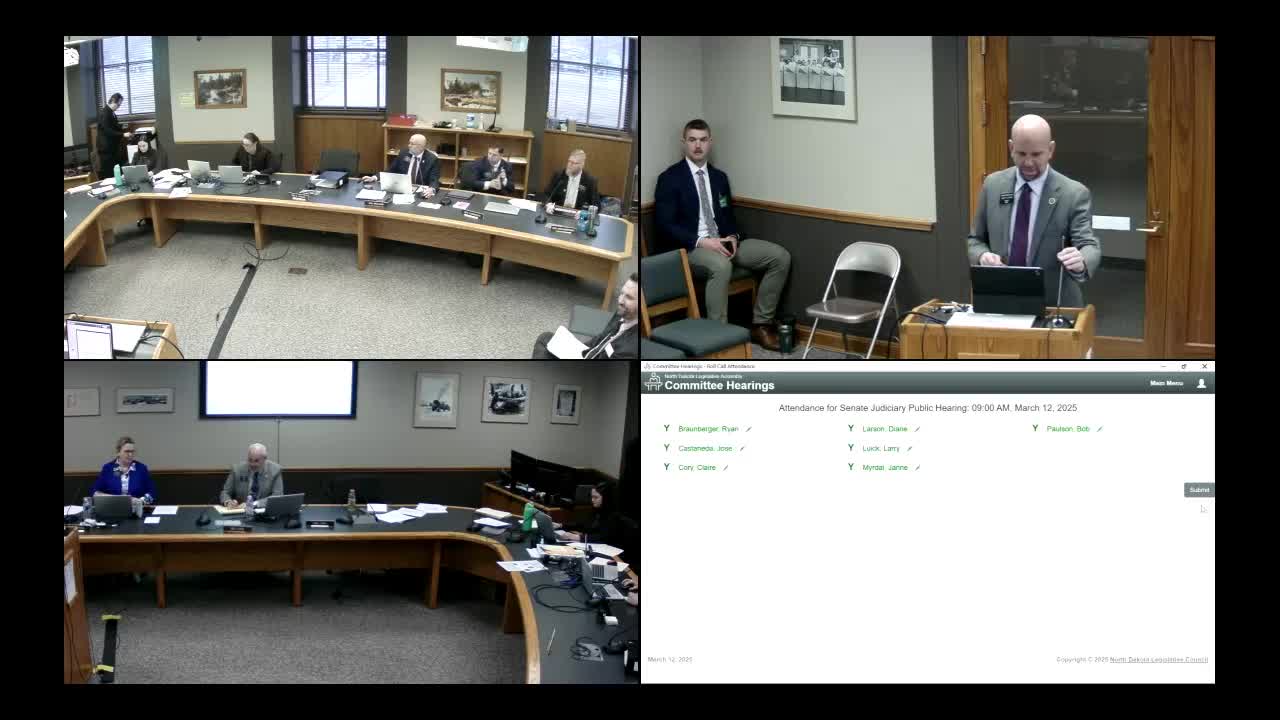
The Senate Judiciary Committee opened a hearing on House Bill 1206, which would clarify sentencing language for operating a vehicle while impaired with a minor in the vehicle.
The Senate Judiciary Committee opened a hearing on House Bill 1206, which amends penalties for operating a vehicle while impaired when a minor is in the vehicle, on the morning the bill was called.
Representative Scott Lauser of District 5 in Minot, the bill sponsor, told the committee the measure is intended to remove a cross-reference that could force a felony-level offense to be sentenced as a misdemeanor. "Clearly this is a felony," Lauser said, recounting a case he was given in which a parent three times the legal limit picked up children from school with two unrestrained minors in the back seat.
The bill would remove the cross-reference found on page 2, lines 19–21 of the current draft so the enhanced-offense provision stands on its own. Aaron Bursts of the North Dakota Association of Counties, who represented state's attorneys at the hearing, described section 1 as adding non-alcohol impairing substances to the statute and said section 2 is the substantive cleanup: "What Representative Lauser is suggesting is to amend out, on page 2, line 19 through 21. Just take that out so it's not a reference to the criminal penalties for a normal DUI," Bursts said.
Bursts and Lauser outlined the statutory scheme that underlies the bill: the first offense with a minor in the vehicle would carry a minimum two-day jail term under the proposal, and a third offense could be treated as a Class C felony with a "year and a day" prison sentence. Bursts noted law-enforcement and prosecution practice complications when other impairing drugs are involved: roadside oral-fluid tests can identify multiple substances but are voluntary in many cases, and blood testing after arrest can show substances present but "does not show impairment," Bursts said. He added that officers must connect observed impairment to substances found in testing.
No one testified in opposition or neutral; the committee closed the hearing on the bill without taking a vote.
The record shows committee members asked questions about testing for marijuana and whether drug-testing technology and evidentiary standards can reliably identify impairment, and witnesses said current blood tests can detect substances but not impairment itself. The bill as presented corrects cross-references in the sentencing text but does not change the structure of the enhanced penalties beyond clarifying which penalty table applies.
Committee action: hearing only; no motion or recorded vote at the time the hearing closed.
Background: Lauser said earlier attempts to attach similar language to another bill were stripped in conference because conferees considered it not germane, prompting the current standalone presentation. The Association of Counties and several state's attorneys had supported related language during the prior cycle.
No further proceedings were recorded on HB 1206 during this hearing.