Get Full Government Meeting Transcripts, Videos, & Alerts Forever!
Get email alerts on the Committee Roundup topic
No spam. Unsubscribe anytime.
Regulated Industries committee advances bills on water surcharges, crane safety, utility oversight, vaping limits and veterinary workforce
Summary
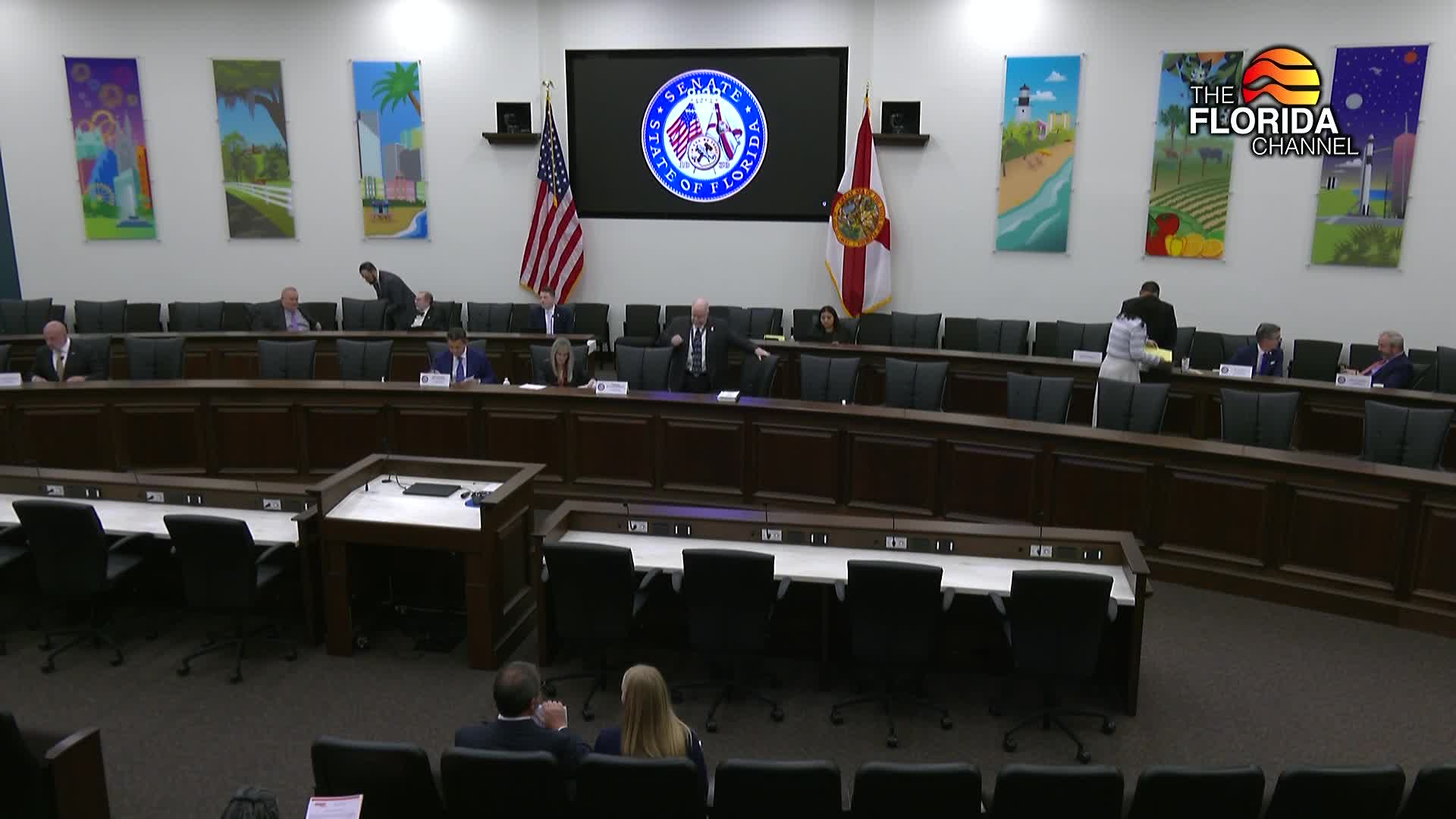
The Florida Senate Committee on Regulated Industries met in Tallahassee and on a series of bills the panel reported several measures favorably, advancing legislation that members and witnesses said touches municipal fairness, public safety, consumer protection and workforce shortages.
The Florida Senate Committee on Regulated Industries met in Tallahassee and on a series of bills the panel reported several measures favorably, advancing legislation that members and witnesses said touches municipal fairness, public safety, consumer protection and workforce shortages.
The committee voted to report favorably bills including SB 202 (municipal water surcharge fairness), SB 346 (repeal of state preemption on hoisting equipment), SB 354 (changes to Public Service Commission rules and oversight), SB 652 (creates a veterinary professional associate classification), SB 928 (restrictions on non‑approved disposable nicotine dispensing devices) and several contractor and hospitality bills. Committee members and outside speakers debated costs and local control, public safety in storms after last year’s crane collapse, ratepayer protections and measures meant to improve access to veterinary services and shelter operations.
Why it matters: the packages affect everyday costs and local authority across Florida — from how residents near a water plant are billed, to whether counties and cities can adopt crane rules in an emergency, to how utility rates and large storm‑hardening plans are reviewed. Witnesses framed the bills as either correcting an unfair local practice (SB 202), closing a public‑safety gap exposed by last year’s crane collapse (SB 346), or reining in what consumer advocates describe as excessive utility returns and opaque rate decisions (SB 354). Other measures aim to limit youth exposure to single‑use disposable vaping devices (SB 928) and expand the veterinary workforce to help animal shelters and low‑cost care (SB 652).
Municipal utility rates and SB 202
Senate Bill 202, sponsored by Senator Jason Jones, was presented as targeted relief for residents of Miami Gardens who pay a surcharge tied to a water treatment plant located in another municipality. Jones said the bill "requires that the municipality operating the plant charge the residents where the plant sits the same rate it charges its residents." Representative Felicia Robinson, testifying as a Miami Gardens resident and former city councilmember, urged the committee to back the measure, saying the bill "does not say get rid of the surcharge. The bill actually says to charge the same fee that you're charging your residence."
Mario Diaz, city manager for North Miami Beach, opposed the bill and said it "forces residents of service providing cities like North Miami Beach to subsidize services for non residents effectively double taxing our residents" and warned of large ongoing expenditures: "North Miami Beach has over $27,000,000 in active projects and maintenance" and that the city had covered "a $4,000,000 shortfall within the water fund." Members asked about prior litigation and a 2017 settlement; Senator Jones referenced a roughly $9,000,000 settlement tied to earlier litigation over the matter.
The committee voted to report SB 202 favorably (reported favorably).
Hoisting equipment and local control: SB 346
Senate Bill 346, presented by Senator Russon, seeks to repeal the statewide preemption of local rules governing hoisting equipment (tower cranes and other cranes). Russon said the change was prompted by last year’s crane collapse in the Tampa Bay area and argued local jurisdictions “require the flexibility to enforce safety measures that address unique regional risks associated with hoisting equipment during severe weather events.”
Opponents, including Carol Bowen of Associated Builders and Contractors, cautioned against a patchwork of local rules, arguing the construction industry benefits from consistent statewide standards and that local building departments already have many inspection powers on job sites. Bowen said local regulation is permitted in many respects and warned repeal could invite inconsistent rules across Florida’s 67 counties and 411 municipalities.
Supporters urged a narrowly tailored approach focused on preparedness before storms. Several senators said they supported further work to reconcile uniform standards with the need to address emergencies quickly.
The committee reported SB 346 favorably.
Public Service Commission oversight: SB 354
Senate Bill 354, a strike‑all substitute presented by Senator Gaetz, would make multiple changes to the Public Service Commission (PSC) process: expand the commission from five to seven members, statutorily designate specific financial expertise (a licensed CPA and a chartered financial analyst), require more explicit factual findings and reasoned explanations when the PSC approves settlements or rate changes, require a schedule for when utilities may submit rate filings and require PSC orders to document cost/benefit logic for storm‑hardening plans.
Consumer advocates and AARP speakers urged stronger PSC oversight. Bill Herman, who described himself as having extensive utility experience, said adding finance expertise to the commission "will give them the tools they need to cut through the fog of an income statement" and urged a favorable report. AARP testimony highlighted concerns about high returns on equity for investor‑owned utilities and rising customer bills. Utilities and some trade groups did not have extended testimony in committee; proponents framed the bill as an accountability and transparency measure.
The committee adopted the substitute and reported SB 354 favorably.
Vaping devices and youth access: CS/SB 928
Senate Bill 928, as amended in committee, targets the sale, display and promotion of non‑approved disposable nicotine products and establishes buffer rules for smoke shops near K‑12 schools. The amendment added a 500‑foot prohibition on new smoke shops opening near K‑12 schools, grandfather language for existing shops and clarified enforcement funding flows.
Senator Kalatiud and Senator Collado discussed the language and the amendment; Susan testimony from Kelly Mallette of the Florida Smoke‑Free Association said the aim is to “change the environment” around disposable vapes so they are not visually enticing to young people. The committee adopted the amendment and reported the committee substitute favorably.
Veterinary workforce: SB 652
SB 652, the Veterinary Workforce Innovation Act presented by Chair Bradley, would create a new credential — veterinary professional associate (VPA) — for individuals with an approved master’s program and national competency testing. The bill limits the surgical procedures VPAs may perform (spay/neuter and procedures not entering a body cavity), requires supervision by a licensed Florida veterinarian and makes supervising veterinarians liable for acts of their VPAs. Proponents including Wayne Jensen (a veterinarian involved in program creation) and Amy Caritenuto (Florida Animal Protection and Advocacy Association) said VPAs would expand access to routine care and help shelters; some practicing veterinarians expressed concern about training and scope.
The committee adopted a technical amendment clarifying the allowed surgical procedures and reported SB 652 favorably.
Other contractor and hospitality bills
The committee also reported favorably several other bills with relatively brief presentations and little debate, including SB 578 (wine container/recyclable inserts parity with beer), SB 606 (clarifying removal and criminal penalty provisions for non‑paying guests at public lodging establishments), and SB 570 (updates to swimming pool and spa contractor scope of work and terminology).
Votes at a glance
- SB 578 (Leake) — Wine containers: reported favorably (roll call: unanimous yes on committee roll call as recorded). - SB 606 (Leake) — Public lodging/checkout and nonpaying guests: reported favorably (unanimous yes as recorded). - SB 202 (Jones) — Municipal water surcharge fairness (Miami Gardens / North Miami Beach): reported favorably (committee recorded one no). - SB 570 (Gruters) — Pool and spa contractor scope: reported favorably (unanimous yes as recorded). - CS/SB 928 (Kalatiud, as amended) — Nonapproved disposable nicotine dispensing devices; smoke‑shop buffers near K‑12 schools: committee substitute reported favorably (unanimous yes as recorded). - SB 346 (Russon) — Repeal of state preemption for hoisting equipment: reported favorably (unanimous yes as recorded). - SB 652 (Bradley) — Veterinary professional associates (VPAs): reported favorably (unanimous yes as recorded). - CS/SB 354 (Gaetz, strike‑all substitute) — Public Service Commission reforms and nonprofit water utility oversight: committee substitute reported favorably (recorded with one no).
Discussion vs. decisions
Much of the committee’s debate was procedural and focused on statutory language and local impacts. The committee distinguished between discussion (questions to staff and witnesses about scope, funding, and unintended consequences), direction (requests that sponsors and stake‑holders continue negotiations and tighten language) and formal action (the committee’s votes to report bills favorably). Several sponsors accepted amendments or technical fixes during the hearing.
What’s next
Reported bills move to the next stage of the legislative process. Sponsors and stakeholders indicated intent to continue negotiations on technical language where concerns remain (notably for SB 202, SB 346 and SB 354). Several senators requested additional information or follow‑up from agencies and utilities prior to potential floor action.
Quotes (selected)
"It forces residents of service providing cities like North Miami Beach to subsidize services for non residents effectively double taxing our residents," — Mario Diaz, City Manager, North Miami Beach.
"The bill simply asks that for those 2 cities for them to be able to be charged the same amount," — Representative Felicia Robinson (speaking as a Miami Gardens resident and former councilmember).
"Adding a certified public accountant and an individual with expertise in finance to the public service commission will give them the tools they need to cut through the fog of an income statement," — Bill Herman (citizen witness, utility experience).
Ending
Committee members generally signaled willingness to move measures while reserving the right to refine statutory language. Several senators emphasized follow‑up work to align statewide uniformity with local emergency preparedness and to ensure consumer protections where significant ratepayer costs or public safety risks are implicated.