Get Full Government Meeting Transcripts, Videos, & Alerts Forever!
Get email alerts on the Digital Forensics Funding topic
No spam. Unsubscribe anytime.
Committee approves fee to fund digital forensic exams for internet-crime investigations
Summary
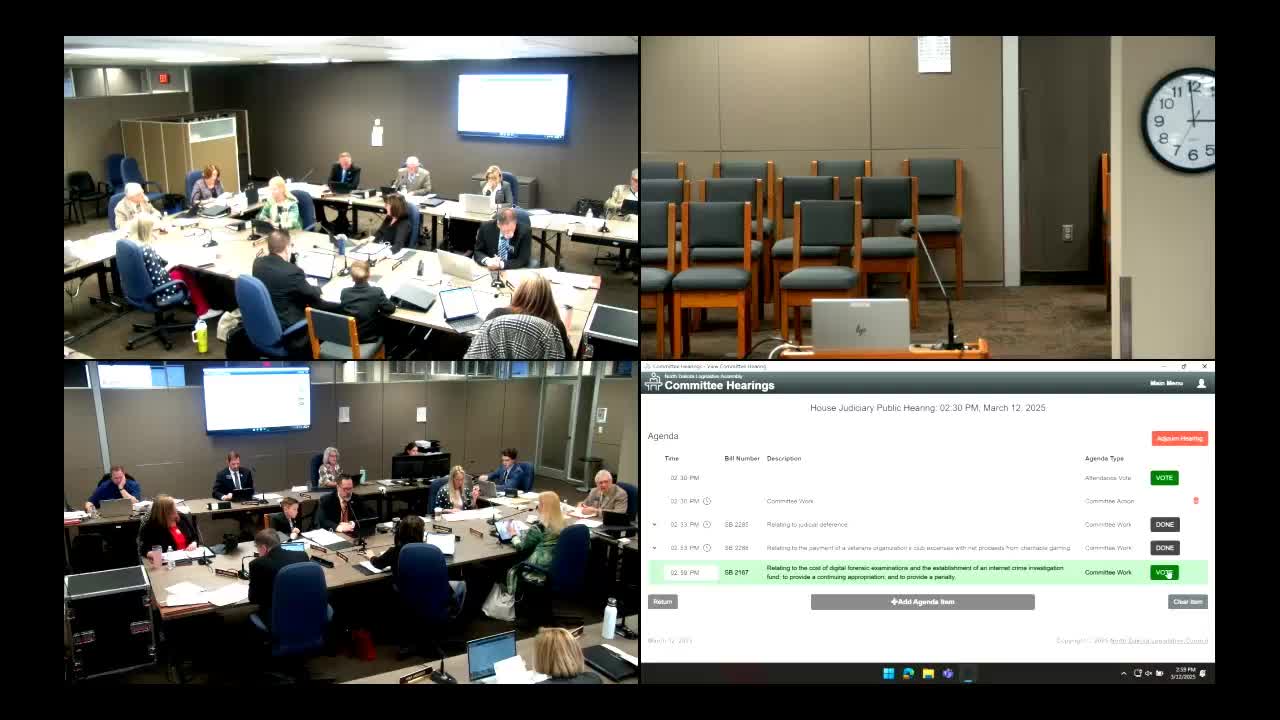
The committee voted 13-0 (one absent) to recommend passage of Senate Bill 2167, creating a maximum $100 defendant fee to fund digital forensic examinations for internet-crime investigations, with funds directed to an Internet Crimes Investigation Fund for technology-facilitated child exploitation and related investigations.
The House Judiciary Committee voted 13-0, with one member absent, to recommend passage of Senate Bill 2167, establishing a fee to support digital forensic examinations used in certain criminal investigations.
Under the bill, courts could assess a maximum $100 fee on defendants to support a fund for digital forensic services. Representative Better summarized the proposal during committee discussion: the fee would apply when digital forensic services were used in an investigation and would be collected to support an Internet Crimes Investigation Fund.
Committee members discussed how much revenue the fee might generate. Witnesses and presenters referred to data points from 2023, stating roughly 21,000 defendants were charged in 2023 and that, historically, about 62% of assessed court fees are paid and between 50% and 80% of cases used digital forensic services. Committee members clarified those numbers were general estimates and not a precise projection for this specific fee. "The numbers we had in testimony, 21,000 defendants in 2023... 62 percent of the defendants actually pay the fees... and then between 50-80% had digital forensics used," a committee speaker summarized.
Committee members also described the purpose of the fund. The money would be used for investigations concerned with technology-facilitated child exploitation and internet crimes against children; agencies could apply for money from the fund to support those investigations.
Supporters noted the fee is a maximum and could be set lower. Representative Wolff said he was "fine with this fee," noting that it would sometimes be applied to defendants who are uncooperative with investigations and that a $100 maximum was acceptable in those circumstances.
The committee approved a motion for a "do pass" recommendation; the roll call showed the motion carried 13-0 with one absent. Representative Christiansen volunteered to carry the bill.
Ending: The committee advanced SB 2167 to fund digital forensics related to internet-crime investigations; fiscal estimates were discussed but presenters characterized the revenue figures as approximate.