Get Full Government Meeting Transcripts, Videos, & Alerts Forever!
Get email alerts on the Healthcare Civil Rights topic
No spam. Unsubscribe anytime.
AG designee briefs commission on Section 504 litigation and health-care civil-rights duties
Summary
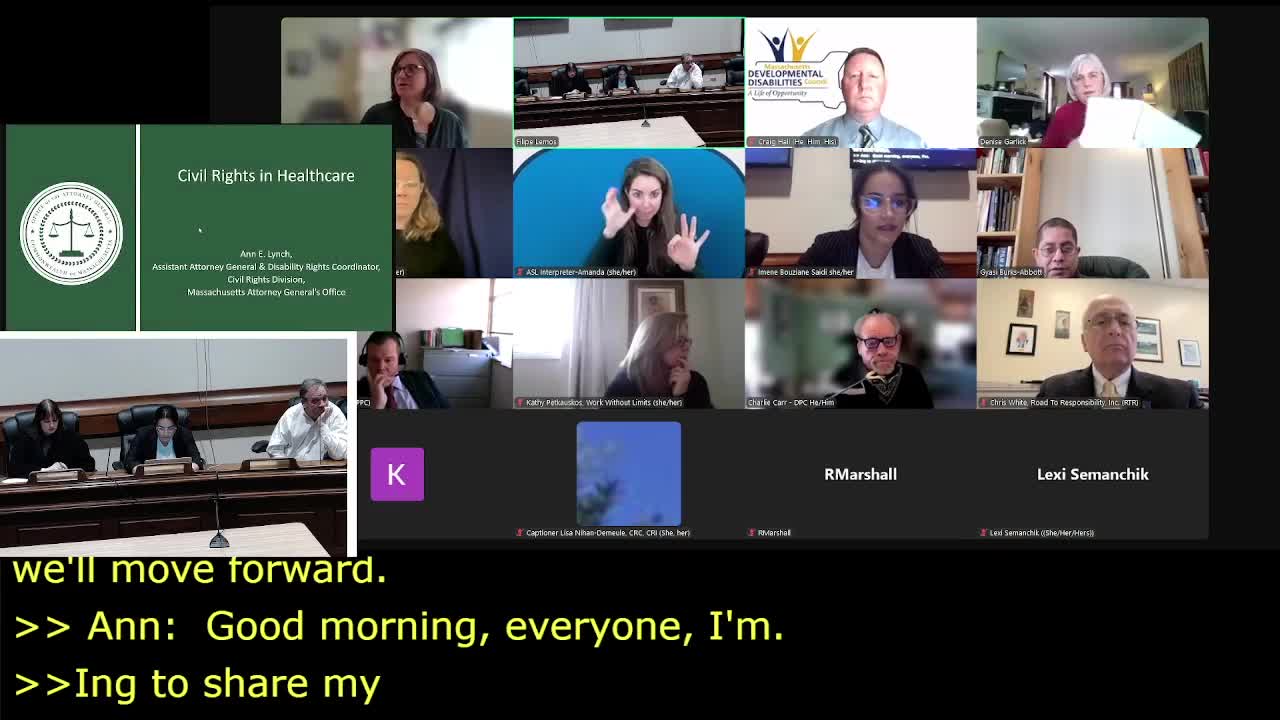
Anne Lynch, assistant attorney general and the Massachusetts Attorney General—s disability rights coordinator, told the Permanent Commission on the Status of People with Disabilities on March 12 that litigation challenging recent Section 504 rulemaking is underway and that health-care providers must continue to meet federal and state civil-rights obligations.
Anne Lynch, assistant attorney general and the Massachusetts Attorney General—s disability rights coordinator, told the Permanent Commission on the Status of People with Disabilities on March 12 that litigation challenging recent Section 504 rulemaking is underway and that health-care providers must continue to meet federal and state civil-rights obligations.
Lynch said the case, long known as Texas v. Becerra and now filed as Texas v. Kennedy after the HHS appointment, was brought in September 2024 by 17 states and challenges HHS—s May 2024 Section 504 regulations. The states— complaint, she said, contests multiple provisions of the rule and argues some regulatory language exceeds statutory authority.
The dispute matters to patients and providers because the May 2024 rules added or clarified requirements the attorney general—s office says apply in health-care settings: digital accessibility for websites and apps, accessibility for newly purchased medical diagnostic equipment, maintenance of accessible features, allowances for service animals, and requirements to provide auxiliary aids and services for effective communication.
Lynch noted one contested item is the Fourth Circuit—s recognition, in a recent ruling, that gender dysphoria can be a disability under certain circumstances; the states bringing the suit say that characterization contradicts language in the 1973 Rehabilitation Act. "I will say the terminology used and the grouping of these conditions are very reflective of the time in which the statute was passed," Lynch told commissioners. She quoted statutory language the challengers cited and said the litigation also presses constitutional spending-clause arguments.
The attorney general—s office also highlighted Olmstead v. L.C., the Supreme Court decision addressing unjustified institutional isolation, which Lynch said underlies parts of the states— challenge to the regulation—s community-integration language.
Lynch reviewed what the civil-rights laws mean in practice for Massachusetts health-care settings. She said Section 504 applies where federal funds (for example, Medicaid and Medicare) support a facility; the Americans with Disabilities Act covers public (Title II) and private (Title III) health-care entities; and Massachusetts public-accommodations law independently bars disability-based distinctions in treatment.
The presentation outlined specific provider duties cited by Lynch: pursue readily achievable barrier removal in older facilities, comply with building-code accessibility requirements when remodeling, and meet medical-equipment accessibility rules. Lynch said the federal government—s August 2024 rule requires that certain public facilities have at least one accessible exam table and an accessible scale by August 2026 and that facilities may not deny care or require patients to bring a companion because of inaccessible equipment.
Lynch emphasized reasonable accommodation and effective communication obligations: examples include scheduling earlier, quieter appointments for patients with sensory or anxiety needs, providing qualified sign-language interpreters for scheduled visits, offering large-print materials or reading forms aloud, and ensuring digital patient portals are accessible. She also discussed language-access duties under Title VI of the Civil Rights Act and Section 1557 of the Affordable Care Act and cited a Massachusetts law requiring competent interpreter services for certain acute-care settings.
Lynch said the Attorney General—s Office has published several guidance documents since January, including general guidance for service providers and two documents aimed at health-care settings that address immigration-enforcement encounters and emphasize patient privacy and limited information-sharing consistent with HIPAA. Her office recommends training staff, designating a point person to handle immigration-enforcement interactions, and establishing private areas where enforcement personnel should not enter without a valid judicial warrant.
Commission chair Denise Garlick thanked Lynch and opened a question period. Commissioner Charlie Carr, speaking as a person with a significant disability, asked what recourse is available when hospitals and clinics fail to meet accessibility obligations. Lynch said individuals can try to resolve issues directly with providers, raise complaints with HHS—s Office for Civil Rights, file complaints with the Massachusetts Attorney General—s Office, or bring claims to the Massachusetts Commission Against Discrimination (MCAD), and she reiterated that her presentation did not constitute legal advice.
Lynch concluded by noting the Attorney General—s Office is closely monitoring the Section 504 litigation and is prepared to act to defend civil rights in Massachusetts.
The Attorney General—s health-care guidance documents and the AG—s civil-rights hotline are available on the office—s website, Lynch said. Commissioners were advised to contact Lynch or the office for copies and further assistance.