Get Full Government Meeting Transcripts, Videos, & Alerts Forever!
Get email alerts on the Community Incidents topic
No spam. Unsubscribe anytime.
Western Massachusetts leaders report rise in antisemitic incidents in schools and public spaces, ask for teacher training and security support
Summary
Religious and community leaders from the Berkshires and the Upper Valley told the commission of online targeting, protests outside a Jewish-owned coffee shop, a school lockdown after a student manifesto with antisemitic threats, and repeated vandalism; witnesses urged statewide resources for educators and security funding.
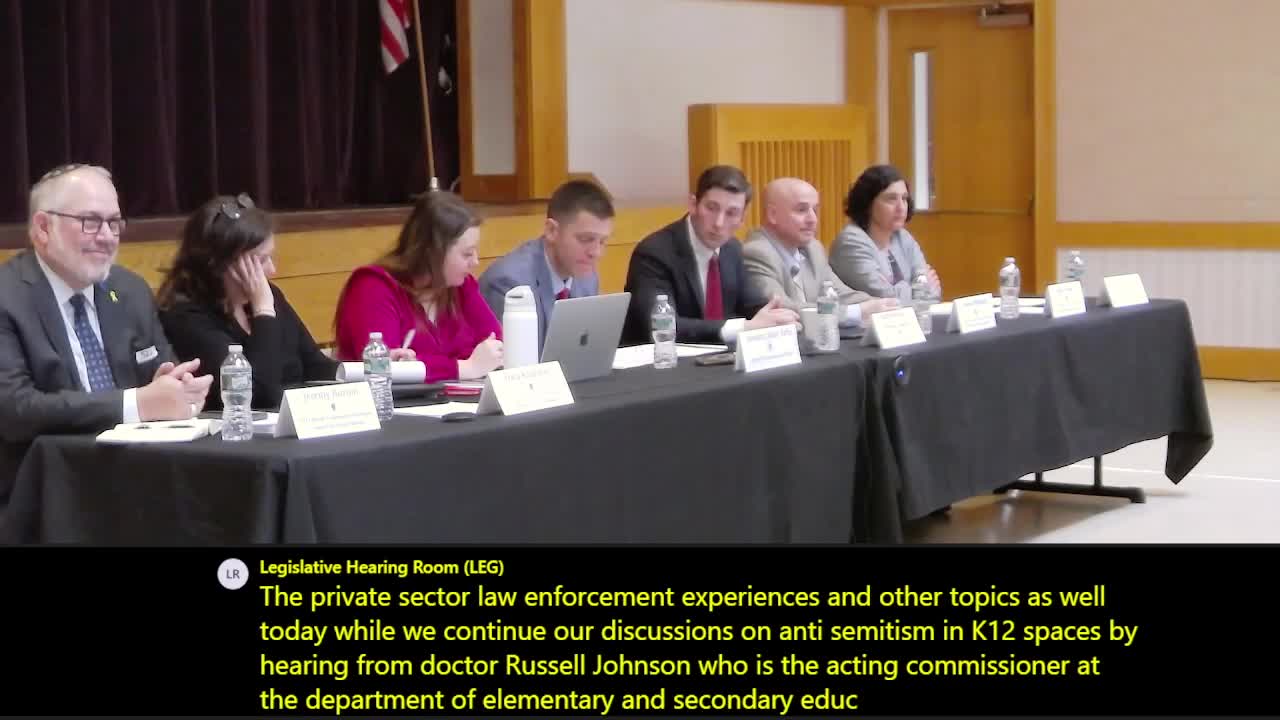
Religious leaders, community federation officials and educators from Western Massachusetts told the Special Commission that local Jewish communities are experiencing a rise in antisemitic incidents in schools, businesses and public life and urged more statewide resources for education and security.
Rabbi Jody Gordon of the Hebra of Southern Berkshire described three local episodes: the online circulation of a photograph of a Jewish minor used to promote demonstrations, a June 2024 protest outside Fuel coffee shop in Great Barrington that carried posters naming Jewish owners and accusing them of funding genocide, and a February 2025 school lockdown after a 16‑page manifesto with antisemitic and anti‑LGBTQ content was circulated in a regional district. “In small communities...incidents when they happen are automatic illustrate a little bit about what it looks like,” Gordon said.
Rabbi Amy Walt of Temple Beth El said teachers and students have left schools because they felt the environment was hostile. Walt argued Holocaust instruction alone has not protected students and urged curricula that teach the “particularity” of antisemitism alongside broader lessons on hate. She said professional development and deeper subject-matter knowledge for teachers are required to help students “wrestle with complicated issues.”
Marla Parr, first vice president of the Jewish Federation of Western Massachusetts, described a continuing series of vandalism and threats across the region and summarized work to increase physical security at synagogues and Jewish institutions. The federation has engaged a security expert to perform threat and vulnerability assessments and to coordinate with local and state police, Parr said.
Henny (Hania) Lewin, a Holocaust survivor who has given testimony for decades, recounted her family’s experience in Lithuania under Nazi occupation and said she uses her talks to urge bystander intervention. “If you hear somebody being bullied, don't say, ‘oh, it has nothing to do with me, and walk away,’” Lewin told commissioners.
Rabbi Ariela Rosen, interim lead rabbi at Congregation B’nai Israel in Northampton, asked the commission to avoid adopting a single codified definition of antisemitism and to prioritize education, free‑speech protections and tools for teachers and students to distinguish legitimate protest from targeted intimidation. “Don’t be naive, don’t be brutal,” Rosen said, summarizing a theme from Jewish tradition she urged the commission to hold in balance.
Springfield educator Dr. Nicole Collins, who teaches grades 5–8 and at the community-college level, described classroom conversations that reflect both ignorance and, in other contexts, deeply politicized hostility. Collins recommended involving teachers in curriculum selection and providing teacher training that recognizes the time and capacity constraints on K–12 educators.
Witnesses pressed commissioners to include interfaith clergy in school‑district outreach, to require schools to notify local Jewish leaders after incidents and to fund both teacher professional development and security upgrades at Jewish facilities. Several speakers also described community responses that ranged from public condemnation to claims of free speech and urged the commission to recommend concrete state supports for districts and small communities.
Ending: Witnesses asked that the commission’s final recommendations reflect the range of Jewish experiences across urban, suburban and rural districts and prioritize practical supports for educators, the provision of vetted curricular materials and funding for security and threat assessments.