Get Full Government Meeting Transcripts, Videos, & Alerts Forever!
Get email alerts on the Education Antisemitism topic
No spam. Unsubscribe anytime.
DESE outlines web resources, rubric and grant tracking to expand Holocaust and antisemitism education
Summary
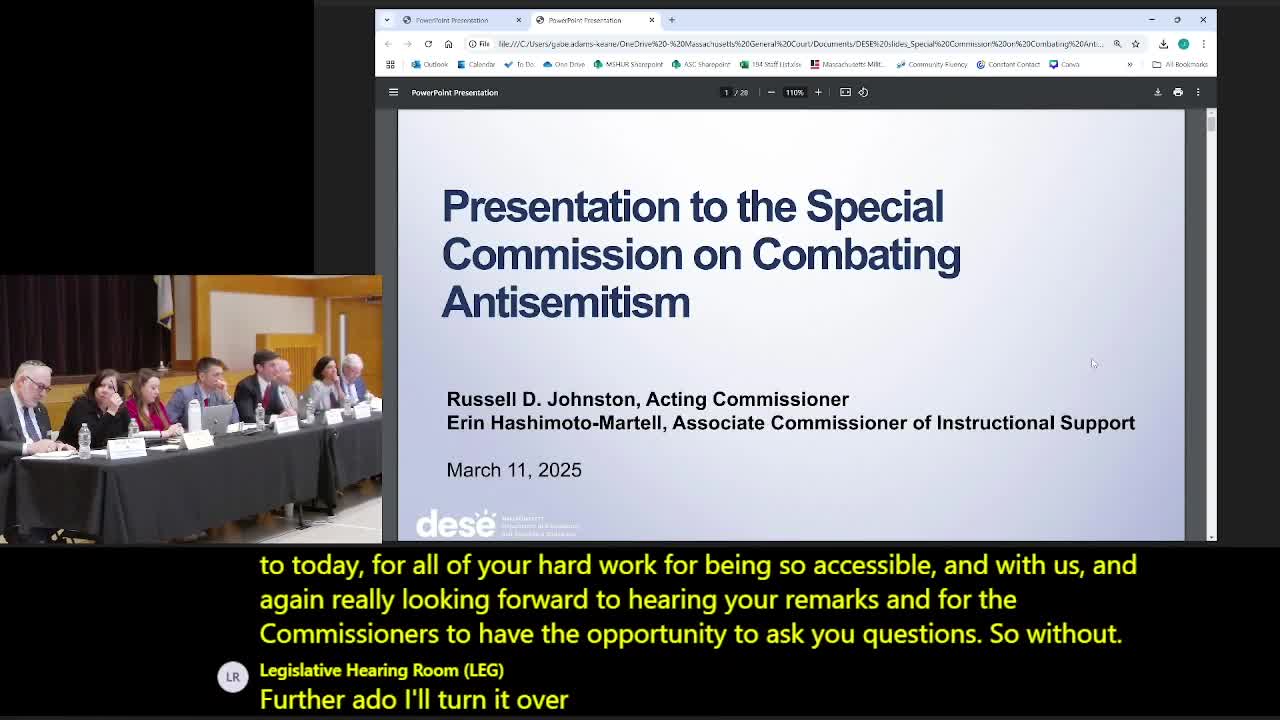
Acting Commissioner Russell Johnson of the Massachusetts Department of Elementary and Secondary Education told the Special Commission on Combating Antisemitism that the department has consolidated guidance and is preparing a rubric and additional supports for districts teaching about antisemitism and genocide.
Acting Commissioner Russell Johnson of the Massachusetts Department of Elementary and Secondary Education told the Special Commission on Combating Antisemitism that the department has consolidated guidance and is preparing a rubric and additional supports for districts teaching about antisemitism and genocide.
Johnson said the department has created a single web page gathering existing guidance and is developing a rubric to help districts evaluate curriculum materials and related professional development. “We have a strong foundation upon which we can build even more efforts related to antisemitism,” Johnson said.
The department framed the work as two phases. Phase 1 grouped existing federal and state guidance, curriculum-framework references and the agency’s Safe and Supportive Schools tools on a new web page. Phase 2 will publish a draft rubric for public comment this spring; the department plans to analyze feedback over the summer and post a final rubric for districts to use when selecting curriculum or professional development vendors.
Erin Hashimoto Martel, Associate Commissioner for the Center for Instructional Support, described how DESE is aligning the rubric with the agency’s curriculum frameworks and its broader strategic priorities for whole-child supports, deeper learning and educator development. “We are addressing this in two phases,” Hashimoto Martel said, summarizing the timeline for draft publication, public comment and revision.
Hashimoto Martel also reviewed the department’s work under the state law on genocide education. DESE has operated an annual genocide-education grant program that has awarded about $2.5 million in recent years. The department contracted MC2 Education to conduct a landscape analysis and early evaluation of grant-supported work; an initial representative-district survey found 76% of respondents reported offering at least one required course that covers genocide and that the Holocaust was the most-covered topic.
Johnson and Hashimoto Martel emphasized implementation limits and the agency’s role. DESE staff told commissioners that the department can publish guidance, vet materials through a rubric, monitor district practice and investigate complaints that fall within state or federal law. Johnson noted the state’s authority is primarily regulatory and grounded in statute; he said proactive supports and technical assistance are central to the department’s plan.
Commissioners pressed for detail about the data and enforcement. Staff acknowledged the department’s current visibility into district practice is strongest where districts request or receive grant funds, and in monitoring visits and complaint investigations. They said the evaluation will continue through additional focus groups and follow-up surveys, and that public feedback on the rubric will be used to refine the department’s recommendations and prioritized resources.
The department asked for public feedback and stakeholder participation as it finalizes the rubric and builds out vendor reviews and recommended materials. DESE officials said additional funding for professional development and curriculum adoption would make statewide implementation faster and more consistent.
DESE made its presentation to the commission and then took commissioners’ questions about Holocaust and genocide education, permitted curricula, complaint processes and the department’s authority to intervene when local materials or trainings are alleged to be discriminatory.
Ending: DESE officials said the draft rubric would be posted for public comment in the spring and that the department will continue the contracted evaluation of the genocide-education grants; they asked the commission and stakeholders to provide feedback, particularly about gaps and resources to support teacher training and high-quality curricular materials.