Get AI Briefings, Transcripts & Alerts on Local & National Government Meetings — Forever.
Committee hears bill to fund industrial symbiosis roadmap, $1.3 million for pilot assistance
Loading...
Summary
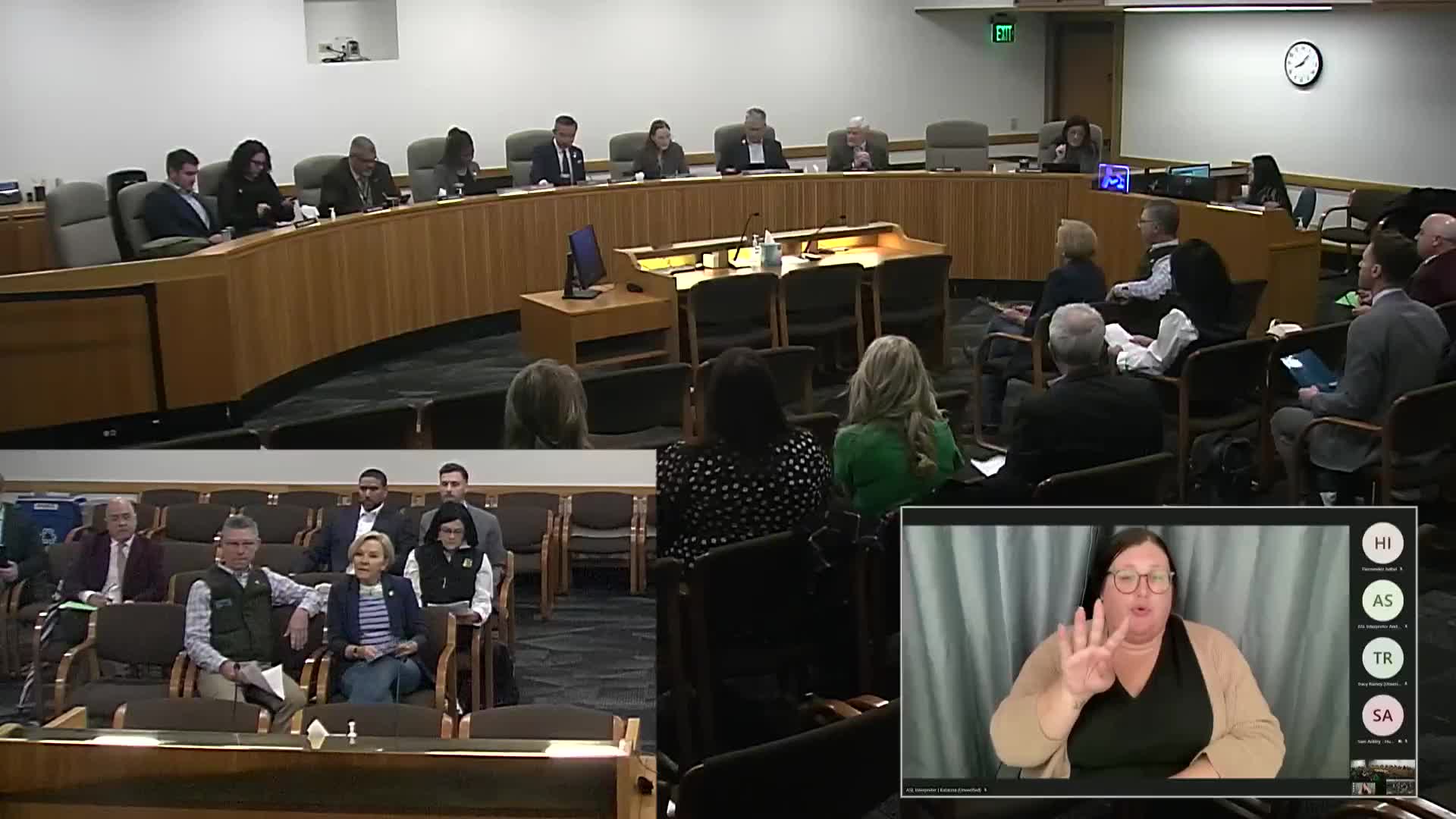
A House committee heard testimony March 12 on HB 3246, which would direct the Oregon Business Development Department to create an industrial symbiosis roadmap and fund technical assistance to up to six pilot communities under a $1.3 million dash-3 amendment.
The House Committee on Economic Development, Small Business and Trade opened a public hearing March 12 on House Bill 3246, which would direct the Oregon Business Development Department (Business Oregon) to develop an industrial symbiosis roadmap and — in a dash-3 amendment — establish a pilot technical-assistance program with an appropriation of $1,300,000.
Supporters told the committee the measure is voluntary and aimed at helping businesses, ports and municipal utilities analyze ways to turn byproducts and waste streams into productive inputs for other industries. "What the bill has two components: one is a report and roadmap on how industrial symbiosis can move forward in the state, and the second is a competitive grant process with a little bit of boost money behind that," said Representative Ken Helm, House District 27, one of the bill sponsors.
The dash-3 amendment expands the bill's definition and goals for industrial symbiosis, directs Business Oregon to run a pilot program offering technical assistance and sets selection criteria for pilots. Under the amendment, pilot communities would receive help with planning and design of symbiosis projects, convening community and industry meetings, and identifying infrastructure opportunities. Business Oregon is directed to select pilot communities that reflect geographic and industrial diversity, including at least one community east of the Cascade Range, one west of the range, at least one with food-processing industry presence, and at least one involving municipal water or wastewater operations.
"It's voluntary. There's no regulatory compunction here, there's no mandatory anything," said Representative Bobby Levy, House District 58, a bill co-sponsor. "We hope the incentives are just that, to incentivize good work."
Nonprofit, local-government and private-sector witnesses described existing projects and local plans they say could use early technical assistance. Rhys Roth, executive director of the Center for Sustainable Infrastructure, described study trips to Denmark and work in Washington state and told the committee that small early investments can help communities design projects that produce co‑products such as renewable natural gas, fertilizer from extracted nutrients, and high‑quality irrigation water. "A small amount of technical assistance early on can help foster that collaboration and planning that can maximize infrastructure investments," Roth said.
Klamath County Commissioner Kelly Minty described a locally developed waterfront pilot concept centered on nutrient recovery and algae processing, and said the county used the convening power of elected officials to advance local planning. "We developed a pilot concept around industrial symbiosis related to our waterfront and agriculture," Minty said, adding that the idea drew cross‑sector agreement in a region where water issues are often contentious.
Food processors described ongoing byproduct reuse and partnerships they said could scale with state support. Debbie Rady, chief quality and stewardship officer at Boardman Foods, described efforts to repurpose onion processing byproducts into cattle feed, packaging materials under study with Oregon State University, and methane capture used for onsite energy. "We're already kind of engaged — we've been engaged," Rady said. Amy Wentworth of Pacific Seafood described existing processing conversion of seafood cuttings into feed, fertilizers and specialty proteins and said the roadmap would help identify additional symbiotic relationships.
Business groups and employers generally supported a market‑driven, nonregulatory approach. Duke Shepherd of Oregon Business & Industry said the bill formalizes a practice many firms already use and that the dash-3 form is preferable to an agency‑led regulatory approach.
Committee members asked how the program would interact with existing regulatory frameworks. A witness noted prior discussions with the Department of Environmental Quality (DEQ) and Business Oregon and said the agencies could advise communities on regulatory pathways but would not rewrite rules in the short term. Representative and committee members also raised specific local examples where permitting and regulatory requirements have affected existing waste‑to‑energy operations; witnesses advised that the pilot assistance would include regulatory navigation and agency coordination where appropriate.
The hearing included extended discussion of out‑of‑state examples such as Denmark and Washington state, and of local pilots from Boardman, Klamath Falls and ports. Supporters said the state roadmap plus modest technical funds would help turn nascent local projects into bankable investments and coordinated infrastructure, while opponents of heavy-handed regulation were assured the measure leaves participation voluntary.
No formal action or votes on HB 3246 occurred at the hearing; the committee closed the public hearing and moved on to the next bill.
The bill as described would: direct Business Oregon to prepare a statewide industrial symbiosis roadmap; implement up to six pilot projects selected to reflect geographic and industrial diversity; and appropriate $1,300,000 for technical assistance to pilot communities, per the dash-3 amendment. Details on program rules, grant criteria and reporting would be determined by Business Oregon implementation if the bill passes.