Get Full Government Meeting Transcripts, Videos, & Alerts Forever!
Get email alerts on the Collections topic
No spam. Unsubscribe anytime.
Oregon Department of Revenue asks for 11 positions, $1.9 million to expand collections after new tools boost recoveries
Summary
Oregon Department of Revenue collection officials on March 12 told the General Government Subcommittee they want more staff to work an expanding inventory of delinquent accounts and other agencies’ receivables, arguing that newer tools and analytics have improved recoveries.
Oregon Department of Revenue collection officials on March 12 told the General Government Subcommittee they want more staff to work an expanding inventory of delinquent accounts and other agencies’ receivables, arguing that newer tools and analytics have improved recoveries.
The collection division’s administrator, Deanna Mack, told lawmakers “for every dollar we bring in, it costs us 6¢ to do that,” and said the agency collected nearly $100,000,000 from accounts it had not been able to resolve earlier after posting a delinquent taxpayer list online.
That list, Mack said, reports taxpayers meeting specified thresholds (the department described the threshold internally as $50,000 or more) and prompted responses from many debtors after the department issued two warning letters ahead of publication. Representative Reschke characterized the effect as the result not only of enforcement but of the “threat of the stick.” Mack said many taxpayers respond once warned and that published accounts are often resolved promptly and removed from the list.
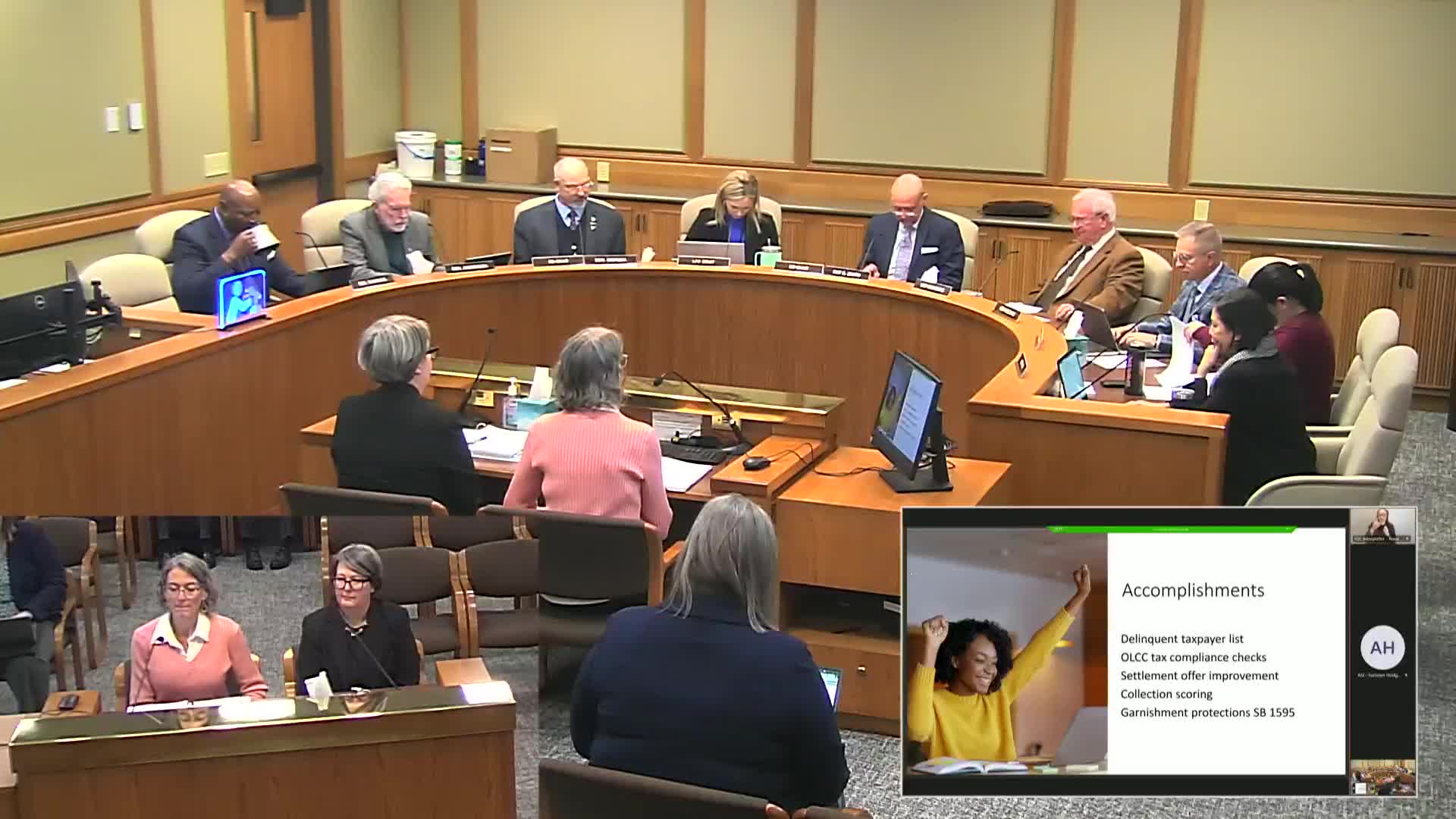
Mack outlined several other operational changes she said improved collections: a licensee tax compliance requirement implemented with the Oregon Liquor and Cannabis Commission for marijuana retailers (which the department reported reduced noncompliance from about 9% to 6% as of March 2025), a rewrite of settlement offer rules to align with federal practice and reduce barriers to offers in compromise, and a collection‑scoring triage system that routes accounts to the appropriate level of collector sooner.
To handle increased workload and accounts now flowing to the department from other agencies, Mack said the department is requesting Policy Option Package 106 (POP 106): an other‑funds limitation increase of $1,900,000 and the addition of 11 positions (9.63 FTE) for the biennium. Mack said approval would move the collection division budget from $56,900,000 and 247.93 FTE to $61,200,000 and 256.93 FTE for the biennium, changes she attributed to inflation and the POP 106 request.
Lawmakers asked how additional staff translate into additional revenue. Representative Gomberg said legislators historically expect revenue agents to produce multiple times their cost; Mack said the statute bars evaluating individual revenue agents by dollars collected because day‑to‑day results vary widely, but that “we have more inventory than we can get at” and that more staff would allow the division to answer more calls and touch more accounts.
Committee members also pressed the department on statutory limits and interagency collections. Mack said the department acts as a collector for other agencies and can recommend debt cancellation to a client agency but lacks authority to cancel debts belonging to other agencies; she noted certain incomes (Social Security, some pension payments) and federal stimulus/ARPA payments are protected from garnishment under law. Mack also described that 2024 legislation (identified in testimony as 2024 Senate Bill 1595) increased minimum‑wage protections and expanded exemption amounts for garnishments, including protecting more home equity and the first $2,500 in a bank account.
No formal vote was taken at the hearing; the department concluded its presentation and offered to provide follow‑up materials and a link to the licensing‑compliance bill lawmakers requested.
Ending: The committee closed the hearing on the revenue appropriation bill and scheduled further proceedings the next day; members asked the department to provide the committee with written follow‑up on details and links to the bills discussed.