Get Full Government Meeting Transcripts, Videos, & Alerts Forever!
Get email alerts on the Stif Transit Funding topic
No spam. Unsubscribe anytime.
Transit leaders tell committee STIF drove service gains but limits remain; agencies seek more stable revenue
Summary
General managers from Rogue Valley, Tillamook and Salem described how the Statewide Transportation Improvement Fund (STIF) expanded weekend, regional and medically essential services, while leaders and ODOT staff warned programs are oversubscribed and agencies face rising operating costs.
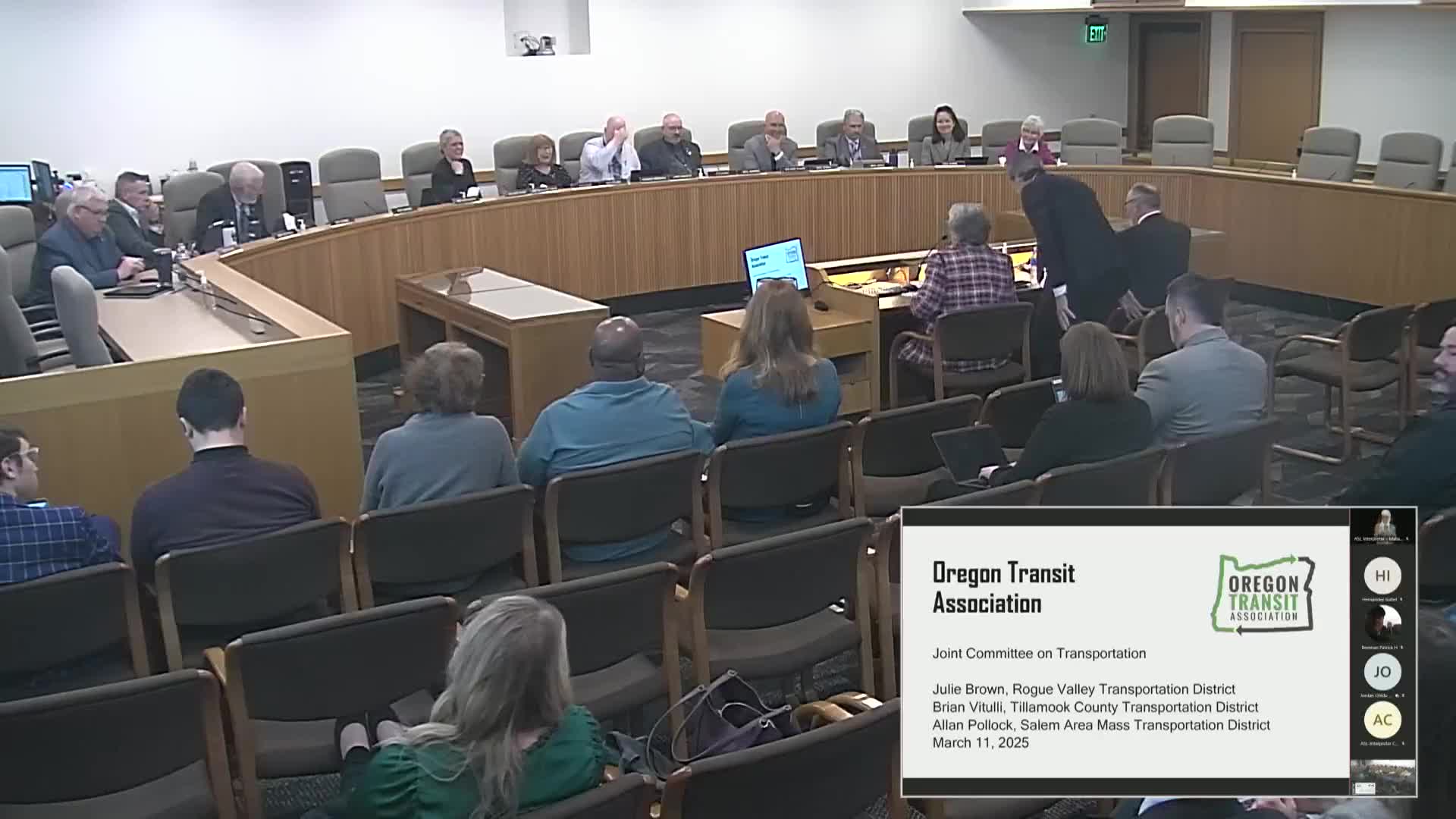
Transit agency leaders and local managers told the Joint Transportation Committee on March 11 that the Statewide Transportation Improvement Fund (STIF) has enabled agencies to restore weekend service, expand routes and provide lifeline trips for medical appointments, but they urged lawmakers to consider additional, predictable revenue and startup funding for smaller jurisdictions.
Panelists described concrete benefits from STIF: Julie Brown, general manager of Rogue Valley Transportation District (RVTD), told the committee STIF supported six new routes and enabled RVTD to grow from about 993,000 service miles in 2017 to more than 1.4 million miles today. "A lot of times when I hear people talk about ridership numbers ... you need to look at it differently. You need to look at it as this is a person," Brown said, recounting an example of a 94‑year‑old woman with stage‑4 cancer who required paratransit support for medical appointments.
Tillamook County Transportation District General Manager Brian Vitulli described rides for people traveling long distances for dialysis and opioid‑treatment programs, saying STIF funding allowed the agency to provide critical, life‑sustaining trips. "The Tillamook County Transportation District literally saved my life," Vitulli quoted a dialysis patient as saying when explaining how services bridged access gaps after the local dialysis center closed.
Salem Area Mass Transit (Cherriots) General Manager Alan Pollack said STIF funding reinstated Saturday and added Sunday service for the first time in Salem, increased frequency and enabled new routes to employment centers. Cherriots reported 3.3 million local rides in calendar 2024 and said youth free‑ride programs produced more than 2.6 million free rides since FY 2022.
ODOT and program mechanics: Suzanne Carlson, ODOT public transit division administrator, explained STIF is funded primarily by a 0.1% payroll tax created by House Bill 2017. She said 90% of STIF dollars are distributed by formula to qualified entities (transit districts, transportation districts, counties and federally recognized tribes), with 5% in discretionary competitive grants and 4% for intercommunity competitive grants. Carlson said ODOT is increasing oversight, adding three‑year on‑site compliance reviews and seeking contract language to hold qualified entities accountable for plan spending.
Revenue and policy questions: Legislative Revenue Office staff briefed the committee on the payroll tax mechanics and noted fiscal tradeoffs if lawmakers considered rate changes; John Hart said a 0.01% increase at current forecasts would raise roughly $16 million for FY 2026 and a 0.05% increase roughly $80 million. LRO staff also noted that payroll taxes are collected on wages and that addressing regressivity by income would require more complex withholding and reconciliation systems.
Panelists' asks: Agency leaders requested more stable and scalable revenue to expand frequency, evening and Sunday service, and startup support for jurisdictions considering new transit. Several witnesses urged the committee to treat transit funding as a complement, not a substitute, to highway funding and to examine public health and economic benefits of expanded transit.
Ending: ODOT and panelists agreed to provide additional studies and national analyses on public‑health benefits, and committee staff were asked to circulate those materials to members.