Get Full Government Meeting Transcripts, Videos, & Alerts Forever!
Get email alerts on the Economic Development topic
No spam. Unsubscribe anytime.
Economic Development outlines H‑1 strategy: Mass Leads Act follow‑through, life sciences support and business front door
Summary
Secretary of Economic Development presented the administration’s H‑1 proposal focused on fundamentals, talent and sector leadership, including Mass Leads Act implementation, a $12M Life Sciences transfer, MassTech and initiatives for small business and a ‘business front door’ portal.
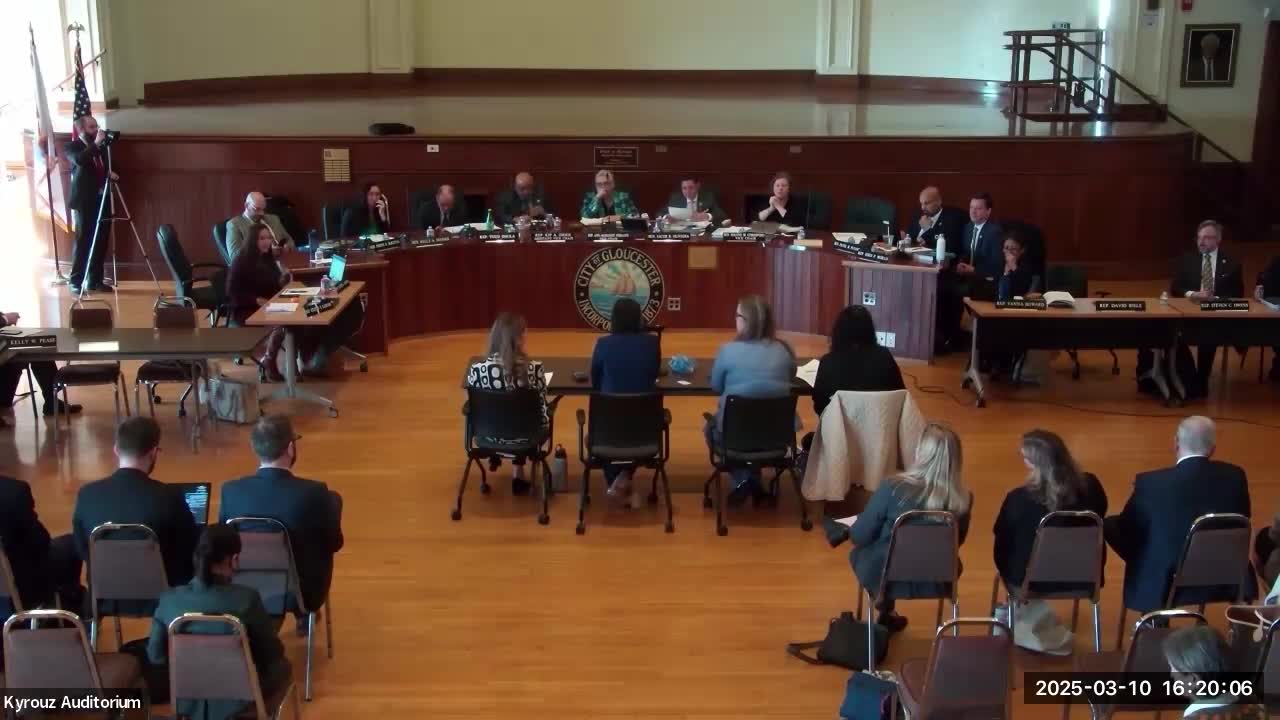
Secretary of Economic Development Judith Howe told the Joint Committee on Ways and Means in Gloucester that the House 1 FY26 proposal for economic development prioritizes fundamentals (infrastructure and downtown revitalization), talent (pathways and retention) and sector leadership (life sciences, MassTech, climate tech and tourism).
The administration’s H‑1 recommendation totals $146,000,000 for economic development programs — an increase of $5,800,000 or about 4% over the prior year — and the secretary emphasized the proposal is designed to generate revenue and jobs beyond its direct appropriations. The office said every $1 invested in regulatory oversight and industry expansion often yields multiple dollars in state revenue and local economic activity.
Major items included a proposed $12,000,000 transfer to the Massachusetts Life Sciences Center split for transparency into two tranches ($7,000,000 and $5,000,000) to support research, commercialization and industry resilience amid shifting federal funding. MassTech would receive $2,500,000 for programs including AI, fintech and cybersecurity; the Center for Advanced Manufacturing would receive $1,200,000 and the Mass Scribe (data protection) work $950,000.
The secretary outlined talent measures tied to the Mass Leads Act and a change to the Workforce Investment Trust Fund that allows expanded use of off‑budget trust receipts. Proposed allocations include $15,000,000 for community empowerment and reinvestment programming, $2.5 million for advanced manufacturing training and $10,000,000 for the Pathmaker program to train life‑sciences manufacturing workers.
Small business technical assistance would be funded at $7,500,000; an innovation voucher line of $1,000,000 was proposed and the entrepreneurship/retention visa entrepreneur‑in‑residence program (branded “Thrive”) would receive $1,750,000 to help talented immigrant entrepreneurs remain and scale businesses in the Commonwealth. The secretary also previewed a ‘business front door’ portal and concierge service designed to make state programs easier to access and to reduce permitting friction for companies locating across regions.
Secretary Howe asked lawmakers to view these budget investments as sales and R&D for the Commonwealth — frontloaded public investment to attract market activity and secure long‑term returns through jobs, tax receipts and new economic activity.
Ending: The administration solicited committee support for targeted investments in life sciences, MassTech, workforce pipelines and a front‑door service for businesses, arguing the budget is a strategic push to retain talent and expand job‑creating industries across the state.