Get Full Government Meeting Transcripts, Videos, & Alerts Forever!
Get email alerts on the Dental Reimbursement topic
No spam. Unsubscribe anytime.
Lawmakers hear urgent calls to raise Medicaid dental reimbursement and streamline payments to recruit providers
Summary
Oregon Health Authority staff briefed the House committee on OHP dental rate mechanics — fee‑for‑service payments and capitation to CCOs — noting adult utilization has not fully rebounded from the pandemic, and the committee then heard hours of testimony urging an industry‑benchmarked rebasing (HB 2,597) and clearer definitions for dental subcontractors (HB 2,211).
An informational session and public hearing before the House Committee on Behavioral Health and Health Care focused on Oregon Health Plan (OHP) dental payment methods and two bills aimed at stabilizing the dental safety net: an informational presentation from Oregon Health Authority staff about fee‑for‑service and capitation components, followed by a public hearing on House Bill 2,597 (rate methodology/rebasing) and testimony on House Bill 2,211 (definition and limits for dental subcontractor scope).
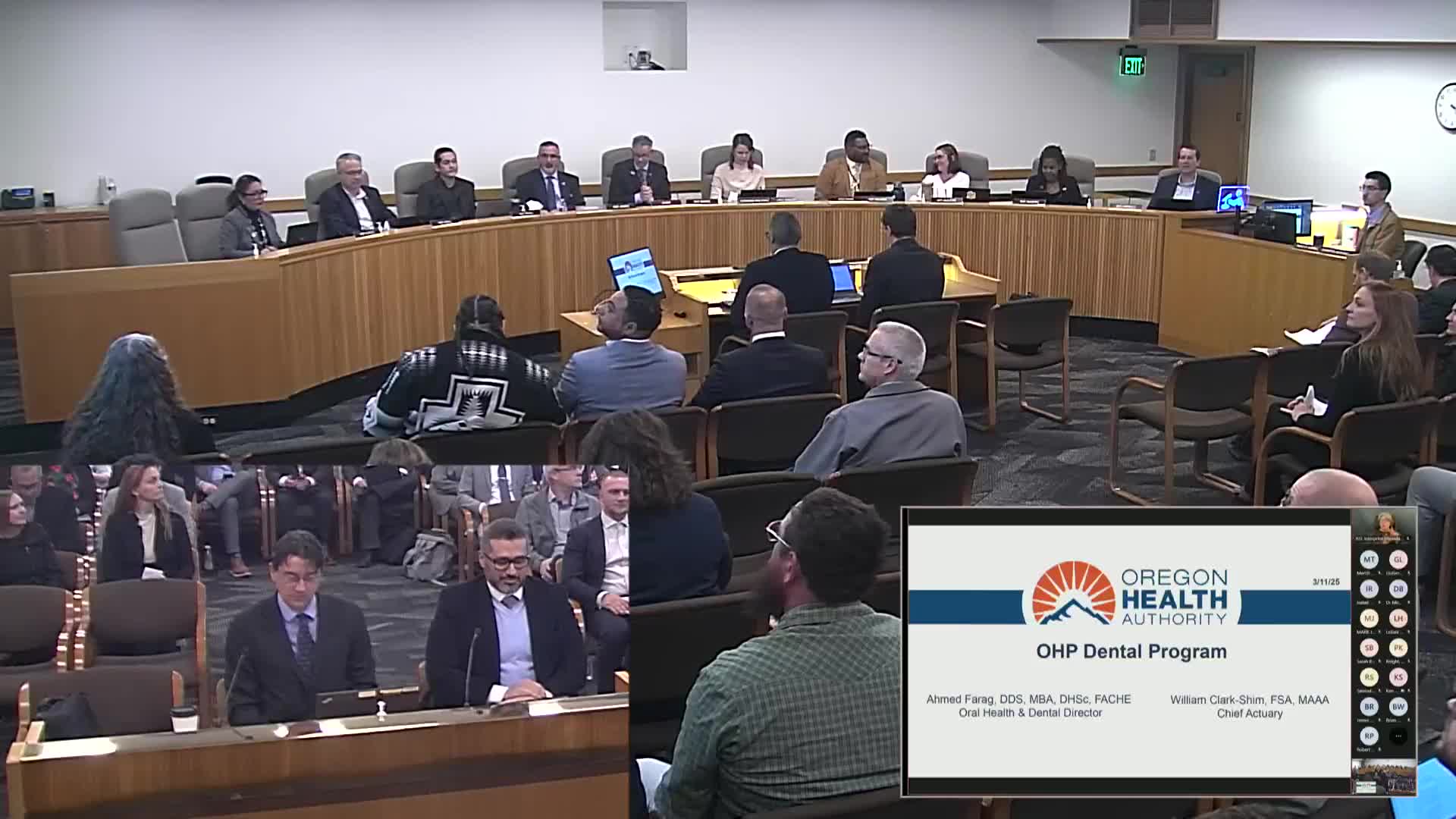
Lede/nut: Ahmed Farag, oral health and dental director at the Oregon Health Authority (OHA), and Will Clarkshim, OHA chief actuary, told the committee that dental payments flow through two channels: a fee‑for‑service schedule (OHA to provider) and capitation (OHA to CCOs, which may subcontract dental services). Clarkshim explained capitation math: rate per service × utilization; utilization dropped steeply in 2020 and has only partially recovered for adults, which suppressed capitation payments in recent years. OHA has created directed payments for 2025 to reward preventive bundles and incentives for new/retaining providers; continuation depends on utilization and budget.
Why it matters: Witnesses — community dentists, large dental groups and dental care organizers — said OHP dental reimbursement has not kept up with costs such as labor, rent and supplies and that low and variable rates force providers out of Medicaid, reducing access. They urged a transparent, market‑based rebasing so rates reflect real cost structures and to reverse a “vicious cycle” of rate cuts and declining participation.
What sponsors and providers proposed: Representative Hai Pham (sponsor of HB 2,597) and Rep. Cyrus Javedi (dentist and sponsor) described HB 2,597 as a database/reference approach to align Medicaid dental valuations with commercial market benchmarks (the bill seeks a floor of roughly 59.8% of commercial rates as testimony put it). These changes would require OHA to incorporate an independent industry benchmark into rate setting and include a biennial report back to the Legislature.
Provider testimony: Willamette Dental Group, ODS Community Dental, Advantage Dental Plus, Oregon Dental Association and independent dentists testified in favor. They said recent rate declines have reduced the number of DCOs and contract dentists and that rural and safety‑net access is at risk. Providers urged technical fixes to HB 2,597 but strongly supported the direction. Willamette Dental Group also testified on HB 2,211 seeking clearer statutory definitions for dental subcontractors and limits on new administrative demands that groups say are unfunded and cause administrative waste.
FQHC caution: Marty Carty of the Oregon Primary Care Association said federally qualified health centers operate under federal payment rules; as drafted, HB 2,597 would not automatically increase FQHC dental reimbursement because their billing and payment rules differ. He warned of unintended consequences if FQHCs are excluded from intended increases.
Data and numbers: OHA staff noted utilization for non‑disabled adults in 2023 was around 70% of 2019 pre‑pandemic levels; they reported “green shoots” in 2024 but said 2026 capitation modeling depends on 2024 processed data. Witnesses cited a 2024 OHSU‑OHA study and a 2024 report showing Oregon Medicaid adult dental reimbursement as a percent of dentist charges (a figure cited by witnesses was ~28.3% in comparative claims referenced during testimony).
Committee action: The hearing closed after extensive testimony; no committee vote on either bill was recorded that day.
Ending: Providers asked the Legislature to move quickly on rate rebasing and on statute clarifications to prevent further erosion of Medicaid dental access.