Get Full Government Meeting Transcripts, Videos, & Alerts Forever!
Get email alerts on the Tax Reconnect topic
No spam. Unsubscribe anytime.
House Revenue committee holds work session on HB 2,092, discusses 1- and 2-year “reconnect” suspensions
Summary
Chair Nathanson opened a work session on House Bill 2,092 to discuss proposed 1- and 2-year suspensions of Oregon’s rolling reconnect to federal tax changes.
Chair Nathanson opened a work session on House Bill 2,092 on March 11 to discuss amendments that would suspend Oregon’s rolling reconnection to certain federal tax provisions. “This work session is for the purpose of discussing amendments only. I do not expect that we will be making any motions or adopting any motions today,” Chair Nathanson said at the start of the session.
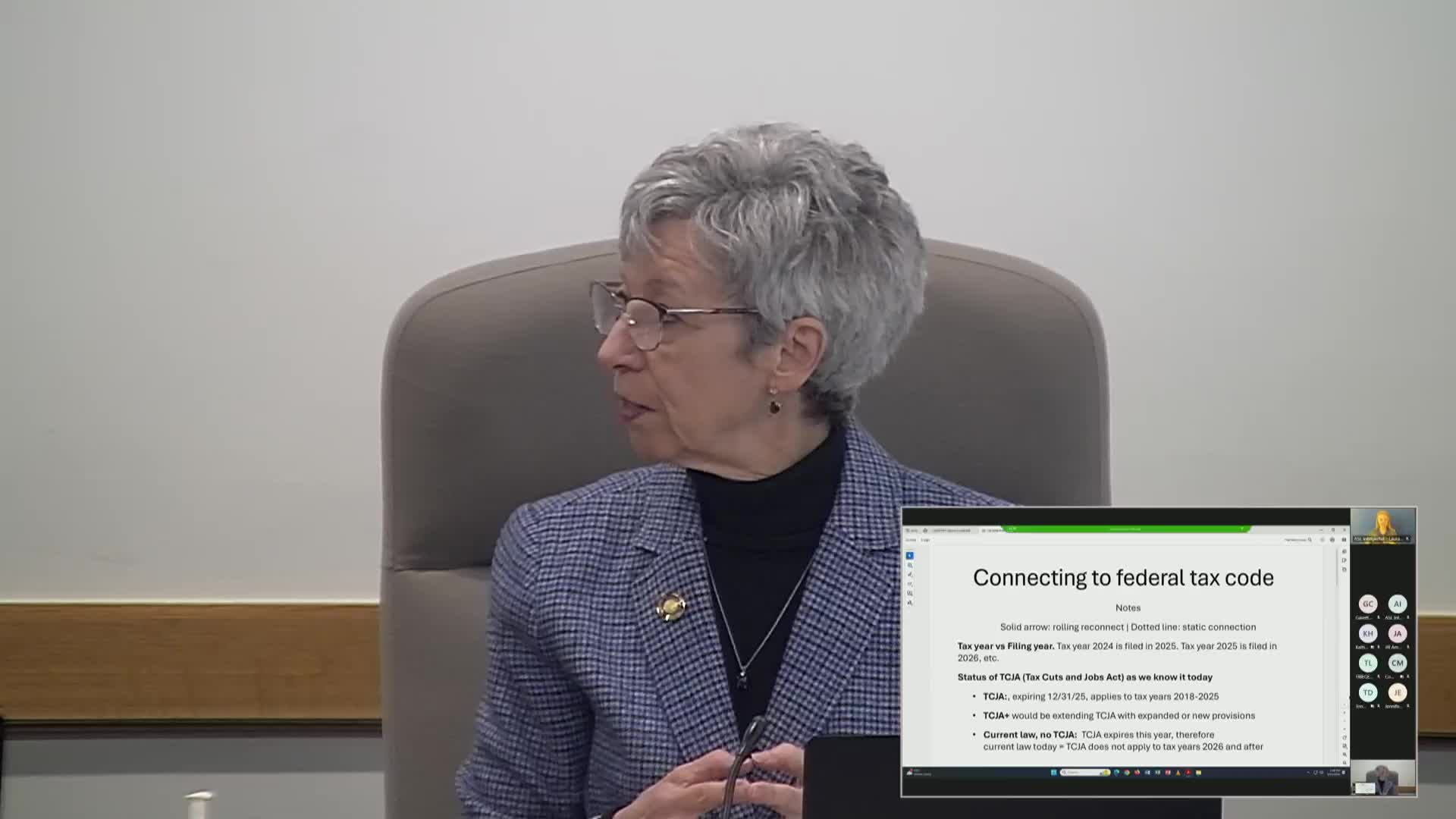
The bill concerns the state’s “reconnect” mechanism tying Oregon taxable-income definitions to changes in federal law from the Tax Cuts and Jobs Act (TCJA). Legislative Revenue Office analyst Chris Hallinach summarized two amendment options available in OLIS: a “-6” amendment that would suspend the rolling reconnect for tax year 2025 only, and a “-7” amendment that would suspend reconnection for tax years 2025 and 2026. “The dash 6 is a 1 year suspension for tax year 2025, where the dash 7 would suspend that rolling reconnect for tax year 2025 and tax year 2026,” Hallinach said.
Committee members asked for historical context about earlier federal changes and how a freeze would have affected Oregon revenue. Representative Reschke asked committee staff to explain the 2017 example. Hallinach described how a hypothetical freeze at the end of 2016 would have delayed direct impacts of the federal law on Oregon until after the freeze period and noted the 2018 legislative response was selective—disconnecting only from particular federal provisions (for example, the pass-through deduction) when those federal changes were enacted.
Staff emphasized that the work session was for understanding and discussion only; the chair reiterated the committee would later move to public hearings on other bills. The committee closed the HB 2,092 work session without taking formal action.
The discussion focused on timing and uncertainty in federal action: presenters repeatedly warned that because Congress had not yet acted on TCJA’s future status, a suspension could provide short-term budget stability but would require the legislature to revisit the connection once federal decisions were finalized.
No amendments were adopted during the work session and no votes were taken.
The committee then closed the HB 2,092 work session and proceeded to other agenda items, including a public hearing on House Bill 3,518.