Get Full Government Meeting Transcripts, Videos, & Alerts Forever!
Get email alerts on the Data Centers topic
No spam. Unsubscribe anytime.
Committee debates data-center bill; environmental groups urge stricter review, industry and local officials back streamlined permit path
Summary
Senate File 1393, as amended, would clarify that most hyperscale data-center backup generation and certain project elements proceed under site permits and AUAR processes rather than the PUC certificate-of-need for generation; committee adopted an A5 amendment and an oral amendment, defeated several proscriptive amendments, and laid the bill over.
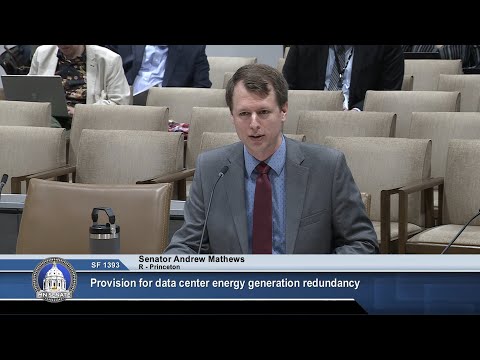
Senate File 1393, carried by Sen. Roger W. (Senator Matthews), drew extended testimony and debate March 12 before the Energy, Utilities, Environment, and Climate Committee. The bill addresses how Minnesota will review and permit large data centers, including whether on-site backup generation must undergo a Minnesota Public Utilities Commission certificate-of-need (CN) process or may proceed under a site-permit/AUAR (Alternative Urban Areawide Review) pathway.
The author said the bill clarifies that many data-center backup generators are not part of a traditional utility transmission-connected generation project and therefore do not meet the existing CN statutory test that triggers review for production tied to the grid. "I believe it clearly does not meet the test since they do not have transmission connected to the grid," Senator Matthews said. The bill's A5 amendment — adopted by the committee — reflects negotiated language from multiple stakeholders and state agencies including the Department of Commerce, the Environmental Quality Board, and the Pollution Control Agency. An oral amendment deleting Section 6 (page 4, line 21 through page 5, line 13) was also adopted during the hearing.
Industry witnesses and local officials urged passage, saying data centers bring investment, property tax revenue and construction jobs. Joel Johnson of the International Brotherhood of Electrical Workers said the projects could provide "thousands of hours of work for all of our members" and help add apprentices. Courtney Lee, senior manager for AWS state and local public policy, said Amazon is exploring Minnesota locations and argued the bill provides the regulatory certainty needed for those investments; she said the company is committed to renewable energy and to water stewardship and noted a company goal to be "water positive" by 2030.
Opponents — including the Minnesota Center for Environmental Advocacy (MCEA), Clean Water Action, 100Percent Minnesota, and Sierra Club — said the legislation weakens environmental review and could exempt very large diesel backup-generator arrays from the CN process. Aaron Clems of MCEA said the bill "would move us further away from meaningful oversight of the hundreds of diesel backup generators proposed" and warned of large water and air impacts. Testimony noted that Amazon sought a CN exemption at the PUC for a Becker site; commissioners recently denied that exemption and asked for a CN filing. Several speakers asked that backup-generator usage be tightly limited and that renewable or lower-emission alternatives be examined.
Committee members debated several floor amendments: Senator McEwen offered an amendment (A3) that would restrict enterprise data centers to industrial zoning except as a conditional use; that amendment failed on a roll call (3 yes, 8 no). An amendment to limit the bill to Becker only (A4) was also defeated by voice vote. Sen. McKeown offered an amendment (A6) that would have capped diesel generator testing/operation to 50 hours unless the grid is down, prohibited use of diesel for peak shaving absent PUC approval, required ultra-low sulfur diesel or renewable diesel, and directed a state study; A6 failed on a roll call. Supporters, including the Department of Commerce and the Pollution Control Agency representatives, said the negotiated A5 language and the PCA's permitting authority provide a more flexible and appropriate regulatory route than a fixed hours cap.
The committee laid SF 1393 over for further consideration; senators and agency staff said they will continue negotiations, and some members asked that portions of the bill be reviewed in the Senate Environment Committee. The hearing featured more than two dozen testifiers representing labor unions, local government, industry (including Amazon Web Services representatives and counsel), environmental groups, and state agencies.