Get Full Government Meeting Transcripts, Videos, & Alerts Forever!
Get email alerts on the Education topic
No spam. Unsubscribe anytime.
ODE says $30M summer learning program reached more than 28,000 students and met most academic goals
Summary
The Department of Education reported results from the 2024 House Bill 4082 summer learning grants: more than 28,000 students served, 66 grantees, 4,627 credits earned and 79% of academic goals met. ODE proposed a five-year plan and a larger Governor’s budget request for expanded learning.
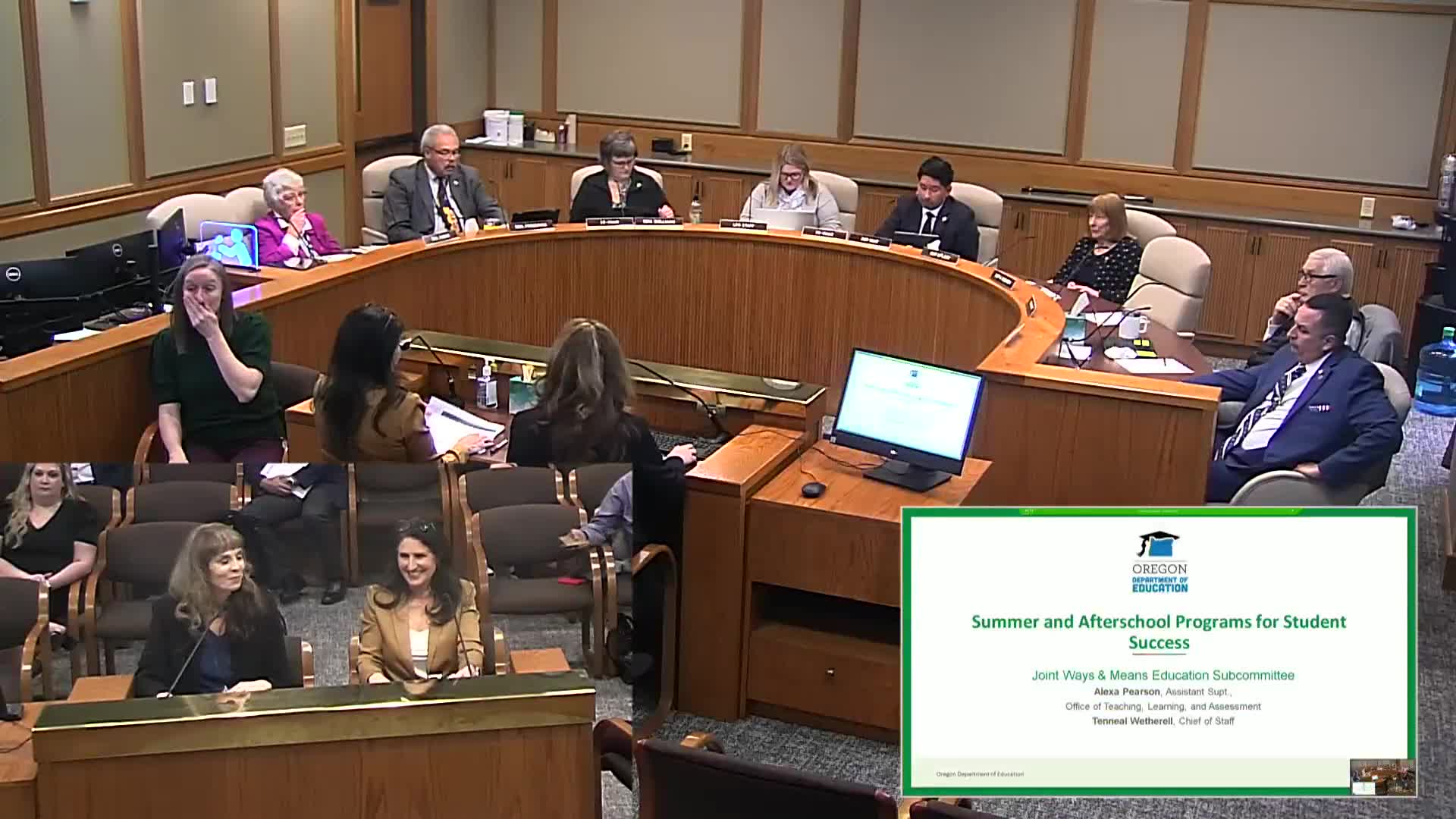
Oregon Department of Education officials on March 11 told the Education Subcommittee that the state’s $30,000,000 summer learning investment in 2024 expanded access to high-quality, in-person programs and produced measurable academic and engagement outcomes.
Alexa Pearson, assistant superintendent at ODE, said the 2024 program reached 28,187 students through 66 grantees spanning 43 school districts, 13 education service districts and 10 charter schools. She said grantees reported 4,627 credits earned and that 79 percent of academic goals were met across literacy, math and science objectives.
The results add context to state planning. ODE described the summer grant as designed to accelerate academic recovery while emphasizing youth development, culturally responsive programming and partnerships. “Programs were expected to have a structured plan that aligned with academics, youth development, and equity goals,” Pearson said.
The agency also reported results of a student perception survey: 8,921 student responses showed 91 percent of participants felt welcomed, 86 percent reported a strong sense of belonging and 84 percent said they had voice in their programming.
Committee members discussed program reach and metrics. Senator Solomon praised the program’s approach and urged expansion: “This was a success, and we need to duplicate it for ’25 and we need to duplicate it then forward for ’26–’27,” he said. Senator Solomon and other members said timely notification and longer planning windows would help districts plan and recruit staff earlier in the school year.
Staff acknowledged data challenges in comparing participation counts and per-student dollars across grantees. Taniel Weatherall said the department had “over corrected” an earlier tally while trying to determine dollars per student and plans to refine data collection tools and pull-down options to clarify whether programs were new or preexisting and which students were served.
ODE summarized lessons learned: programs require timely, consistent funding; transportation and culturally responsive outreach reduce barriers; workforce development and cross-agency partnerships strengthen delivery. Personnel costs represented the largest portion of spending (about 63 percent); ODE reported that roughly 92.5 percent of the $30,000,000 had been expended.
Looking forward, ODE described a five-year implementation plan to expand formula-based summer grants, strengthen quality and partnerships, and build a statewide ecosystem for expanded learning. The Governor’s 2025–27 budget proposal includes $75,000,000 for expanding summer and after-school learning and $3,170,000 to create an expanded learning team within ODE to coordinate grants and reporting.
Committee members asked ODE to share grantee lists and application records; agency staff said they would provide recipient lists when available and work to improve outreach to districts, educators and families.