Get Full Government Meeting Transcripts, Videos, & Alerts Forever!
Get email alerts on the Wildlife Management Wolves topic
No spam. Unsubscribe anytime.
Senate committee hears broad testimony on SB 777, which would raise nonlethal funding and add multipliers to wolf depredation payouts
Summary
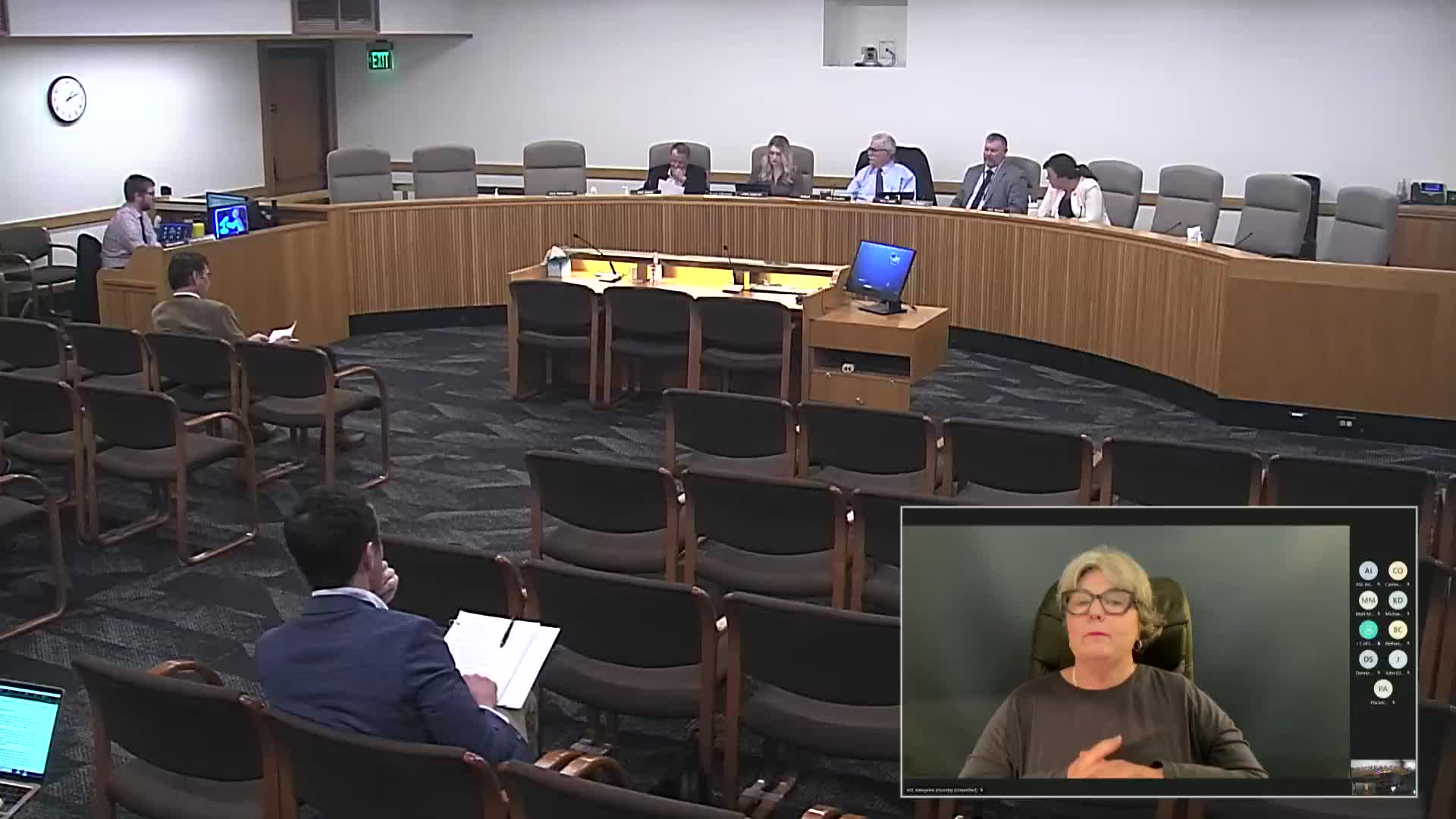
The Senate Committee on Natural Resources and Wildfire opened a public hearing March 11 on Senate Bill 777, a measure that would revise Oregon's wolf depredation compensation program by adding per-animal multipliers, a $25,000 cap and a higher minimum allocation for nonlethal deterrence.
The Senate Committee on Natural Resources and Wildfire opened a public hearing March 11 on Senate Bill 777, a measure that would revise Oregon's wolf depredation compensation program by adding per-animal multipliers, a $25,000 cap and a higher minimum allocation for nonlethal deterrence.
The dash-5 amendment described by staff would increase the statutory minimum of program funds that counties must use for financial assistance for nonlethal livestock management from 30% to 50%, allow county committees to select a multiplier up to specified caps, and set a $25,000 maximum compensation per animal. The amendment specifies multipliers of up to 5 times fair market value for calves and yearlings and for sheep and goats, up to 3 times fair market value for cows, and a single-times fair market value for certain other livestock and working dogs.
Why it matters: SB 777 addresses recurring conflict between livestock producers and wolves by changing how the state calculates and allocates compensation. Proponents said the changes would increase participation in the compensation program and better account for indirect economic losses; opponents said the multipliers risk depleting the fund and that prevention and enforcement should be prioritized.
Producers, county officials and livestock-interest groups spoke almost uniformly in favor of the dash-5 amendment. Senator Todd Nash (primary sponsor) said the bill is a compromise that reduces earlier proposed multipliers and removes the hard-to-prove "missing livestock" category, and that the new multipliers and higher nonlethal minimum were concessions to reach agreement. "We are acknowledging that we're giving up 3 head in a normal situation," Nash said, explaining why a 5x multiplier was adopted for some categories.
Brandon Persinger of the Association of Oregon Counties testified: "I am here today as a strong supporter of the dash 5 amendment for senate bill 7 7 7." Multiple county and Eastern Oregon representatives said the bill would help counties and ranchers who report low participation rates under the existing program; Persinger and other witnesses cited a statewide statutory structure for county committees (cited in testimony as ORS 610.150).
Ranchers gave detailed examples of on-the-ground costs. Carmen Oakes, a Wheeler County sheep and cattle producer, described roughly $134,200 in additional fencing, hired help housing and other nonlethal costs she expected this year. Dennis Sheehy and John Williams, both ranchers and wolf-committee leaders, argued that the multiplier approach reflects documented undercounting of carcasses and indirect losses such as weight loss and lowered conception rates.
Conservation groups and wildlife advocates opposed the bill or the dash-5 amendment. Colin Reynolds of Defenders of Wildlife said his group was "in opposition to SB 777 and the dash-5 amendment," citing concerns that the proposed multipliers would create financial consequences that could drain the fund and would not address program implementation problems. Bethany Cotton of Cascadia Wildlands told the committee: "Senate bill 7 7 7 is bad public policy. Senate bill 7 7 7 is anti science," and argued the Legislature should instead invest in prevention, Department of Fish and Wildlife staffing and anti-poaching efforts.
Several witnesses noted a companion funding vehicle (identified in testimony as Senate Bill 985) and emphasized that SB 777 makes policy changes while funding would be addressed separately in the budget or through ways-and-means. ODA/ODFW roles were discussed: the compensation program is administered through the Oregon Department of Agriculture and verifications are performed by Oregon Department of Fish and Wildlife field staff, witnesses said.
The committee did not take a final vote on SB 777 at the March 11 hearing. The public hearing drew roughly two dozen witnesses from ranching groups, county associations and conservation nonprofits; several senators spoke to the need to balance compensation, nonlethal prevention and enforcement resources.
The hearing record also includes past policy context: the compensation program began in the 2000s, the Oregon Wolf Conservation and Management Plan (2019) and academic work estimating carcass detection rates were cited repeatedly, and witnesses described a 2012 ODA implementation of a compensation and financial assistance program.
Votes at this session: none taken on SB 777; the committee closed the public hearing without action.
Looking ahead: Senators and witnesses urged follow-up discussions on funding, agency capacity for prevention and enforcement, and continued stakeholder engagement; the committee signaled a possible work session or return of the bill at a later date.