Get Full Government Meeting Transcripts, Videos, & Alerts Forever!
Get email alerts on the Education topic
No spam. Unsubscribe anytime.
Oregon Department of Education details early literacy spending, federal $57 million grant
Summary
ODE officials completed an early-literacy briefing, described how prior state investments were distributed and confirmed a new federal Comprehensive Literacy State Development (CLSD) grant worth $57 million per year for five years. Officials said most federal funds will be subgranted to districts and noted reporting and evaluation plans.
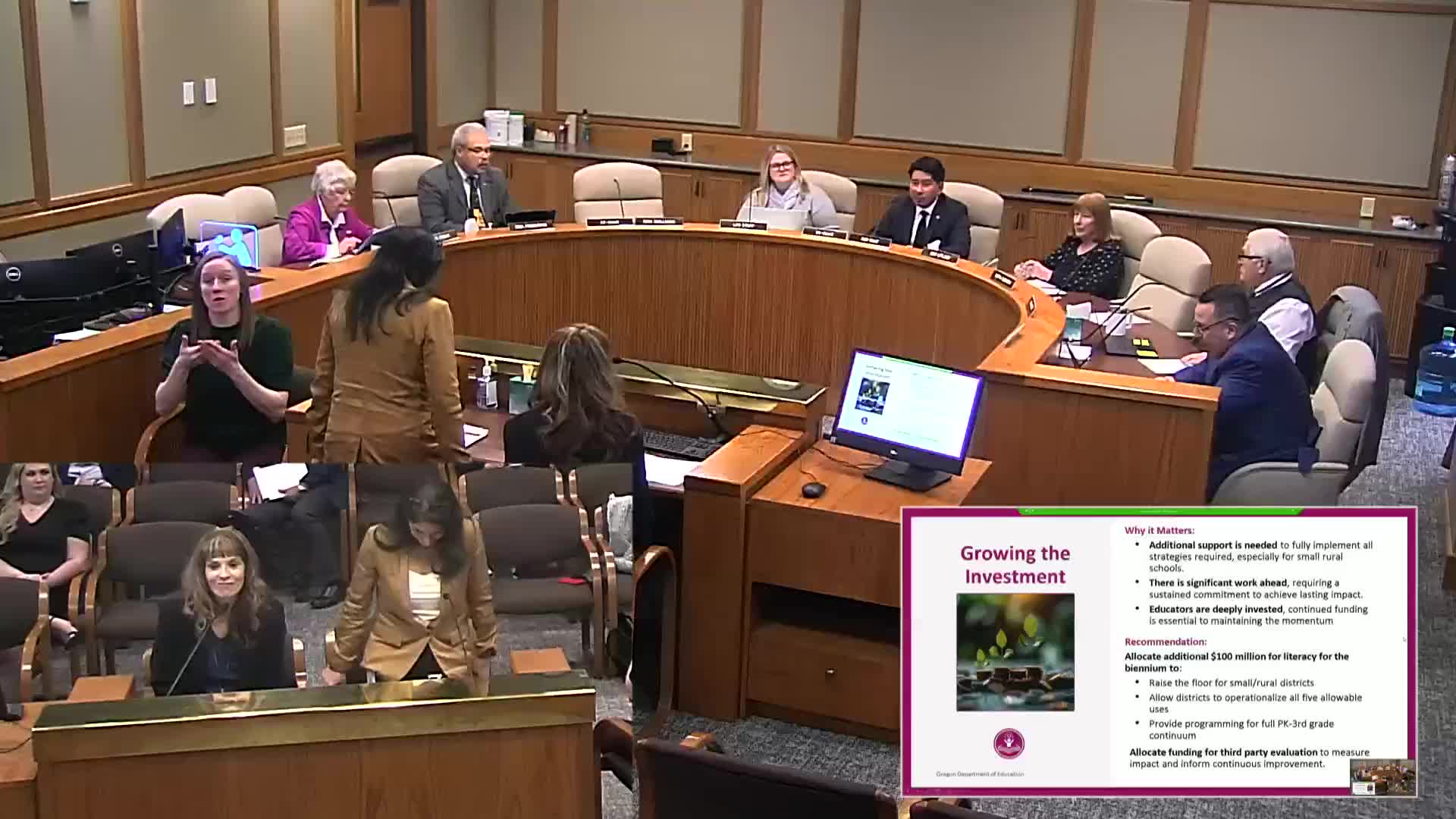
The Oregon Department of Education on March 11 completed an informational briefing for the Education Subcommittee on early literacy funding and the agency’s plans to expand supports across the birth-to-12 continuum.
The presentation explained how a prior $90 million state investment was distributed to districts via a formula grant and previewed a newly awarded federal Comprehensive Literacy State Development grant worth $57,000,000 per year for five years.
The presentation matters because the state and federal grants together shape how districts pay for literacy coaches, curriculum, tutoring and summer programming — the elements ODE said research shows most likely to improve reading outcomes.
Alexa Pearson, assistant superintendent in ODE’s Office of Teaching, Learning and Assessment, said districts that received the earlier state funds had to submit plans describing use of the five allowable uses and must file quarterly expenditure reports. “We review their expenditure reports and made sure that…if they were doing high-dosage tutoring, it had to be for at least 10 weeks,” Pearson said.
Pearson and other agency staff described how the new federal CLSD award will be administered. “We were awarded $57,000,000 annually for five years,” Pearson said. She said 95 percent of those funds are required to be subgranted to districts and other eligible entities and 5 percent are reserved for state agency administration and statewide planning.
Agency staff said the combination of state and federal funding will allow smaller rural districts to hire full-time literacy coaches, expand summer programming, increase high-dosage tutoring slots and fund third-party evaluation. Pearson gave examples showing how a small district’s biennial floor allotment ($85,000) could fund only a half-time coach, while additional investment could support a full-time coach plus tutoring and summer slots.
Taniel Weatherall, chief of staff for ODE, said the department plans to support coherent, state-to-region professional learning and to fund program evaluation. “It would allow funding for a third-party evaluation, which would greatly increase our collective ability to measure impact and engage in continuous improvement,” Weatherall said.
Committee members pressed agency staff on recipient lists and reporting. Senator Frederick asked for a list of CLSD recipients; Pearson said selections have not been made and she will provide the list when available. On prior state funds, agency staff said the $90 million was distributed by formula to every school district and eligible public charter school and required each grantee to indicate which allowable uses it would pursue.
Pearson said ODE currently monitors grantee expenditure reports and is working to strengthen evaluation and reporting so the state can better measure outcomes across different curricula and assessments. She also noted the agency’s recent inclusion in a national instructional materials and professional development network to support high-quality curriculum implementation.
The subcommittee did not take formal action during the informational briefing. Agency staff said they will continue follow-up with member requests for recipient lists and additional implementation details.