Get Full Government Meeting Transcripts, Videos, & Alerts Forever!
Get email alerts on the Public Health And Safety topic
No spam. Unsubscribe anytime.
Planning commission reviews two draft mobile food‑unit ordinances and asks staff to seek vendor, fire and health input
Summary
Fluvanna County planning staff presented two draft ordinances to define and regulate mobile food units; commissioners asked staff to add fire‑code and building‑code language and to consult food‑truck operators, the fire marshal and the health department before returning with a revised draft.
Fluvanna County planning staff presented two draft ordinances to define and regulate mobile food units (food trucks, concession trailers, push carts) and to identify where they would be allowed. The planning commission discussed safety, health, fire‑code compliance and impacts in residential areas and directed staff to refine a permissive draft, add explicit references to fire and mechanical code requirements, and consult existing mobile‑vendor operators and fire/health officials before returning with a final draft for advertisement.
Under the two drafts presented, one version would allow mobile food units by right in all zoning districts; an alternate version would allow them by right in commercial, agricultural and industrial districts but require a special‑use permit (SUP) in residential districts (R‑1 through R‑4). Planning staff asked the commission whether A‑1 agricultural parcels should require an SUP unless the mobile unit is associated with agritourism; commissioners discussed that question but did not adopt a final position at the hearing.
Nut graf: Commissioners sought to keep the county’s approach permissive and predictable while filling regulatory gaps—requiring operators to obtain zoning permits, comply with the state fire code and the Virginia Department of Health, and follow local trash and noise rules—rather than imposing routine SUPs for every temporary operation.
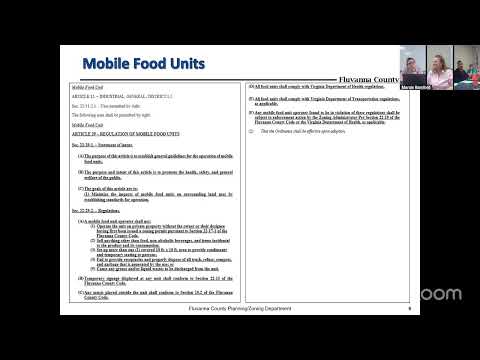
Discussion highlights included public‑safety and health controls. Commissioners and staff agreed to insert explicit fire‑code and mechanical/hood requirements (for operations that generate grease or vapors) into the ordinance language; Planning staff noted that food‑truck operators must comply with state fire marshal and construction‑code requirements and should present documentation of inspections from the jurisdiction where they are licensed. The draft included a requirement that mobile food operators obtain a zoning permit before operating on private property and that units provide trash receptacles and not discharge grease or liquid waste to the ground.
Commissioners expressed concern about narrow residential streets and about trucks parking in ways that could create hazards near schools or bus stops. One commissioner suggested allowing mobile units by right for most districts and handling infrequent residential events via a special‑event permit process rather than a site‑by‑site SUP, while another cautioned that neighborhood safety requires some extra review. The commission asked staff to reach out to food‑truck vendors operating within or near Fluvanna County and to consult the county fire marshal and health department; staff said they would gather feedback and bring a revised draft back at a future meeting (possible May timeframe was discussed).
Quotes are limited to meeting speakers: a planning staff member noted the draft regulation’s first requirement—"Mobile food unit operator shall not operate the unit on private property without the owner or their designee having first been issued a zoning permit pursuant to section 22‑17‑1 of the county code." A commissioner said of residential operations, "I'm concerned in residential areas about the safety of the way that they could be parked" and recommended guardrails for safety review.
Ending: Staff will revise the draft to add explicit fire‑code/hood and suppression language, prepare a vendor outreach summary and return with a refined ordinance for commission consideration and possible advertisement.