Get Full Government Meeting Transcripts, Videos, & Alerts Forever!
Get email alerts on the Opioid Settlement Allocations topic
No spam. Unsubscribe anytime.
Hamilton County earmarks $2 million in opioid settlement funds; considers school construction agreement and several zoning requests
Summary
At its weekly meeting the Hamilton County Commission reviewed a memorandum of agreement with Hamilton County Schools on alternative construction delivery, approved multiple routine purchases and grants, and proposed $1.4 million in restricted and $600,000 in unrestricted opioid settlement allocations to local nonprofits.
County Mayor (name not specified in the transcript) told the Hamilton County Commission on March 25 that the county will allocate $1.4 million from restricted opioid settlement funds and $600,000 from unrestricted distributor settlement funds to local nonprofit organizations as part of a “renewal” project aimed at bolstering recovery services and community supports.
The proposed $2 million package is intended as one-time capital investments for nonprofit recovery and support organizations, the mayor said. “Most of what you see today, dollars 1,400,000.0 of it is from the restricted bucket. Those are within the very tight constraints that the state of Tennessee has given us,” the mayor said, adding staff and county leaders have been projecting settlement payment timing and building reserves over the last few years.
Why it matters: The county’s opioid settlement dollars are restricted by state guidance and are being distributed to local providers that county officials say could work in coordination with emergency medical services and community recovery teams. The allocation moves a portion of the county’s accumulated settlement reserves into programs and capital investments intended to strengthen recovery infrastructure, officials said.
School construction memorandum of agreement
Todd Lehman, a county staff member, briefed commissioners on Resolution 325-19, a proposed memorandum of agreement between Hamilton County and Hamilton County Schools that would permit the school board to use alternative construction delivery methods—such as construction manager at risk—on certain projects. Lehman said county general government is not authorized under state law to use those alternative delivery methods but the school board is, and the MOA would allow the school board to select a construction manager on projects where that delivery method is appropriate.
Justin Witt, Hamilton County Schools, said the change provides an additional option for complex projects and “allows us to bring in another design another construction professional to bring them in early with the architect the designers to go through budgeting and, hopefully, an opportunity to value engineer and and basically give another some more insight on reaching a a guaranteed maximum price for the project.” Lehman said the county would be notified when the school board intends to use the alternative delivery method and that a design committee with advisory participation from county government would remain part of the selection process.
Routine finance, procurement and grants
The commission read and discussed multiple routine finance and procurement items, several without extended comment. Among the items described in the meeting record were:
- $467,608.73 grant through the Tennessee Department of Military/Tennessee Emergency Management Agency for radiological emergency preparedness (resolution 325-26). - $62,400 to Hamilton County Emergency Medical Services from the State Department of Emergency Medical Services to pay $800 education supplements for 78 eligible paramedic employees (resolution 325-21). Miss Cooper (Hamilton County EMS) clarified that “eligible” refers to paramedics, not AEMTs or sheriff’s personnel. - A three-year software and data solution services agreement with ZOLL Data Systems Inc. valued at $202,120 for EMS ambulance billing (resolution 325-36). - Purchase and installation of fencing and equipment for the county impound lot from Safeware Inc., $60,429.77 (resolution 325-23). - Chester Frost Park Eagles Nest restroom and shower facility contract not to exceed $533,055 (resolution 325-29). - Building content renewal and haul-off services for the Hamilton County Justice Building from BELFOR USA Group Inc., $158,000 (resolution 325-30). - A playground equipment donation to the city of Red Bank valued at $18,876.56 (resolution 325-31). - A noncompetitive procurement for courthouse security upgrades and renovations, $52,721 (resolution 325-32).
Many of these items were presented as budgeted, grant-funded, or on state contract and drew little or no public comment during the meeting.
Zoning and land-use items
Planning staff and applicants presented several land-use matters that drew discussion. Brian Schultz, planner with the Regional Planning Agency (RPA), described a planned unit development (PUD) special permit request for about 19.5 acres at 8875 Hixson Pike proposing 57 units (30 single-family homes and 27 townhomes); staff recommended approval and noted the density is typical for low-density residential development. Mike Price, MAP Engineers, said the site has significant topography and that substantial grading would be required; he added the plan retains perimeter single-family lots with townhomes clustered in the interior.
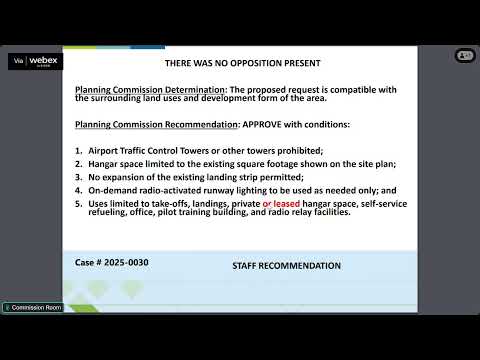
In separate, related cases near the existing Skypark airfield, staff presented three items that would revert a 2023 rezoning back to agricultural, abandon an earlier special permit tied to a prior residential-with-hangars plan, and approve a new special permit to allow hangars and airport-related uses. Brian Schultz and Mark Litchford (representing the property owner) said the owners intend to use space for hangars and private airport operations rather than the townhome-with-hangar concept previously proposed; Litchford said the facility would remain a private airport (not listed as a public airport in registries) and that he did not expect an increase in takeoffs or landings as a result of the reconfiguration.
Votes and next steps
Clerks read dozens of resolutions and permit items into the record; the meeting transcript records the items presented and discussion but does not include roll-call vote tallies for the resolutions. Several items drew no public comment (“no lights”), and staff said some items will return in later packets when final contracts and backup details are prepared.
Ending note: Commissioners advanced a mix of grants, routine procurements, capital projects and land-use matters and reviewed a package of opioid settlement allocations that county leaders said aim to move restricted funds into local recovery and community supports. Specific vote outcomes were not recorded in the excerpted transcript.