Get Full Government Meeting Transcripts, Videos, & Alerts Forever!
Get email alerts on the State Budget topic
No spam. Unsubscribe anytime.
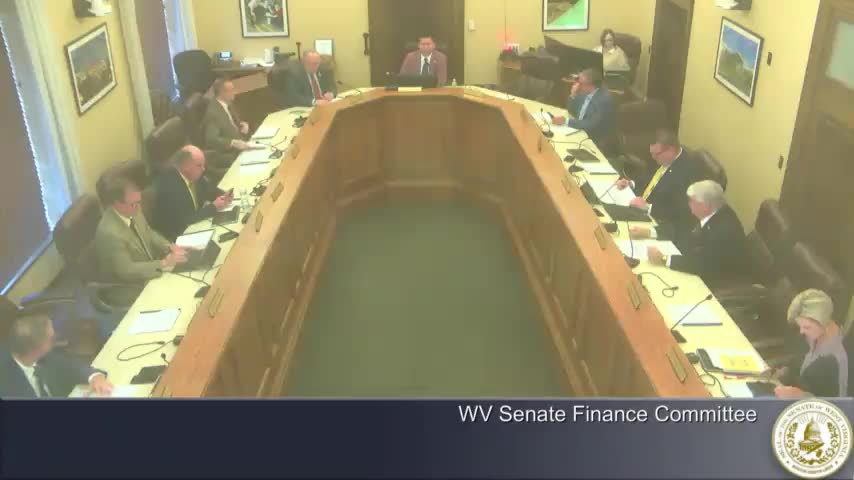
Senate Finance committee hears Department of Revenue five-year budget, staffing and capital plans
Summary
The West Virginia Department of Revenue presented a five-year budget overview covering nine divisions, staffing levels and planned capital improvements including IT/cloud hosting upgrades and a $4 million building renovation contribution from the tax department.
The West Virginia Senate Finance Committee heard a five-year budget presentation from the Department of Revenue on a package of operating and special-revenue items covering nine divisions, department Secretary Eric Nelson told the committee.
The presentation outlined each division’s general- and special-revenue lines, staffing and vacancy figures, and planned capital improvements. Nelson told senators the department’s office budget runs about $650,000 annually, highlighted a one-time transfer into the personal income tax reserve fund enacted in a prior special session, and identified recurring transfers and borrowing for cash-flow purposes.
The presentation matters because the revenue department administers taxes, licensing and transfers that affect general revenue, special revenue funds and local payments such as bond servicing and county distributions. Committee members will use the department’s figures as they weigh the executive budget and anticipated fiscal notes on legislation.
Nelson walked the committee through each of the nine divisions: the office of the cabinet secretary; the Alcoholic Beverage Control (ABC) commission; the budget office; the insurance commissioner’s office; the municipal bond commission; the Office of Tax Appeals; the Racing Commission; and the tax department. He noted that some lines are primarily special revenue (for example, ABC and Racing Commission), while others include transfers and pass-throughs that affect multiple funds.
Key budget details cited during the presentation included a personal income tax reserve fund balance the secretary said is $460,000,000; an approximately $140 million annual range for ABC special-revenue receipts (liquor and beer taxes and excise); and gross lottery revenues exceeding $1,100,000,000 on an annual basis. Nelson also described recurring cash-flow borrowing from the rainy day fund of up to 1.5 percent of general revenue, which he said has amounted to roughly $75 million over recent years.
Committee members asked about staffing and vacancies. Nelson said vacancies are funded in the proposed budget and that most vacancies have been open less than a year, with some in a one- to two-year range. He and staff highlighted particular recruitment challenges in the tax division for auditors and compliance staff, positions the department said require specialized skills and have been difficult to fill.
On capital improvements, Nelson said the tax department has set aside $4,000,000 for building improvements to the revenue center downtown, with an additional contribution expected from the Division of General Services. He and staff also described planned software and security upgrades: ABC licensing and enforcement software modernization, lottery security and licensing improvements, and a move to cloud hosting for tax systems.
Nelson acknowledged that some divisions have very large spending-authority figures that do not necessarily reflect cash flow but rather allowable authority — for example, the insurance commissioner’s office has high spending-authority figures tied to the state’s role with the old workers’ compensation fund.
The packet presented to the committee included a staffing table showing total FTEs, vacancies, payroll and overtime by division through February. Nelson said the insurance commission’s FTE count had fallen from about 260 to 206 over a few years as the agency’s responsibilities changed.
Procedural note: earlier in the meeting the committee approved the minutes for Monday, March 10, 2025, by voice vote after a motion from the vice chairman; the chair said, “the ayes have it.”
The department concluded by offering to follow up with additional information and fiscal notes as requested by the committee.
Less urgent details: the presentation also covered the municipal bond commission’s role as paying agent for county, board of education and municipal bonds and noted roughly $232,500,000 flows annually to bondholders through that account, according to the slides Nelson presented.