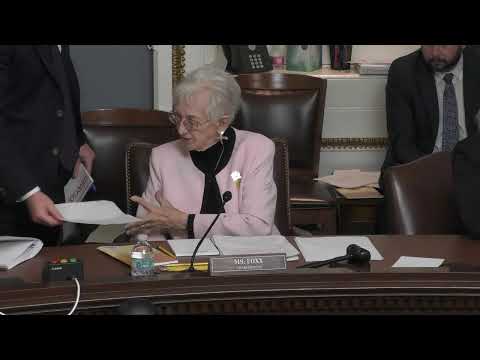
Rules Committee advances CRA resolution to overturn IRS DeFi broker reporting rule; lawmakers split on enforcement vs. taxpayer burden
Get AI-powered insights, summaries, and transcripts
SubscribeSummary
The Rules Committee reported a closed rule enabling House consideration of H.J. Res. 25, a congressional review act measure to nullify an Internal Revenue Service rule on broker reporting for decentralized finance transactions. Supporters called the rule unworkable; opponents warned of lost revenue and greater tax evasion risk.
The House Rules Committee on Tuesday approved a closed rule to consider H.J. Res. 25, a Congressional Review Act resolution to overturn an Internal Revenue Service rule that would require certain reporting for decentralized finance (DeFi) transactions.
Rep. Mike Carey, who led discussion for the measure, described the IRS rule as unworkable for the architecture of DeFi platforms and said it would impose large costs on both industry and the IRS. "The DeFi broker rule is not only unfair to American digital asset holders and entities, but is also unworkable given the structure of the DeFi exchanges," Carey said. He and other supporters argued that the rule would force platforms to spend billions to comply and would impose reporting burdens on individual holders that the IRS could not process efficiently.
Democrats and rule opponents cautioned that repealing the rule would reduce the IRS's ability to detect noncompliance in a market the agency and Treasury say contributes to a tax gap. "H.J. Res. 25 would remove the portion of the Biden administration's regulations that pertain to decentralized exchanges," Rep. Danny Davis said in opposition, citing a Congressional Budget Office–style estimate reported in committee testimony that the Treasury could lose roughly $4 billion if the reporting requirement were rescinded.
The committee record shows the CRA resolution was bundled into a consolidated closed rule that also governed consideration of H.R. 11 56 (pandemic UI fraud) and H.R. 19 68 (continuing resolution). The committee approved the consolidated closed rule and forwarded it to the floor for consideration; the motion was reported passed by the committee (committee tally reported: 9 ayes, 3 nays).
Supporters of the CRA argued the IRS exceeded the authority Congress intended in the 2021 infrastructure law and that rulemaking should be revisited with clearer statutory direction and stakeholder input. Opponents said that nullifying the IRS rule would make it more difficult to spot tax evasion facilitated through less‑regulated venues and could help conceal illicit activity tied to narcotics trafficking and other crimes.
The Rules Committee's action sets a closed rule for floor debate; H.J. Res. 25 may be considered under those terms on the House floor. If the floor approves the CRA resolution and the Senate sustains it, the IRS rule would be nullified under the Congressional Review Act; if the Senate does not act or the President vetoes subsequent action, the rule may remain in effect or be reissued with statutory changes.
Provenance: proponents introduced the CRA resolution in committee testimony and it was included in the consolidated closed rule reported by the Rules Committee to the House floor.