Get Full Government Meeting Transcripts, Videos, & Alerts Forever!
Get email alerts on the Youth Violence Prevention topic
No spam. Unsubscribe anytime.
Committee advances 'Safety and Violence Education and Students Act' requiring youth violence-prevention, social inclusion training and student clubs
Summary
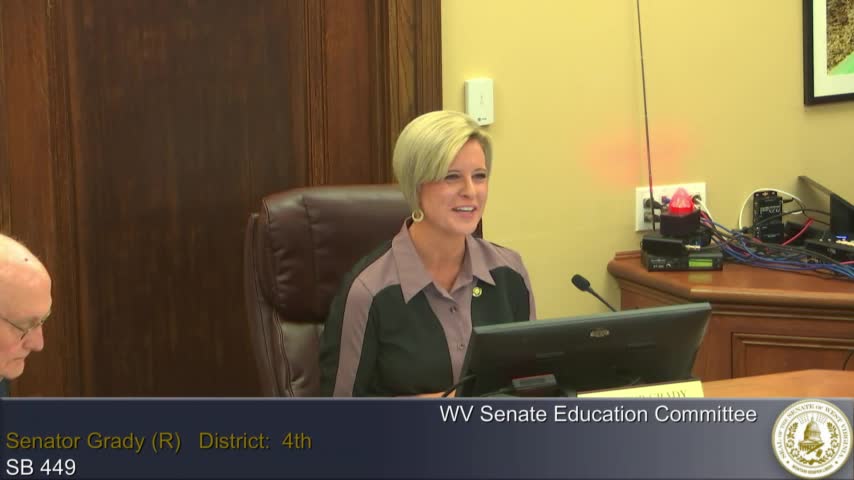
The Senate Education Committee on March 6 adopted a committee substitute for Senate Bill 548 creating the Safety and Violence Education and Students Act, which requires annual evidence-based youth violence-prevention training for grades 6–12, annual social inclusion training K–12, and authorizes student-led violence-prevention clubs.
CHARLESTON — The West Virginia Senate Education Committee on March 6 adopted a committee substitute for Senate Bill 548 that creates a new article titled the Safety and Violence Education and Students Act and establishes multiple school-year requirements aimed at violence prevention and social inclusion.
Under the substitute, schools serving students in grades 6–12 must provide at least one hour (or one standard class period) of evidence-based youth-violence prevention training each school year; the Department of Education is required to develop and publicly maintain a list of evidence-based trainings and materials — including no-cost programming if available — and to review that list at least every 36 months. “It’s my understanding that there are trainings available out there that… that’s no cost. That’s my understanding,” Counsel said when asked about funding for training options.
The substitute also requires all schools serving students in grades K–12 to provide at least one hour (or one standard class period) of evidence-based social-inclusion training each school year covering how to identify social isolation, the importance of taking social isolation seriously, and strategies to promote inclusion. A separate section allows the Department of Education to require schools to designate student-led violence-prevention clubs that must be open to all students and have at least one identified adult supervisor; those clubs are to sustain awareness activities related to suicide prevention, violence prevention or social inclusion and foster student leadership development.
A section on state and federal funding encourages the Department to apply for available funds to offset implementation costs; the substitute also includes a definitions section and makes the requirements voluntary for public charter schools and nonpublic schools.
Senators questioned how districts would fit the new requirements into limited instructional minutes. The Junior Senator from the Eighth asked who decides what in-school minutes should be reallocated when new curricular time is mandated; Counsel said there is no code provision specifically assigning that prioritization and indicated local school leadership (teachers, principals, county boards) would operate under existing policies. A senator noted that elementary guidance time is often used for counselor-led lessons and suggested that, in practice, the new training could be provided during scheduled guidance or counseling periods rather than by reducing core instructional minutes.
Committee members expressed support for prevention efforts and noted differing operational impacts at elementary and high school levels; the committee adopted the substitute by voice vote and then voted to report it to the full Senate with a recommendation that it pass, under the original double committee reference first to the Committee on Finance.
Votes at a glance: Committee substitute agreed to by voice vote; motion to report to full Senate (first referral to Finance) carried by voice vote and declared adopted by the chair.
The substitute leaves many implementation details — including which staff deliver training, whether districts will require additional instructor training, and the amount of external funding available — to the Department of Education and local districts.