Get email alerts on the Appropriations topic
No spam. Unsubscribe anytime.
Rules Committee backs full‑year continuing resolution to fund government through Sept. 30
Summary
The House Rules Committee approved a closed rule advancing H.R. 1968, a full‑year continuing resolution to fund federal operations through Sept. 30, 2025. Supporters said it avoids a shutdown; critics said it hands too much flexibility to the executive and cuts programmatic spending and local allocations.
The House Rules Committee on Tuesday approved a closed rule to bring H.R. 1968, the Full‑Year Continuing Appropriations and Extensions Act, 2025, to the House floor, a measure supporters said would prevent a government shutdown and opponents said would cede too much authority to the executive and cut key programs.
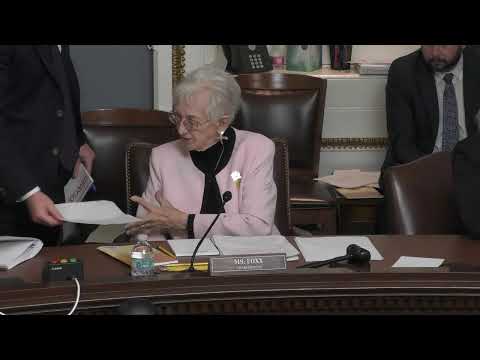
Chairwoman Sharon Fox opened the hearing and introduced witnesses before the committee took up the continuing resolution, which the Appropriations Committee chairman described as a full‑year continuing resolution to fund the government through Sept. 30, 2025. "This legislation helps avoid the government shutting down and allows us to continue our work and service to the American people," Rep. Tom Cole, chairman of the Appropriations Committee, told the panel.
The bill would maintain largely flat funding for federal agencies while including a number of "anomalies," according to Cole, who said the measure increases defense discretionary spending slightly and leaves Social Security, Medicare and Medicaid untouched. "It's a clean CR, fully funding our government," Cole said. He added that the measure provides approximately $6 billion in additional funding to meet commitments for veterans' toxic‑exposure care and that the bill trims many congressionally directed projects as opposed to program baselines.
Opponents, led by Rep. Rosa DeLauro, the ranking member of the Appropriations Committee, characterized the package as a "blank check" that transfers discretion over program levels and execution to the White House. "A full year CR transfers more power to the executive branch to shut off and repurpose funding as they see fit," DeLauro said, arguing the measure reduces non‑defense funding compared with prior negotiated top lines and leaves long‑standing advance appropriations — notably larger funding proposals for veterans' toxic‑exposure care — off the table for fiscal 2026.
Debate at the Rules Committee focused on a set of recurring points: supporters stressed the binary choice of funding the government or triggering a shutdown in days; supporters said the CR prevents disruption to services and preserves a modest increase for defense pay. Critics pressed that the CR reduces the appropriations committee's control over detailed spending and removes previously available advance funding for some prioritized accounts. A number of members also raised concerns about how the CR affects funding authority for the District of Columbia and for specific construction projects in the Army Corps of Engineers portfolio.
Committee members voted on several proposed changes to the rule and to the bill. An amendment from Delegate Eleanor Holmes Norton to exempt the District of Columbia from a shutdown and allow DC to spend under its enacted FY2025 local budget failed in the committee by recorded roll call (3 ayes, 9 nays). An amendment to add FY2026 advance appropriations for the Veterans Toxic Exposure Fund also failed on a recorded vote (3 ayes, 9 nays). The committee then approved the majority motion to report the consolidated closed rule that includes H.R. 1968; the motion passed and the committee ordered the rule to the floor (recorded tally reported in committee: 9 ayes, 3 nays).
What this means going forward: if the House adopts the rule on the floor, H.R. 1968 would be brought up under the terms the Rules Committee set: closed consideration with a single motion to recommit and defined debate time. Lawmakers who pressed for a negotiated, full appropriations package said they still expect to return to regular order for FY2026 appropriations over the coming months; backers said the CR buys time and prevents the immediate damage of a lapse in funding.
Votes at a glance (committee roll calls reported in the hearing record): • Norton (DC) amendment to allow DC to spend at FY2025 enacted local levels — failed, committee roll call 3 ayes, 9 nays. • Nadler amendment to add FY2026 advance funding for the Veterans Toxic Exposure Fund — failed, committee roll call 3 ayes, 9 nays. • Motion to report the consolidated closed rule (moves H.J. Res. 25, H.R. 11 56 and H.R. 19 68 under closed rules) — passed, committee recorded tally 9 ayes, 3 nays.
Members on both sides said they preferred regular‑order appropriations, but differed on whether the CR was the least‑bad path to keep the government open. Supporters framed it as a necessary, short‑term step; critics said a full‑year CR of this design risks shifting too much execution authority away from Congress and into the executive branch, and that programmatic choices embedded in the CR disadvantage some local governments and applicants for discretionary projects.
The Rules Committee transmitted the closed rule to the floor; the House is scheduled to debate and vote under the terms approved by the committee.
AI generated
The text on this page is AI generated. Summaries, highlights, analysis, and video transcripts are all produced from the original source material.
AI can make mistakes, so if you spot one, and we will fix it for everyone.
Note: the source content is unaltered by us. Any content source we link to, be it a video, an audio recording, or a document, is presented exactly as its publisher released it. That publisher is usually a government body, sometimes an individual official or another organisation.