Get Full Government Meeting Transcripts, Videos, & Alerts Forever!
Get email alerts on the Treasurer Audit topic
No spam. Unsubscribe anytime.
Committee sends resolution directing county clerk to oversee audit after tax-settlement discrepancies
Summary
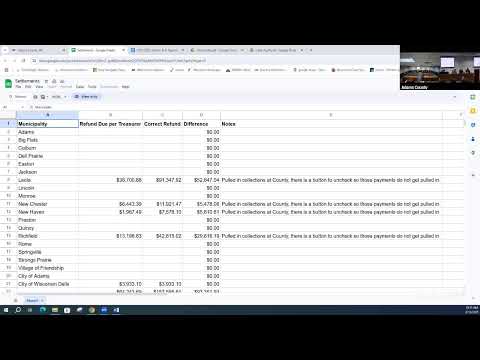
The PAD and PHY committee voted to forward a resolution under Wis. Stat. 59.47 directing the Adams County clerk to oversee an audit of the county treasurer's office after officials identified discrepancies in February tax settlements totaling roughly $733,110.77 and larger town-by-town differences.
At its March 12 meeting, the PAD and PHY committee voted to forward a resolution directing the Adams County clerk to oversee an audit of the county treasurer's office after staff reported large discrepancies in February tax-settlement reports.
The resolution invokes Wis. Stat. 59.47 and was moved onto the floor and then approved by committee vote; supervisors recorded aye votes and the motion will go to the County Board next week. Committee members and town clerks told the committee that errors in settlement reports left municipalities concerned about missing funds and timing for their required reports.
The dispute centered on how Catalyst, the county’s new tax-management software, and the treasurer’s data pulls handled collections during the statutory grace period for first-installment tax payments. Corporation counsel told the committee that state law treats the five working‑day grace period as the relevant window and that the County Board can appoint the county clerk to serve as auditor under Wis. Stat. 59.47. Counsel also cited Wis. Stat. 59.25 to note that county officers may examine county books and records.
County Treasurer Kara Dozle described how she pulled settlement reports and why she entered payments when she did. She said she followed the training she had and that she “stands by my decision to enter payments that I believe should legally have been included in [the] February settlement,” and asked the committee to focus on resolving the reconciliation rather than criticizing her personally.
Finance staff member Kyle Patterson said his reconciliation work produced materially different figures for several towns. He told the committee that, for one municipality the treasurer reported roughly $39,000 due back but his work indicated the correct amount should be “closer to $91,000, roughly.” Patterson told the committee his department ran multiple reports (December, January, and county-only collections) to compare what the towns reported collecting versus what appeared on the settlement runs.
Committee members and several town clerks who emailed the committee told the panel that some towns were told they were short substantial amounts, and that the towns rely on timely, reconciled settlement figures to meet their budgets and reporting deadlines. Corporation counsel read an email the committee received saying the county was preparing to release “a refund of overpaid property tax settlement to all municipalities in aggregate of $733,110.77,” and that finance staff had offered to help reconcile before refund checks were processed.
Members described the issue as both operational and an oversight matter: some supervisors said mistakes can occur with a new treasurer and new software, but that the counties and towns need reconciled figures to the penny. Several supervisors urged that the audit be allowed to proceed so the County Clerk can direct reconciliation and, if necessary, employ outside counsel to obtain access.
The committee approved the resolution and recorded affirmative votes; the committee chair said the measure will go to the County Board next week. The resolution directs the county clerk, under Wis. Stat. 59.47, to oversee the audit and reconciliation of the February tax-settlement reports; the committee did not record detailed corrective steps in the meeting beyond authorizing the audit direction.
The committee discussion also noted software support delays from Catalyst and training gaps in the treasurer’s office; several speakers said an audit will protect both municipalities and county staff by establishing a reconciled, documented accounting trail.
The audit direction is procedural: it does not itself reissue checks or set final settlement amounts. The committee’s vote authorizes the clerk to direct the audit; the results of that review and any subsequent checks or corrections will be determined after reconciliation and may be brought back to the County Board for final actions.