Get Full Government Meeting Transcripts, Videos, & Alerts Forever!
City council committee presses BHSB on 988, mobile crisis staffing and provider accountability
Summary
At an oversight hearing, Behavioral Health System Baltimore outlined the city—s crisis-response infrastructure (988, mobile teams, sobering center) and funding, while council members pressed for outcomes data, clearer local enforcement of provider standards and answers on workforce and licensing limits under Maryland—s any-willing-provider rules.
BALTIMORE — The Baltimore City Council—s Public Health and Environment Committee held an oversight hearing on the city—s behavioral health system, focusing on the 988 crisis hotline, mobile crisis teams, a sobering (crisis stabilization) center and gaps in provider accountability.
Councilwoman Felicia Porter, chair of the committee, convened the hearing to review "Baltimore City's capacity to respond to increasing behavioral health challenges," including city and non-city providers, database reporting and the visibility of pro-behavioral-health efforts. Adrienne Bridenstine, vice president of policy and communications at Behavioral Health System Baltimore (BHSB), presented an overview of the public behavioral health system and crisis response infrastructure.
The nut graf: BHSB says Baltimore—s public behavioral health system serves roughly 75,000 people a year and draws down substantial Medicaid funding, but committee members said the city lacks consistent outcome metrics, local enforcement leverage over providers and enough staffed mobile crisis teams to meet demand. Council members pressed BHSB for follow-up data and cost estimates to fully staff mobile response teams and to publicly report outcomes for funded programs.
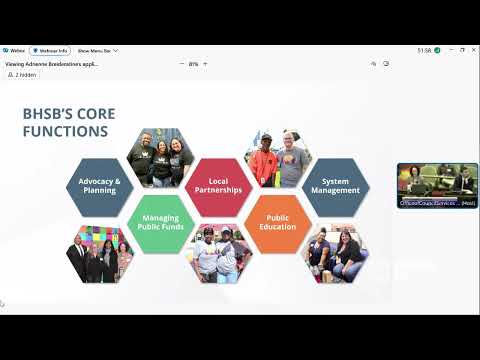
BHSB overview and system scale BHSB described itself as the city—s local behavioral health authority and a nonprofit that "manages public funds around $60,000,000 in grants annually" for services not reimbursable through Medicaid, Bridenstine said. She said the local public behavioral health system serves about 75,000 people annually — roughly 40% of the state—s public behavioral health population — and that Medicaid claims for the community draw about $700 million.
Crisis response: 988, mobile teams and the sobering…
Already have an account? Log in
Subscribe to keep reading
Unlock the rest of this article — and every article on Citizen Portal.
- Unlimited articles
- AI-powered breakdowns of topics, speakers, decisions, and budgets
- Instant alerts when your location has a new meeting
- Follow topics and more locations
- 1,000 AI Insights / month, plus AI Chat