Get Full Government Meeting Transcripts, Videos, & Alerts Forever!
Get email alerts on the Behavioral Health Crisis Response topic
No spam. Unsubscribe anytime.
City council committee presses BHSB on 988, mobile crisis staffing and provider accountability
Summary
At an oversight hearing, Behavioral Health System Baltimore outlined the city—s crisis-response infrastructure (988, mobile teams, sobering center) and funding, while council members pressed for outcomes data, clearer local enforcement of provider standards and answers on workforce and licensing limits under Maryland—s any-willing-provider rules.
BALTIMORE — The Baltimore City Council—s Public Health and Environment Committee held an oversight hearing on the city—s behavioral health system, focusing on the 988 crisis hotline, mobile crisis teams, a sobering (crisis stabilization) center and gaps in provider accountability.
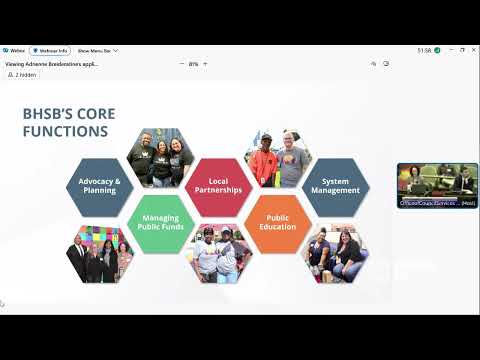
Councilwoman Felicia Porter, chair of the committee, convened the hearing to review "Baltimore City's capacity to respond to increasing behavioral health challenges," including city and non-city providers, database reporting and the visibility of pro-behavioral-health efforts. Adrienne Bridenstine, vice president of policy and communications at Behavioral Health System Baltimore (BHSB), presented an overview of the public behavioral health system and crisis response infrastructure.
The nut graf: BHSB says Baltimore—s public behavioral health system serves roughly 75,000 people a year and draws down substantial Medicaid funding, but committee members said the city lacks consistent outcome metrics, local enforcement leverage over providers and enough staffed mobile crisis teams to meet demand. Council members pressed BHSB for follow-up data and cost estimates to fully staff mobile response teams and to publicly report outcomes for funded programs.
BHSB overview and system scale BHSB described itself as the city—s local behavioral health authority and a nonprofit that "manages public funds around $60,000,000 in grants annually" for services not reimbursable through Medicaid, Bridenstine said. She said the local public behavioral health system serves about 75,000 people annually — roughly 40% of the state—s public behavioral health population — and that Medicaid claims for the community draw about $700 million.
Crisis response: 988, mobile teams and the sobering center Bridenstine outlined Baltimore—s regional 988 operations, which serve central Maryland and are run by three providers that share technology and dispatch tools. She said the 988 helpline handles roughly 50,000 calls annually, the line—s answer time currently averages 10–17 seconds, and the regional operation employs about 99 counselors in total. She said BHSB has expanded open-access clinic arrangements, a bed registry and GPS-enabled dispatch software to coordinate mobile responses.
On mobile crisis teams, Bridenstine said Baltimore now has 24/7 mobile team coverage but still faces workforce and funding limits that leave some calls unresolved or delayed. She said mobile-response deployments in the past year totaled 1,163 completed visits in the region and that most on-scene responses are resolved without hospital transfer. Council President Zeke Cohen pressed for outcomes, saying, "I saw a lot of inputs and outputs. I didn't see a lot of outcomes."
BHSB described the city—s sobering services (the crisis stabilization center) as a 24/7 sobering facility in West Baltimore that provides walk-in, EMS drop-off and hospital referrals, and that includes 30 days of post-discharge case management to connect people to continuing care. Bridenstine said the facility provides "sobering services only" and does not operate as a full psychiatric crisis stabilization center.
Provider oversight, complaints and regulatory limits BHSB said it funds 123 subvendors (FY23 grant funding cited as $52,000,000) and directly monitors those programs through audits and site visits. Bridenstine explained that oversight of Medicaid-funded providers largely rests with the Maryland Department of Health and that BHSB—s role often requires partnership with the state: "We get the complaint, we will investigate it ... and then we make a recommendation to the state," she said.
Several council members raised the limits of local enforcement. Members discussed Maryland—s "any willing provider" framework, which Bridenstine said is implemented through state statute and COMAR (Maryland regulations) and allows providers who meet accreditation and licensing requirements to enter the Medicaid system. Committee members argued that the current process prevents local authorities and neighborhoods from stopping providers that later prove to be low-quality or harmful.
Accreditation and supply of providers Johnny Fielding, cofounder of Leading by Example, and other panelists described variability in accreditation standards. Fielding, whose organization provides outpatient and residential behavioral services, said he selected Joint Commission accreditation for his programs because it includes hospital-level scrutiny, and he contrasted that with providers whose primary credential is CARF accreditation. Dan Rabbit, policy director at BHSB, emphasized one clearly established measure of treatment quality for opioid use disorder: "The one intervention that is consistently very effective ... is medication," and he said regulation changes are being proposed to prevent licensed providers from discriminating against patients using medications for opioid use disorder.
State actions affecting the system Bridenstine noted two recent state-level actions: a federal-review-driven moratorium (extended through June 30, 2025) on certain provider types (psychiatric rehabilitation programs, intensive outpatient treatment, partial hospitalization) while COMAR revisions are completed, and a pause starting March 31, 2025, on new authorizations for recovery housing because Maryland—s recovery housing administrator (MDRN) reported funding shortfalls.
Council requests and next steps Committee members asked BHSB for follow-up materials and analyses, including: (1) outcome metrics for programs BHSB funds directly and for crisis services; (2) a breakdown of 988 and mobile-crisis performance, including how often teams are unavailable and what it would cost to staff mobile crisis teams to an effective level; (3) data on language-access use and bilingual capacity for 988 and mobile responses; and (4) utilization and follow-up outcomes for the sobering/crisis stabilization center (including the 30-day post-discharge case-management results). BHSB agreed to return with deeper data on crisis operations, outcomes and estimates for staffing and funding gaps.
No formal votes or legislative actions were taken at the hearing; the session concluded with committee members urging continued collaboration with state partners, refinement of COMAR regulations and exploration of stronger local tools to screen and monitor providers.
The committee also heard a presentation from Johnny Fielding about his nonprofit, Leading by Example, which provides outpatient mental health, therapeutic behavioral services for youth, care coordination and a residential rehabilitation program for transitional-age youth. Fielding described service lines and the organization—s community-based approach but did not ask for or receive any formal action from the council during the hearing.
Ending: The committee closed the hearing after public testimony was called for (no public speakers appeared in the chamber) and council members reiterated that more oversight work and follow-up data will be needed to address workforce shortages, provider accountability and gaps in crisis response.