Get Full Government Meeting Transcripts, Videos, & Alerts Forever!
Get email alerts on the Deaf Services topic
No spam. Unsubscribe anytime.
Committee advances bill to expand devices purchasable with Delaware fund for people who are deaf or hard of hearing
Summary
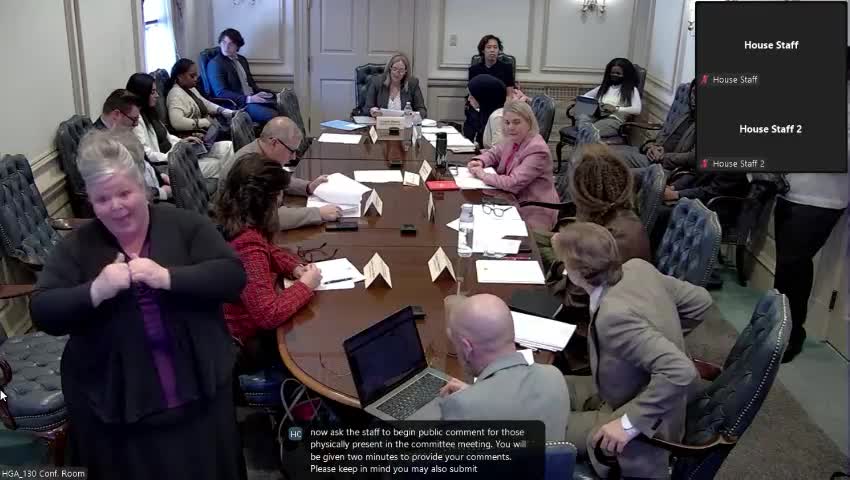
House Bill 53, sponsored by Representative Morrison, was released from the Technology Committee. The bill broadens eligible equipment purchased from the state telephone‑surcharge fund to include modern assistive devices, sets administrative and reserve limits, and requires an annual report on fund use.
Representative Morrison introduced House Bill 53 to amend Title 26 of the Delaware Code to expand the types of telecommunications and alerting devices that may be purchased with a fund paid for by a small surcharge on telephone bills to benefit people who are deaf, hard of hearing, or have speech disabilities.
The bill would expand eligible items beyond legacy equipment to include everyday assistive devices such as alarm clocks, baby monitors, doorbells and smoke detectors that provide visual or vibrating alerts; hearing‑aid compatible cell phones; computer captioning packages; large visual displays and pagers; phones with amplifiers; and hearing‑related emergency response kits. Representative Morrison said the change responds to advocates who noted the fund has been buying equipment that has become obsolete as consumer technology has evolved.
Committee discussion covered the size of the telephone‑surcharge fund, administrative limits and reporting requirements. Representative Morrison initially cited a larger figure for the fund balance, and a committee member corrected that the fund balance is about $1.7 million. The bill caps administrative spending from revenue at 15% in a fiscal year, requires the fund to retain a reserve sufficient to cover at least three months of expenses, and mandates an annual report by Sept. 30 detailing expenditures and remaining balances to the governor and legislative officers.
Alicia Jenkins of the Delaware Division of Vocational Rehabilitation (identified in committee as an expert witness and affiliated with the Department of Labor) explained that the position referenced in the bill is currently general‑funded within the department; she said roughly $160,000 is already allocated to that position. Committee members discussed that reclassifying an existing position would avoid an immediate fiscal note, while adding additional staff in the future would require a budget process and could trigger a fiscal note.
Feta Fernsler, president of the Delaware Association for the Deaf, testified virtually in support and said the group had worked on this issue for a decade to move from outdated equipment toward devices that meet current needs; she told the committee the change will “encourage people to get the help that they need.”
A motion to release HB 53 from committee was moved (mover not specified on the record) and seconded by Representative Wilson Anton. The committee conducted a roll call vote with the following recorded: Representative Wilma, yes; Representative Wilson Anton, yes; Representative Lohrman, yes; Representative Griffith, yes; Representative Johnson, yes; Representative Smith, absent; Representative Jones Giltner, yes; Representative Morris, yes; Representative Vandewijn, absent. The motion carried and the bill was released from committee.
The bill would require the office administering the program to develop policies and procedures for eligibility and distribution; committee members and witnesses said those details will be worked out using best practices from similar programs in other states. The committee advanced the bill to be posted and considered further according to the legislature's next steps.