Get Full Government Meeting Transcripts, Videos, & Alerts Forever!
Get email alerts on the Comprehensive Plan topic
No spam. Unsubscribe anytime.
Consultants preview Lake Bluff comprehensive plan update; public hearing set for March 19
Summary
Teska Associates and Opticos presented a draft comprehensive plan update emphasizing community input, land-use guidance for redevelopment areas, environmental resilience, transportation improvements and housing tools; a public hearing on the draft is scheduled for March 19.
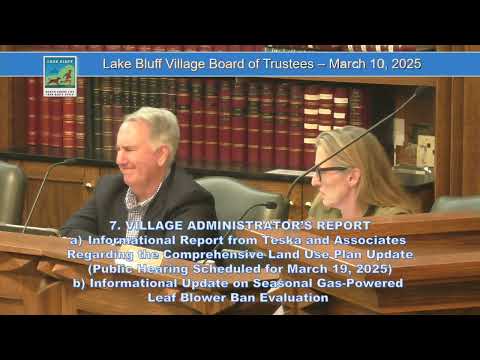
Consultants for the village presented an advance preview of Lake Bluff’s draft comprehensive land use plan and told trustees a public hearing on the draft is scheduled for March 19.
Michael Blue of Teska Associates and colleague Andrew Dunham briefed the Village Board of Trustees on March 10 about the plan update prepared with Opticos and Hay & Associates. Blue described the comprehensive plan as “a statement of policy. It’s not regulatory,” and said it is intended to guide future zoning and budget choices rather than impose immediate requirements.
Consultants said the update reflects about 18 months of work and substantial public engagement: more than 4,000 website visits, roughly 321 subscribers to project updates, and numerous Common Map comments that the team said were incorporated or passed to staff for follow-up when outside the plan’s scope. The plan highlights several subareas and choices for future land use, including:
- Western Lake Bluff and the Route 41/176 corridor: concepts for horizontal mixed-use, buffers along busy roads, and potential redevelopment near major intersections. - The Central Business District: encouragement of appropriate mixed-use redevelopment while preserving key historic structures. - Former manor and village-owned sites: approaches to allow “missing middle” housing that preserves open space and natural features, and to balance neighborhood scale concerns. - Environment and open space: maintenance of ravines and habitat, resilience strategies for flooding and heat, and measures to reduce emissions and promote electrification. - Transportation: working with IDOT on the Route 41/176 interchange, pursuing grade separation at Union Pacific crossings, expanding trails and sidewalks, and adding traffic-calming near schools.
Consultants described implementation as a separate, subsequent step and encouraged the village to use the plan when setting budgets and evaluating development proposals. They also flagged a possible phase 1 study for the rail bridge area and referred to longer-term projects such as deep-tunnel stormwater work that could include bridge replacement.
Trustees and staff asked detailed questions about potential housing locations, connectivity to existing neighborhoods, and screening of any residential uses near business parks. Consultants stressed the plan’s role in answering “what does the village want to see here?” and said adoption would follow public input. The public hearing is listed on the village website and members of the public can comment at the hearing or submit comments online.
No action to adopt the plan was taken on March 10; staff and consultants will collect further input and return to the board for consideration and adoption steps.