Get Full Government Meeting Transcripts, Videos, & Alerts Forever!
Get email alerts on the Permitting Reform topic
No spam. Unsubscribe anytime.
Baltimore officials outline permit-reform plan; administration commits near-term targets for staffing and third-party reviews
Summary
At an informational hearing, the mayor’s office and agency leaders described the 'Be More Fast' initiative and a new ePermit system, detailed early performance gains, and committed to deliver specific staffing and implementation timelines to the council.
City officials outlined a package of operational changes, technology upgrades and pilot programs intended to speed permitting and development approvals in Baltimore and committed to several specific near-term steps in response to council questions.
Deputy Mayor Justin Williams, who presented an overview of the mayor’s Be More Fast initiative, described two central elements: creation of a director of permitting and development services (a cross-agency coordinator) and formation of a Be More Fast advisory group of private-sector and community stakeholders. "We can't control interest rates or global supply chains, but we can absolutely control how our own government operates," Williams said, adding that the administration has launched permit-stat tracking and moved the call center to improve customer service.
Housing Commissioner Alice Kennedy told the committee the new ePermit system launched Feb. 3 and that the city issued just under 40,000 permits in 2024 (39,943), a 7.4% increase from 2021 to 2024. Kennedy said most construction permits processed in 2021–2024 were completed in 0–10 days, with a significant share in an 11–20 day range and a smaller number taking 91 days or more. She described phased work to integrate the city’s code-enforcement system onto the new platform and to add web scheduling and shorter cycle times.
Chief James Wallace of the Baltimore City Fire Department described plans to reclassify three sworn positions into civilian plans-review roles, said one part-time hire is already improving throughput, and said the department has used limited third-party plan-review authority on four large projects with time savings on at least one project. Wallace said the department intends to expand third-party review primarily for smaller, high-volume projects to absorb an estimated 25% of plan-review workload and retain final oversight.
Committee members pressed for concrete timetables and staffing numbers. Chief Wallace said reclassification requests were submitted and had advanced through the budget office to Human Resources and expected review by the Board of Estimates (BOE) in late April or early May; department staff clarified that the positions could be reclassified and available to recruit by the first BOE meeting in May. Director Laura Larson said the Finance Department had flagged cost issues for the conservation-district bill earlier in the hearing but did not oppose permit reforms; she agreed to provide a consolidated cost analysis for the Be More Fast initiative by an April BOE schedule.
The administration made several explicit commitments during the hearing and in response to committee requests: Chief Wallace agreed to report back within two weeks (by March 25 per the committee record) with an assessment of the number of additional inspectors/plans-reviewers needed by the fire marshal’s office; Deputy Mayor Williams and Chief Wallace agreed the three reclassifications would be processed through Human Resources and targeted for completion by May 7 (committee record); and the administration agreed to return to the committee within two weeks with a date-certain plan to stand up an expanded third-party plan-review program (committee record). The administration also committed to developing implementation timelines and a communications plan for third-party reviewers; the city said a public-facing dashboard of permit metrics is being developed and will be released once validated, and the administration agreed to provide a draft timeline and list of dashboard metrics to the committee ahead of the city’s budget hearings.
On service metrics the administration reported measurable early improvements: call-center answer rates rose from under 10% (before the call-center redesign) to above 90% in months after changes, with some weeks reporting over 94% answer rates after additional staffing and IVR routing changes. DHCD staff said the new system allows inspectors to access permits and upload photos in the field, a change they said should reduce administrative turnaround times though exact time-savings remain to be quantified.
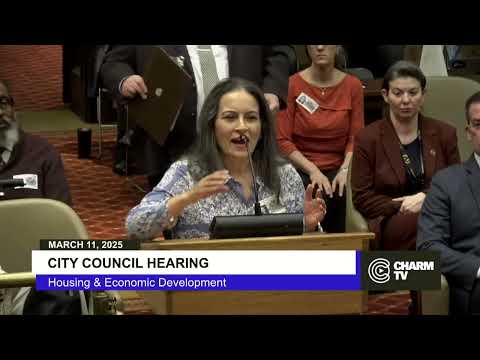
Public commenters urged clearer instructions and transparency. Jeff Duberry of the Society for the Preservation of Federal Hill and Fells Point said applicants currently struggle to track permit status, that CHAP integration remains incomplete for some historic-district workflows, and that reducing unpermitted work will help city revenue and neighborhood outcomes.
Ending: The committee directed follow-ups and set near-term deadlines for reclassification and reporting. Council members said they would schedule additional oversight sessions and requested that the administration provide the metrics, staffing analysis and communications timeline the committee asked for ahead of the budget review.